Skip to content
You can now search across every topic, entity and event.What's new
European Energy Markets
31JUL

Berlin cabinet clears gas-plant subsidy law

4 min read
09:44UTC

Germany's federal cabinet approved the StromVKG capacity-payment law on Monday and referred it to the Bundestag. The statute pays operators to build dispatchable gas plants the market will not finance.

EconomicDeveloping
Key takeaway

Berlin will pay operators to build gas plants the market will not finance on price alone.

Germany's federal cabinet approved the Stromversorgungskostensenkungsgesetz (StromVKG) on Monday 8 June and referred it to the Bundestag for debate 1. The StromVKG is a capacity-payment law: it pays operators a long-term premium to build and hold dispatchable backup generation, rather than waiting for wholesale prices to reward that capacity on their own. The draft funds the build through competitive auctions opening 8 September and 22 December 2026, with the subsidy bill peaking near EUR 3bn a year from 2031.

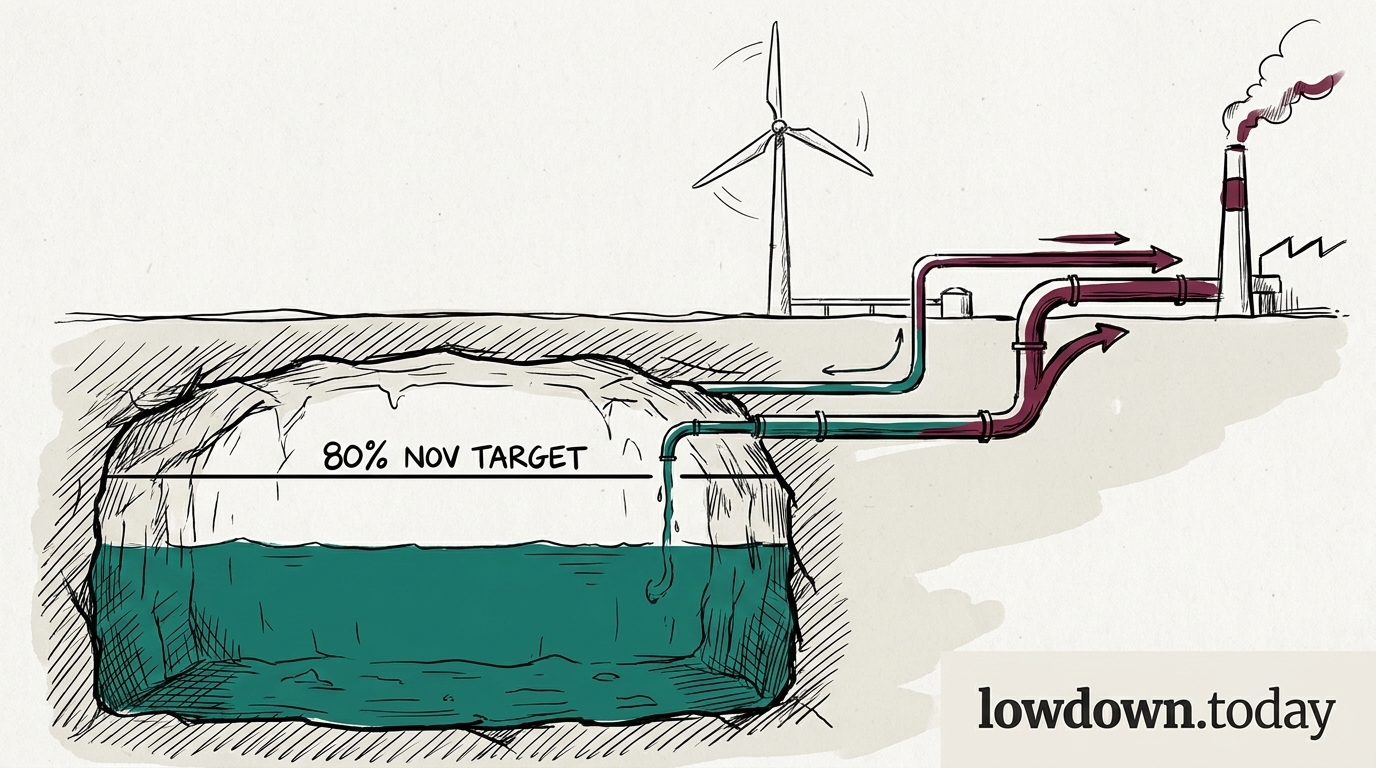
The target has been cut hard, to 10 GW of new capacity by 2032 from the coalition's original 20 GW ambition, with an 11 GW headline. The mechanism is the point: this is Berlin paying to build the very gas plants its own clean spark spread says cannot run at a profit. FNB Gas, Germany's association of gas transmission operators, declared the market-based storage-refill mechanism broken on zero-booking auction evidence , setting the institutional predicate for a capacity payment that substitutes for an absent price signal.

The StromVKG is a distinct instrument from Economy Minister Katherina Reiche's 12 GW hydrogen-ready gas tender agreed with Brussels ; the StromVKG is the capacity-payment statute, that tender is the build mandate. Industry has pushed for swift passage, because the September auction date cannot hold unless the Bundestag votes before its summer recess.


Deep Analysis

In plain English

Germany's government approved a law on Monday to pay companies to build gas power stations that the market says cannot currently make money. The law is called the Stromversorgungskostensenkungsgesetz, or StromVKG for short, which roughly means 'law to reduce electricity supply costs'. The problem it solves: Germany needs backup power stations that can switch on when the wind drops and the sun is not shining, but right now those gas stations lose money every time they run. No private company will build a power plant that loses money. So the government is promising to pay a fixed annual fee just for the plant being available, regardless of whether it actually runs. The target is 11 gigawatts of new capacity, roughly the output of 11 large power stations, at a cost of up to EUR 3 billion a year from 2031. The first contracts go out to tender on 8 September this year, so companies have very little time to prepare bids.

Deep Analysis
Root Causes

The StromVKG has two distinct root causes, not one.

The immediate cause is the negative clean spark spread: at EUR -8 to -9/MWh, Germany's existing CCGTs cannot cover their running cost, and no rational investor builds new ones without revenue certainty beyond the spot market. FNB Gas's declaration in May that the market-based storage-refill mechanism is broken is the institutional expression of the same failure: both the storage booking market and the generation investment market have stopped sending buildable price signals.

Germany's April 2023 nuclear exit removed the only domestic near-zero-cost baseload anchor; the 2022-2023 corrosion crisis in France had briefly suppressed the FR-DE spread, but Germany's grid now has no equivalent low-cost baseload to counter gas clearing prices.

Without nuclear, the German grid requires roughly 30-40 GW of dispatchable backup for low-wind, low-solar periods. Renewables growth does not reduce that requirement in the short term; it may increase it as peak renewable output grows faster than storage and demand flexibility can absorb.

What could happen next?
  • Risk

    Bundestag passage before the summer recess is the critical path gate: if the vote slips to autumn, the 8 September first tender date cannot hold, pushing the first new capacity delivery from 2028 to 2030 or later.

    Immediate · Assessed
  • Consequence

    The EUR 3bn annual cost peak requires a financing vehicle compatible with Germany's constitutional debt brake; without one, the subsidy schedule may be deferred or curtailed, making the 10 GW target the ceiling rather than the floor.

    Medium term · Assessed
  • Precedent

    Germany adopting a capacity-payment mechanism confirms that pure energy-only markets cannot finance dispatchable backup at carbon prices above EUR 70/tonne; every EU member state with a high renewable share now faces the same structural choice.

    Long term · Assessed
First Reported In

Update #16 · TTF closes above EUR 50 on Iran risk re-rate

Clean Energy Wire· 8 Jun 2026
Read original
Different Perspectives
Spain's LNG terminal operators
Spain's 9,145 GWh terminal inventory is the largest single stock in the EU LNG network, an option value that can reroute cargoes wherever the winter strip pays best rather than a cavern gas obligation tied to a fixed date. That flexibility matters more as Germany's cavern shortfall pushes more of the winter security question onto import infrastructure.
European Commission
European Commission
Brussels holds the bloc to 90% on a flexible window while Germany, holding roughly a quarter of EU storage capacity, tracks toward missing its own lower 80% figure by 21 points. A national shortfall this size in the anchor market matters more to bloc security than the flexible timetable alone can absorb.
French power exporters and CRE
French day-ahead rose in step with Germany but by less, reopening a EUR 7-17 premium that makes northward export flows commercially attractive again after the EUR 43.09 discount evaporated in days. CRE separately authorised RTE and Enedis to buy flexibility locally, betting the coming winter's binding constraint is grid congestion rather than a shortage of firm capacity.
TTF trading desk
TTF trading desk
A visible national shortfall like Germany's 21-point gap is a directional signal, not noise, for a desk holding the summer-winter spread. TTF's flat EUR 58-60 range through this week's German price swings says the market has not yet chosen to reprice refill risk into the front of the curve.
German cavern and CCGT operators
German caverns kept buying prompt gas at TTF near EUR 58-60 through the inversion; the wind collapse to 2.4 GW then flipped the spark spread to plus EUR 29 and put turbines back in the same queue. Every day turbines win that bid, injection at a third of the 877 GWh/day pace needed falls further behind.
Slovakia
Slovakia
Slovakia says it dropped its hold-out on the 21st sanctions package only after Ursula von der Leyen personally signed written gas-price and supply guarantees. The Council of the European Union's own 17,238-character release on the package names neither Slovakia nor any guarantee, leaving Bratislava's account unconfirmed by the institutional record.



