Skip to content
You can now search across every topic, entity and event.What's new
European Energy Markets
31JUL

Bundestag opens its gas-plant subsidy law debate

4 min read
09:44UTC

The Bundestag held StromVKG's first reading on 11 June and sent it to committee under accelerated procedure; the Greens want hydrogen-conversion pathways as the price of support.

EconomicDeveloping
Key takeaway

Germany's gas-plant subsidy clears its first reading; the September tender now hinges on beating the 10 July recess.

The Bundestag, Germany's federal parliament, held the first reading of StromVKG on 11 June 2026 at 15:20 CET and, after a 30-minute debate, referred it to the Committee on Economic Affairs and Energy under accelerated procedure 1. StromVKG is the German gas-plant capacity law, a statute that pays for new gas-fired power plants the market alone will not fund. The cabinet had adopted the bill three days earlier .

The statute confirms two tender tranches: 4.5 GW auctioned on 8 September 2026 and a further 4.5 GW on 22 December 2026, with battery storage shut out of the first 9 GW on long-duration availability rules that favour gas-fired plant 2. The exclusion runs through a dispatch-hour threshold batteries cannot meet, so the opening round is in effect a gas-plant subsidy. For a capacity-market trader that 9 GW is firm new thermal supply landing from the early 2030s, but only if the auctions hold their dates.

Alliance 90/The Greens opposed backing new fossil capacity without, in their phrasing, credible and ambitious hydrogen-conversion pathways, and demanded technology-neutral criteria as the price of support 3. That is the same coalition-blocking dynamic that paralysed the prior 10 GW gas-plant law, when a coalition partner threatened to block a statute three years in preparation .

The binary to trade runs through the parliamentary timetable, not the politics. Second and third readings must clear before the 10 July summer recess for the September auction to hold. The Greens' conversion-pathway demand is a committee-stage lever, so if it lands as binding amendments the readings slip and the first auction moves with them. It reads straight through to forward German capacity prices and to combined-cycle spark economics once the capacity payment is dated.


Deep Analysis

In plain English

Germany is trying to solve a problem: the country needs backup power plants that can run whenever solar and wind output drops, but the electricity market does not pay enough to make building those plants financially viable. The gas market price is too high and the electricity price too volatile for a private company to risk building a gas plant without government support. StromVKG is the law that would pay those companies to build 9 GW of gas-fired generation in two batches, with the first auction in September 2026. Opposition Greens want any funded plant to have a credible plan to switch to hydrogen-based fuel before 2035; without that, they say, Germany would be locking in fossil gas for decades. Whether the Greens can attach that condition before the summer parliamentary break is the key unknown.

Deep Analysis
Root Causes

The need for StromVKG reflects two compounding structural failures. First, the German CCGT clean spark spread has run at roughly EUR -8 to -9/MWh through May-June 2026, meaning gas plant cannot cover its operating costs at current TTF and EUA levels without a capacity payment subsidy. No rational private developer will finance construction of a dispatchable gas plant into a market where the marginal operating economics are negative.

Second, Germany's renewable build has outpaced its firm-capacity additions. High-wind and high-solar periods collapse power prices to zero or negative, while low-generation periods require full backup coverage. The resulting merchant spread (the revenue a gas plant earns from price volatility alone) has fallen below the long-run marginal cost of new entry, creating the investment gap the capacity payment is designed to fill.

What could happen next?
  • Consequence

    If StromVKG clears the Bundestag before the 10 July recess, the 8 September auction proceeds and establishes Germany's first capacity-market clearing price, creating a new forward-price reference for CCGT construction financing across Central Europe.

    Short term · Assessed
  • Risk

    Committee-stage amendments attaching binding hydrogen-conversion criteria could trigger European Commission state-aid re-examination if the criteria are technology-specific, replicating the two-year delay France experienced in 2016-18 with its own capacity mechanism.

    Medium term · Suggested
  • Opportunity

    Battery storage developers excluded from the first 9 GW capacity-payment stream can pivot to the frequency-regulation and short-duration ancillary markets, which Germany's grid operator Bundesnetzagentur has flagged as undersupplied through 2027.

    Short term · Suggested
First Reported In

Update #17 · The 17 June ban is priced as paperwork

Bundestag· 11 Jun 2026
Read original
Causes and effects
This Event
Bundestag opens its gas-plant subsidy law debate
The variable a capacity desk needs to price is the calendar: the bill must clear before the 10 July recess for the first tender to hold its September date.
Different Perspectives
Spain's LNG terminal operators
Spain's 9,145 GWh terminal inventory is the largest single stock in the EU LNG network, an option value that can reroute cargoes wherever the winter strip pays best rather than a cavern gas obligation tied to a fixed date. That flexibility matters more as Germany's cavern shortfall pushes more of the winter security question onto import infrastructure.
European Commission
European Commission
Brussels holds the bloc to 90% on a flexible window while Germany, holding roughly a quarter of EU storage capacity, tracks toward missing its own lower 80% figure by 21 points. A national shortfall this size in the anchor market matters more to bloc security than the flexible timetable alone can absorb.
French power exporters and CRE
French day-ahead rose in step with Germany but by less, reopening a EUR 7-17 premium that makes northward export flows commercially attractive again after the EUR 43.09 discount evaporated in days. CRE separately authorised RTE and Enedis to buy flexibility locally, betting the coming winter's binding constraint is grid congestion rather than a shortage of firm capacity.
TTF trading desk
TTF trading desk
A visible national shortfall like Germany's 21-point gap is a directional signal, not noise, for a desk holding the summer-winter spread. TTF's flat EUR 58-60 range through this week's German price swings says the market has not yet chosen to reprice refill risk into the front of the curve.
German cavern and CCGT operators
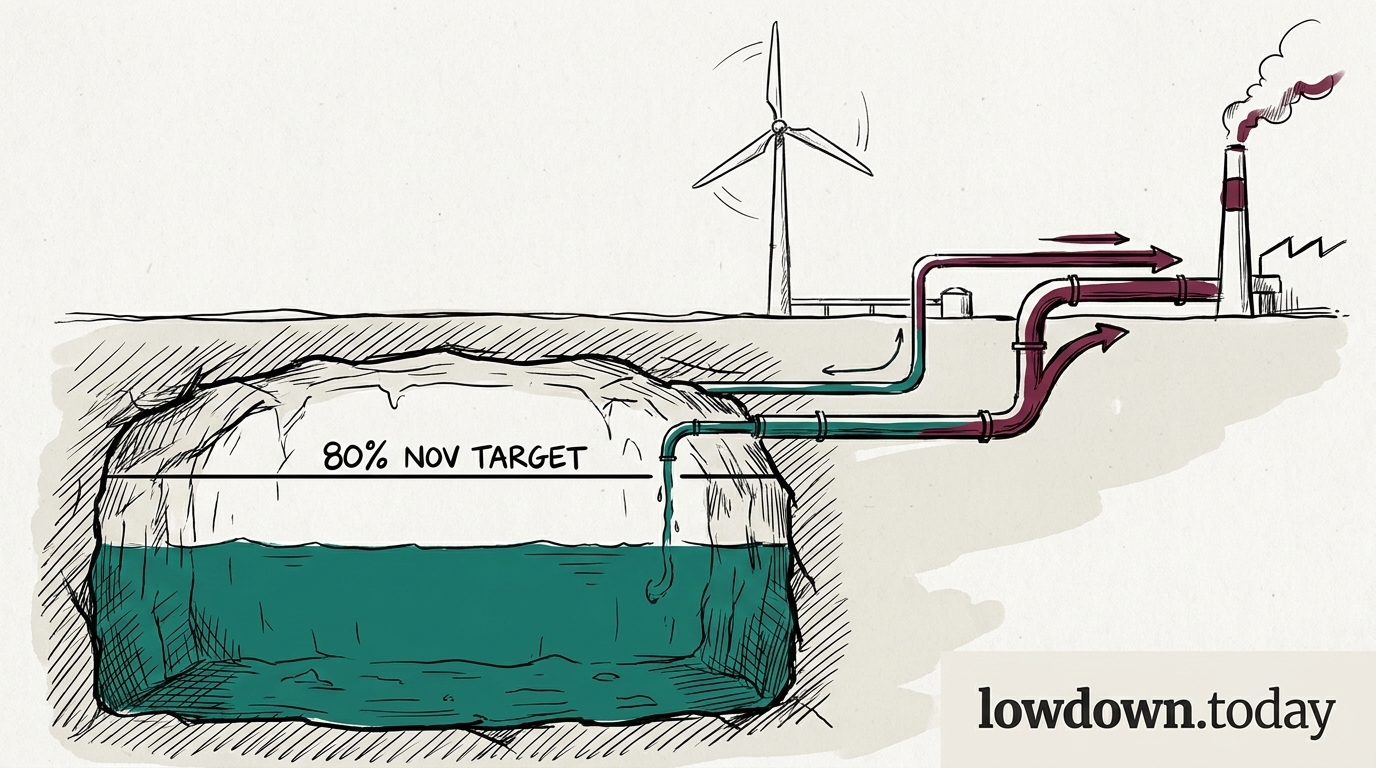
German caverns kept buying prompt gas at TTF near EUR 58-60 through the inversion; the wind collapse to 2.4 GW then flipped the spark spread to plus EUR 29 and put turbines back in the same queue. Every day turbines win that bid, injection at a third of the 877 GWh/day pace needed falls further behind.
Slovakia
Slovakia
Slovakia says it dropped its hold-out on the 21st sanctions package only after Ursula von der Leyen personally signed written gas-price and supply guarantees. The Council of the European Union's own 17,238-character release on the package names neither Slovakia nor any guarantee, leaving Bratislava's account unconfirmed by the institutional record.



