Skip to content
You can now search across every topic, entity and event.What's new
European Energy Markets
31JUL

20th sanctions: Arc7 ban live, maritime ban blocked

4 min read
09:44UTC

The EU Council adopted the 20th Russia sanctions package on 23 April; the Arc7 maintenance ban entered force 25 April, but the full maritime services ban on Russian crude failed for want of unanimity.

EconomicAssessed
Key takeaway

Arctic LNG capacity is the chokepoint that bit; the maritime services ban remains the chokepoint that did not.

The EU Council adopted the 20th Russia sanctions package on Thursday 23 April 1. Two days later, on Saturday 25 April, the package's Arc7 LNG tanker and icebreaker maintenance ban entered force, the same day the Russian LNG short-term contract ban took effect.

Arc7 is the icebreaker-class hull rating the Yamal LNG Arctic export facility relies on to move cargoes through ice-bound seasons of the Northern Sea Route. The Arc7 ban was proposed in the package flagged on 25 April and is now operative. Hill Dickinson noted that six Arc7 vessels are due dry-dock across the next maintenance cycle and lose access to EU yards, the only European maintenance infrastructure rated for the class. That narrows Yamal LNG's Arctic export availability in the late-2026 maintenance window. The package also added 46 shadow-fleet vessels to the port-access ban and introduced a mandatory "no Russia" clause on EU tanker sales to third countries, designed to stop second-hand sales rebuilding the shadow fleet through European yards.

The full maritime services ban on Russian crude and petroleum products was the package's headline target and failed for want of unanimity. Hungary was identified in earlier reporting as the blocking party; Hill Dickinson noted the measure remains on hold 2. The blockage matters because the maritime services ban is the chokepoint instrument The Commission has designed to attack the shadow-fleet insurance and reflagging chain; without it, the 46 vessel addition to the port-access ban is a partial remedy, not a structural one. Arctic LNG capacity tightens; refined-product and crude flows through shadow-fleet hulls do not.

The legislative calendar has a domestic political edge that the Brussels readout does not show. Hungary's blocking vote landed inside a fortnight that also produced the Druzhba pipeline restart and the MOL infringement decision, all running off the same domestic political reset. Péter Magyar took office on 12 April; the pipeline resumed flow on 22 April; the maritime ban failed for unanimity 23 April. Whether the next sanctions iteration revisits the maritime services ban with revised text or trades it for asset-freeze tightening is the live operational question for European refiners watching primary-product flows.


Deep Analysis

In plain English

Russia has a special type of ship, called an Arc7 tanker, designed to carry LNG through Arctic ice. These ships were built in European yards and can only be serviced by European companies. Six of them are due for maintenance in the coming months. Under the 20th sanctions package, they can no longer use European dry-docks for that maintenance. The EU also wanted to go further and ban European companies from providing shipping services; insurance, pilotage, technical management; to vessels carrying Russian crude oil. But that broader ban needed every EU member to agree, and it didn't happen. So the shadow fleet of tankers that moves Russian crude around Western sanctions remains partially open for business.

Deep Analysis
Root Causes

The full maritime services ban required unanimity and failed. Hungary, whose Péter Magyar government is still in formation, has not yet publicly revised Budapest's position on maritime sanctions despite Magyar's pre-election pro-EU positioning. The Arc7 maintenance ban was achievable because it is narrowly targeted and does not directly threaten the crude supply chains of any single member state's refinery sector.

The shadow fleet circumvention route for crude remains open because the 46 vessels added to the port-access ban are a fraction of the total fleet. ICIS and Argus Media estimate Russia's shadow fleet at 600-700 vessels; 46 additions represent roughly 7% of the operational fleet, insufficient to materially alter aggregate crude export volumes.

What could happen next?
  • Consequence

    Six Arc7 vessels denied EU maintenance yards over the next maintenance cycle narrows Yamal LNG's Arctic export availability; deferred maintenance adds hull-integrity risk priced conservatively by marine actuaries.

    Short term · 0.78
  • Risk

    Russia's domestic Arc7 maintenance ramp, if it reaches parity with EU yard standards within 24-36 months, reduces the long-term deterrent value of the maintenance ban to near zero.

    Medium term · 0.6
  • Opportunity

    Hungary's shift under Magyar government creates a potential path to unanimity on the full maritime services ban in the 21st package, closing the crude circumvention route the 20th package left open.

    Short term · 0.5
First Reported In

Update #6 · REMIT II live; storage instrument absent

EU Council· 29 Apr 2026
Read original
Different Perspectives
Spain's LNG terminal operators
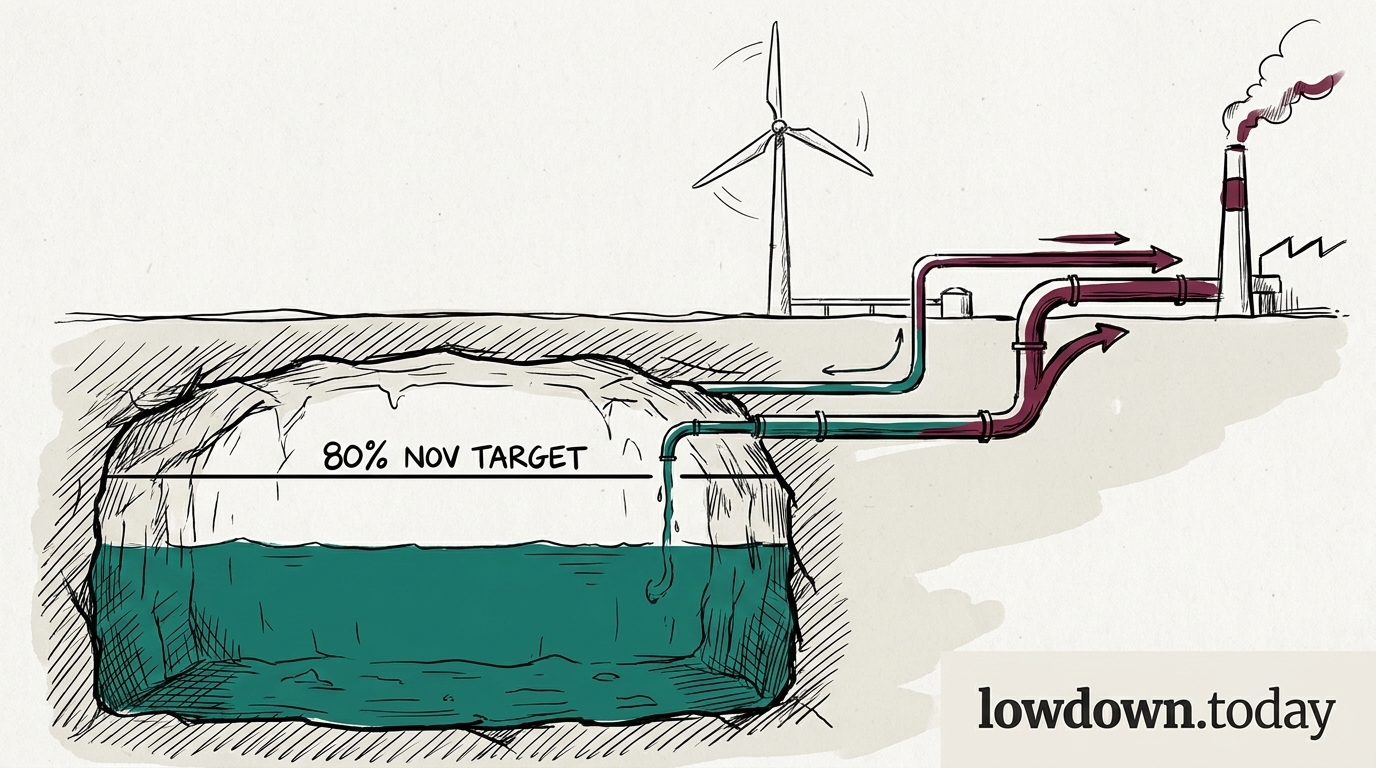
Spain's 9,145 GWh terminal inventory is the largest single stock in the EU LNG network, an option value that can reroute cargoes wherever the winter strip pays best rather than a cavern gas obligation tied to a fixed date. That flexibility matters more as Germany's cavern shortfall pushes more of the winter security question onto import infrastructure.
European Commission
European Commission
Brussels holds the bloc to 90% on a flexible window while Germany, holding roughly a quarter of EU storage capacity, tracks toward missing its own lower 80% figure by 21 points. A national shortfall this size in the anchor market matters more to bloc security than the flexible timetable alone can absorb.
French power exporters and CRE
French day-ahead rose in step with Germany but by less, reopening a EUR 7-17 premium that makes northward export flows commercially attractive again after the EUR 43.09 discount evaporated in days. CRE separately authorised RTE and Enedis to buy flexibility locally, betting the coming winter's binding constraint is grid congestion rather than a shortage of firm capacity.
TTF trading desk
TTF trading desk
A visible national shortfall like Germany's 21-point gap is a directional signal, not noise, for a desk holding the summer-winter spread. TTF's flat EUR 58-60 range through this week's German price swings says the market has not yet chosen to reprice refill risk into the front of the curve.
German cavern and CCGT operators
German caverns kept buying prompt gas at TTF near EUR 58-60 through the inversion; the wind collapse to 2.4 GW then flipped the spark spread to plus EUR 29 and put turbines back in the same queue. Every day turbines win that bid, injection at a third of the 877 GWh/day pace needed falls further behind.
Slovakia
Slovakia
Slovakia says it dropped its hold-out on the 21st sanctions package only after Ursula von der Leyen personally signed written gas-price and supply guarantees. The Council of the European Union's own 17,238-character release on the package names neither Slovakia nor any guarantee, leaving Bratislava's account unconfirmed by the institutional record.



