Skip to content
You can now search across every topic, entity and event.What's new
European Energy Markets
15JUN

Markets bet on short war: Brent $82

4 min read
12:23UTC

Brent crude rose 11% and gold hit a record $5,362 per ounce — but the numbers are far below what a sustained Hormuz closure would produce, revealing a market consensus that the strait will reopen.

EconomicDeveloping
Key takeaway

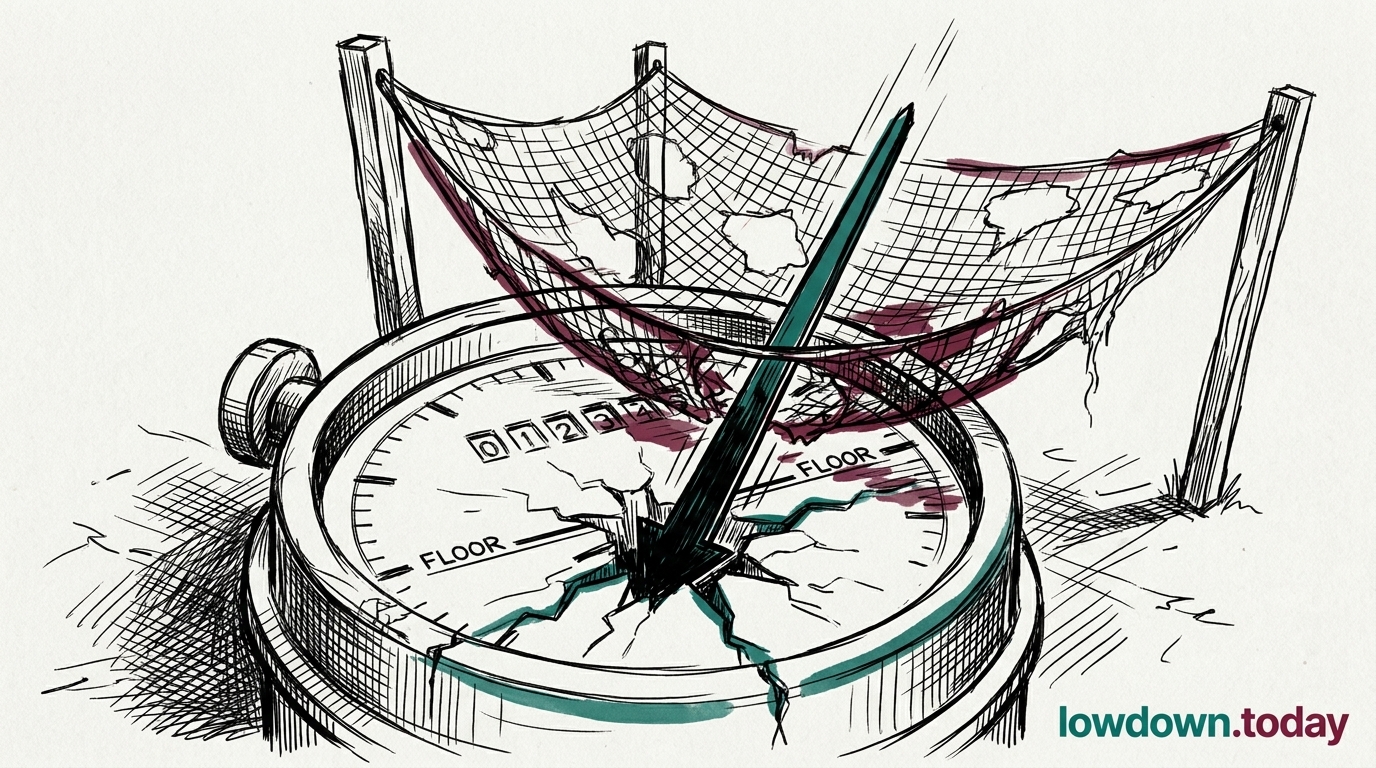
Markets are pricing a contained, short air campaign rather than the prolonged Hormuz-closure scenario — and the gap between spot prices and analyst projections quantifies precisely what being wrong will cost.

Brent Crude opened at $82.37 per barrel on Saturday, up 11% from the roughly $73 level where it traded before the strikes began . Gold hit a record $5,362 per ounce. The Nikkei fell 2%, European futures dropped 2.3%, and Dow futures fell 300 points.

These are elevated numbers, not crisis numbers. The gap between Brent at $82 and the $110–130 range that Goldman Sachs and JP Morgan project for a prolonged conflict contains a specific assumption: that the IRGC's Strait of Hormuz closure — broadcast on VHF Channel 16 with the backing of anti-ship missiles, fast-attack boats, and mines — will not hold. Hapag-Lloyd has suspended transit and 14 LNG tankers have halted, but markets are pricing the closure as a temporary measure, not a sustained blockade of the waterway through which roughly 20% of globally traded oil passes.

Equities tell the same story. A 2% Nikkei decline and 300-point Dow futures drop reflect traders positioning for the scenario embedded in President Trump's statement that the US will commit no ground troops and his claim that the operation is "ahead of schedule" — a short, intense air campaign followed by a return to something resembling the status quo. A ground invasion, a sustained Hormuz blockade, or Iranian attacks on Gulf oil infrastructure would trigger repricing of a different order.

Gold's record $5,362 reads differently from oil. The figure is a safety trade — institutional capital moving to hard assets against the possibility that the base case is wrong. Oil prices reflect the expected scenario. Gold prices reflect the tail risk. The two readings together show a market that has chosen its bet but is hedging against being wrong.


Deep Analysis

In plain English

When a major conflict breaks out near the Persian Gulf, the first question global markets ask is whether oil will stop flowing. The Strait of Hormuz — the narrow channel between Iran and Oman — is the passage through which roughly 20% of the world's oil travels. If Iran closes it, or if tanker attacks make it too dangerous to transit, oil prices spike sharply, raising the cost of fuel, manufacturing, shipping, and almost everything else. The current 11% rise in oil prices is significant but relatively restrained — markets believe the strait will remain open, that the conflict will be short, and that Trump's 'no ground troops' pledge is credible. The simultaneous record gold price reflects something different: not fear about oil specifically, but a broader flight to safety as investors hedge against the possibility that markets have mispriced containment.

Deep Analysis
Synthesis

The market data constitutes a real-time probability estimate of scenario outcomes. Brent at $82.37 prices roughly a 70–80% chance of containment and a 20–30% chance of escalation; the analyst projection of $110–130 for a prolonged conflict implies the market is already embedding a significant escalation premium above pre-conflict levels of approximately $73. The JP Morgan recession probability increase to 35% is the most consequential single figure in the dataset: it reflects not just the oil shock but the compound effect of supply chain disruption, travel disruption (1,579 flights cancelled), reduced Gulf investment flows, and the self-fulfilling dynamics of confidence effects. Gold at a record $5,362 signals that institutional investors are positioning for a scenario in which the conflict lasts long enough to cause sustained macroeconomic damage, even if the strait remains technically open.

Root Causes

The market reaction is a rational aggregation of available information under uncertainty. Oil is up because supply risk is real but not yet materialised. Gold is at a record because the dollar's safe-haven status is complicated by the US's direct role in the conflict and the legal controversy over congressional authorisation — investors seeking neutral stores of value are bidding gold independently of oil. Equity falls reflect both direct risk (companies with Middle East exposure, airline sector devastation) and indirect risk (recession probability increasing to 35% per JP Morgan). The divergence between oil's modest move and gold's record high is analytically significant: it suggests investors are more uncertain about geopolitical and dollar stability than about near-term oil supply specifically.

What could happen next?
2 risk1 consequence1 meaning1 opportunity
  • Risk

    If Hormuz closure persists beyond 72 hours or tanker attacks escalate, the oil price repricing from $82 toward the $110–130 analyst range could be rapid, amplified by market positioning, and self-reinforcing through inflation expectations.

    Short term · Assessed
  • Consequence

    The JP Morgan recession probability increase to 35% means consumer and business confidence effects may now begin to act independently of the conflict's actual outcome.

    Short term · Assessed
  • Meaning

    Gold at a record $5,362/oz signals that institutional investors are hedging not just energy risk but broader geopolitical and dollar-stability risk — a qualitatively different threat assessment than oil prices alone would suggest.

    Immediate · Assessed
  • Risk

    Central banks face a stagflationary dilemma: an oil shock pushes inflation upward while recession risk rises simultaneously, constraining both rate-cutting and rate-hiking responses.

    Medium term · Suggested
  • Opportunity

    Non-Gulf oil producers — including US shale operators, Norwegian state energy, and West African producers — may benefit from sustained elevated prices if the conflict extends beyond the market's current containment assumption.

    Short term · Suggested
First Reported In

Update #6 · Pentagon produced no evidence for Iran war

Bloomberg· 1 Mar 2026
Read original
Causes and effects
This Event
Markets bet on short war: Brent $82
Market pricing shows institutional investors believe the conflict will remain a contained air campaign without sustained disruption to global energy supplies — a bet that carries large downside risk if the Strait of Hormuz closure holds or tanker attacks escalate.
Different Perspectives
Spain's LNG terminal operators
Spain's 9,145 GWh terminal inventory is the largest single stock in the EU LNG network, an option value that can reroute cargoes wherever the winter strip pays best rather than a cavern gas obligation tied to a fixed date. That flexibility matters more as Germany's cavern shortfall pushes more of the winter security question onto import infrastructure.
European Commission
European Commission
Brussels holds the bloc to 90% on a flexible window while Germany, holding roughly a quarter of EU storage capacity, tracks toward missing its own lower 80% figure by 21 points. A national shortfall this size in the anchor market matters more to bloc security than the flexible timetable alone can absorb.
French power exporters and CRE
French day-ahead rose in step with Germany but by less, reopening a EUR 7-17 premium that makes northward export flows commercially attractive again after the EUR 43.09 discount evaporated in days. CRE separately authorised RTE and Enedis to buy flexibility locally, betting the coming winter's binding constraint is grid congestion rather than a shortage of firm capacity.
TTF trading desk
TTF trading desk
A visible national shortfall like Germany's 21-point gap is a directional signal, not noise, for a desk holding the summer-winter spread. TTF's flat EUR 58-60 range through this week's German price swings says the market has not yet chosen to reprice refill risk into the front of the curve.
German cavern and CCGT operators
German caverns kept buying prompt gas at TTF near EUR 58-60 through the inversion; the wind collapse to 2.4 GW then flipped the spark spread to plus EUR 29 and put turbines back in the same queue. Every day turbines win that bid, injection at a third of the 877 GWh/day pace needed falls further behind.
Slovakia
Slovakia
Slovakia says it dropped its hold-out on the 21st sanctions package only after Ursula von der Leyen personally signed written gas-price and supply guarantees. The Council of the European Union's own 17,238-character release on the package names neither Slovakia nor any guarantee, leaving Bratislava's account unconfirmed by the institutional record.



