Skip to content
You can now search across every topic, entity and event.What's new
European Energy Markets
15JUN

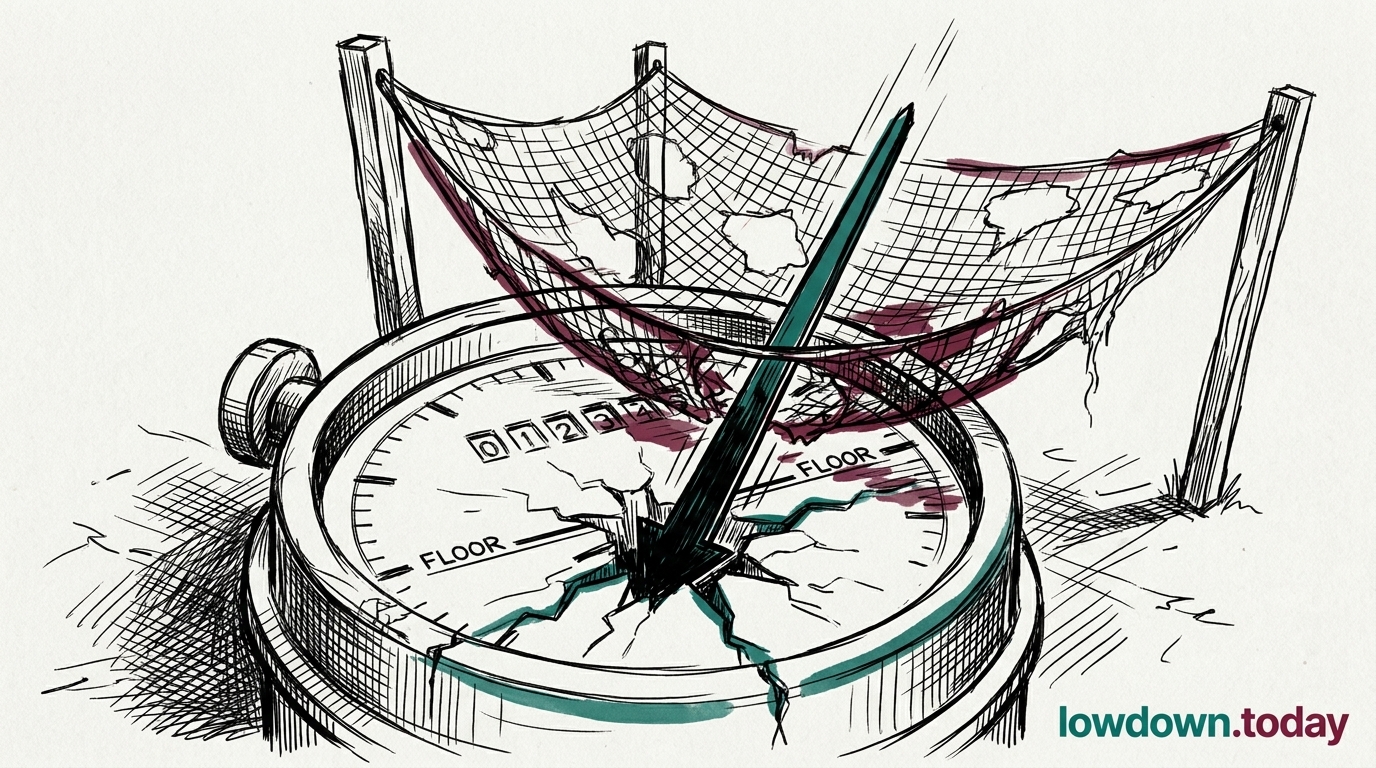
Brent breaks $101 Hormuz floor at $104.71

5 min read
12:23UTC

Brent crude opened Monday Asian trading at $104.71 a barrel on 11 May, up 3.42% from Friday's $101.29 settle, breaking the three-day Hormuz premium floor on the back of Trump's social-media rejection.

EconomicDeveloping
Key takeaway

A Truth Social post produced a $3.42 Brent move and ended the three-day Hormuz floor in a single Asian session.

Brent July futures opened Monday Asian trading on 11 May 2026 at $104.71 a barrel, up 3.42% from Friday's $101.29 settle 1. WTI June futures moved with them, rising 3.67% to $99.09. The move broke the $101 Hormuz premium floor for the first time since that floor was set on 7 May, and it landed before the New York opening bell, meaning the CME (Chicago Mercantile Exchange) pit had already absorbed Donald Trump's Sunday Truth Social rejection of the Iranian MOU reply before Wall Street had the screen up. CNBC carried the prints from the Asian session.

What moved was not the kinetic picture; what moved was the verbal-instrument picture. Friday's settle priced continuation of the MOU process and quiet sanctions enforcement . Monday's open priced the absence of any written rejection or counter-text. The structural Hormuz premium, which US gasoline at $4.54 a gallon had already been forecast to persist post-deal, no longer needed a kinetic trigger to break upward. A 14-second social-media post produced a $3.42 move in the global benchmark, and that is a re-rating, not a spike.

The lag from a $4 move in crude to the pump is well understood by underwriters but invisible to the driver. A UK motorist will see 4-6p per litre on the forecourt within roughly a fortnight; a US driver should expect 8-12 cents per gallon on the same lag. OPEC+, through which Saudi Arabia had been mediating quietly until that posture ended on 10 May, faces an oil-revenue uplift it did not engineer. P&I clubs (Protection & Indemnity, the marine-liability insurers) now have a wider re-pricing band on Gulf-anchorage cover because the rejection contained no enrichment language, no sequencing detail and no timetable to price against.

The instruments Friday traders watched were notices, designations and Federal Register lines. The instrument Monday traders are watching is a Truth Social post. CME's Asian pit treats both as data, and on the evidence of one weekend will continue to do so. Brent above $108 is the next technical resistance, and the verbal-instrument re-pricing pattern decides whether that level holds.


Deep Analysis

In plain English

Brent crude is the global benchmark, so a UK or US driver feels a Hormuz strike on Asian shipping the same way they feel a strike off Mexico. When something threatens the supply of oil from the Middle East, where about a fifth of the world's oil passes through one narrow strait called Hormuz, prices go up everywhere, even in countries that produce their own oil. On Monday morning, before European or American markets had even opened, traders in Asia saw Trump's social-media rejection of Iran's peace proposal and immediately pushed oil prices up by about 3.4%. That might not sound dramatic, but it translates to real costs. UK petrol prices typically follow crude oil moves with a 2-3 week delay, so drivers can expect to pay 4-6 pence more per litre within a fortnight. US drivers face a similar lag and an 8-12 cent per gallon increase.

Deep Analysis
Root Causes

The pump-lag transmission mechanism operates through two channels that carry the Monday Brent move to consumers at different speeds.

For petrol, the UK refinery-to-forecourt lag runs 2-3 weeks because refiners hold crude inventory 4-6 weeks ahead; the crude price change therefore reaches finished product pricing after a refinery processing cycle. The 4-6 pence per litre figure assumes a straight pass-through of Brent's 3.42% move; in practice, retail margins absorb some of the move in competitive markets, and the effective pump impact is typically 60-70% of the crude move.

For wholesale diesel, the lag shortens to 5-10 working days because diesel is priced more directly off gas-oil futures, which correlate more tightly to the same Brent move. European road hauliers using forward diesel contracts are partially insulated for the duration of their hedge, but spot-rate operators face immediate exposure.

For air travel, jet fuel, North American prices rose 95% year-on-year in early May, prices on a 30-day rolling average basis, meaning airlines carrying 60-day fuel hedges do not immediately feel Monday's move, but unhedged carriers booking fuel at spot will recalculate their fuel surcharges within the week.

What could happen next?
  • Consequence

    Asian price discovery on thin Sunday-night liquidity now functions as the dominant mechanism translating diplomatic signals into oil prices, giving Truth Social posts an outsized market impact over Iranian official statements, a structural asymmetry energy risk desks will price into future sessions.

    Immediate · 0.81
  • Risk

    If Brent holds above $103 for five or more consecutive sessions, insurance P&I clubs will begin adjusting their additional war-risk premiums for the Gulf, adding a further per-voyage cost layer on top of the crude price move.

    Short term · 0.72
  • Consequence

    The USPS, Amazon, and FedEx fuel surcharges imposed in early May will trigger escalation clauses if the Brent 30-day rolling average breaches $105, adding incremental parcel delivery costs across UK and US e-commerce supply chains.

    Short term · 0.68
First Reported In

Update #94 · Tehran writes, Trump tweets, Brent breaks

CNBC· 11 May 2026
Read original
Causes and effects
This Event
Brent breaks $101 Hormuz floor at $104.71
Asian futures priced the MOU rejection upward before New York opened, breaking the first floor that had held since 7 May.
Different Perspectives
Spain's LNG terminal operators
Spain's 9,145 GWh terminal inventory is the largest single stock in the EU LNG network, an option value that can reroute cargoes wherever the winter strip pays best rather than a cavern gas obligation tied to a fixed date. That flexibility matters more as Germany's cavern shortfall pushes more of the winter security question onto import infrastructure.
European Commission
European Commission
Brussels holds the bloc to 90% on a flexible window while Germany, holding roughly a quarter of EU storage capacity, tracks toward missing its own lower 80% figure by 21 points. A national shortfall this size in the anchor market matters more to bloc security than the flexible timetable alone can absorb.
French power exporters and CRE
French day-ahead rose in step with Germany but by less, reopening a EUR 7-17 premium that makes northward export flows commercially attractive again after the EUR 43.09 discount evaporated in days. CRE separately authorised RTE and Enedis to buy flexibility locally, betting the coming winter's binding constraint is grid congestion rather than a shortage of firm capacity.
TTF trading desk
TTF trading desk
A visible national shortfall like Germany's 21-point gap is a directional signal, not noise, for a desk holding the summer-winter spread. TTF's flat EUR 58-60 range through this week's German price swings says the market has not yet chosen to reprice refill risk into the front of the curve.
German cavern and CCGT operators
German caverns kept buying prompt gas at TTF near EUR 58-60 through the inversion; the wind collapse to 2.4 GW then flipped the spark spread to plus EUR 29 and put turbines back in the same queue. Every day turbines win that bid, injection at a third of the 877 GWh/day pace needed falls further behind.
Slovakia
Slovakia
Slovakia says it dropped its hold-out on the 21st sanctions package only after Ursula von der Leyen personally signed written gas-price and supply guarantees. The Council of the European Union's own 17,238-character release on the package names neither Slovakia nor any guarantee, leaving Bratislava's account unconfirmed by the institutional record.



