Skip to content
You can now search across every topic, entity and event.What's new
European Energy Markets
4JUN

France-Germany spread sets EUR 96.20 record

4 min read
10:45UTC

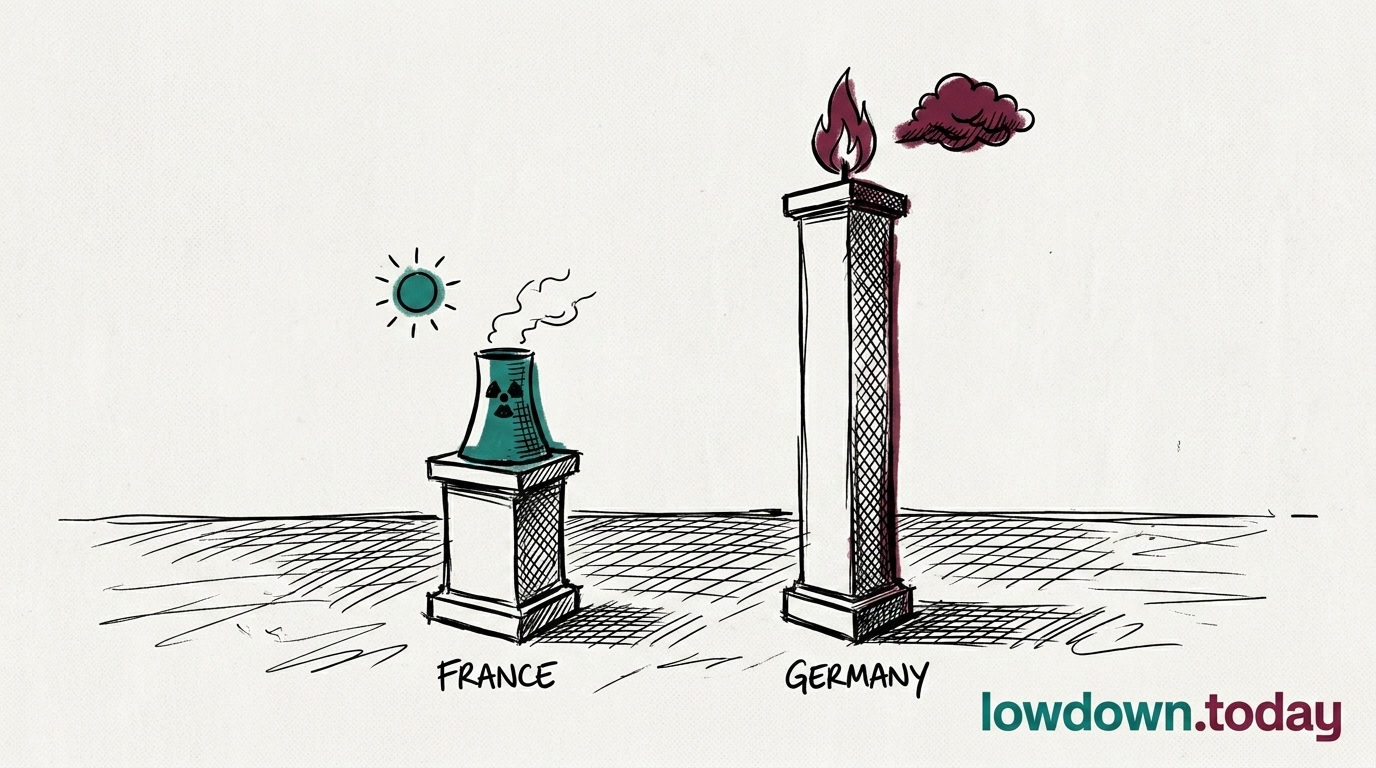
The France-Germany day-ahead power spread reached a record EUR 96.20/MWh for Monday delivery, France at EUR 28.05 against Germany at EUR 124.25. The prior record of EUR 93.68 was set only five days earlier.

EconomicDeveloping
Key takeaway

Wind did not compress the spread; the nuclear-versus-gas gap widened to a record, reversing only from September.

The France-Germany day-ahead power spread reached a record EUR 96.20/MWh for Monday 8 June delivery, with France at EUR 28.05/MWh against Germany at EUR 124.25/MWh 1. That topped the EUR 93.68 record set only five days earlier on 3 June , itself more than double the EUR 46.58 the spread reached on 21 May . Sunday weekend renewables had cleared both markets far lower, so Monday's demand return exposed the structural gap rather than a one-off weather print.

France dispatched a nuclear fleet near zero short-run marginal cost on Monday while Germany set price on a carbon-burdened gas stack above EUR 124, so the gap is plant mix rather than weather. Since CRE switched France from ARENH to VNU in January , the advantage passes straight through. CRE is The Commission de Regulation de l'Energie, France's energy regulator; ARENH was the legacy regulated nuclear-access scheme, and VNU, the Valorisation de la Nucleaire, is the volume-based mechanism that replaced it. French industrial buyers now pay close to the EUR 28 print, a roughly EUR 96/MWh day-ahead cost advantage over German peers landing at the factory gate.

EDF takes Flamanville-3, its 1.65 GW EPR reactor declared commercial on 5 May, into a one-year overhaul from September, pulling 1.6 GW of that nuclear cushion precisely as heating demand returns and dating the reversal point . Every compression of this spread through the series has been a low-demand artefact that reverses on the next working-day print; the trend is widening, not mean-reverting.


Deep Analysis

In plain English

On Monday, French power cost EUR 28 per megawatt-hour while German power cost EUR 124. The gap, EUR 96, is a record. Imagine paying four times more for the same thing in the neighbouring country. The reason is simple: France runs mostly on nuclear power stations, which are cheap to operate once built. Germany shut its last nuclear plants in 2023 and relies heavily on gas-fired power stations, which are expensive right now because gas prices are high. The price difference passes directly to factories: a French car plant pays far less for electricity than a German one, which puts German manufacturers at a disadvantage. The gap should narrow in September when France takes one of its reactors offline for maintenance, but it will not close until Germany builds new, cheaper dispatchable power plants, which is what Monday's new subsidy law is designed to fund.

Deep Analysis
Root Causes

Three independent structural factors produce the EUR 96 spread.

First, the merit-order split: France dispatches nuclear at near-zero short-run marginal cost while Germany's gas-set stack carries TTF plus EUA carbon. At EUR 50 TTF and EUR 76 EUA, the German marginal cost sits above EUR 132/MWh; French nuclear sits at roughly EUR 5-10/MWh on short-run cost.

Second, the VNU pricing pass-through: CRE's January 2026 switch from ARENH (Accès Régulé a l'Electricite Nucléaire Historique, the prior fixed-price nuclear access scheme) to VNU (Valorisation de la Nucléaire, a volume-based mechanism) means French industrial offtakers pay near the EUR 28 day-ahead print. German industrial peers pay near the EUR 124 print. The regulatory change turned a wholesale anomaly into a factory-gate cost gap.

Third, interconnector saturation: the France-Germany interconnectors are physically limited; when the spread exceeds transport cost plus losses, additional French exports are not possible, so the gap cannot be arbitraged away in the day-ahead session.

What could happen next?
  • Consequence

    German industrial buyers on spot-indexed power contracts face a EUR 96/MWh cost premium over French peers, a gap that feeds directly into manufacturing cost-competitiveness and accelerates production relocation discussions already underway in energy-intensive sectors.

    Immediate · Reported
  • Risk

    Flamanville-3's September 2026 overhaul removes 1.6 GW from the French nuclear fleet, mechanically narrowing the spread into a period when heating-season demand builds; the long-France short-Germany position unwinds fastest at that point.

    Short term · Reported
  • Precedent

    The consecutive record prints on 3 June and 8 June establish that the EUR 93-96 spread is not a one-off weather artefact but a repeatable condition whenever working-day demand returns to a nuclear-anchored France and gas-set Germany.

    Medium term · Assessed
First Reported In

Update #16 · TTF closes above EUR 50 on Iran risk re-rate

euenergy.live· 8 Jun 2026
Read original
Causes and effects
This Event
France-Germany spread sets EUR 96.20 record
Returning wind did not compress the split; the nuclear-versus-gas merit-order gap widened to a record, now flowing straight to the French factory gate.
Different Perspectives
Marine insurers and AIS trackers covering Hormuz
AIS data shows severe curtailment on 20 July, 479 vessels anchored, 36 dark, 123 still broadcasting inside the strait, not the closure the IRGC claims. War-risk premiums move on the unresolved CENTCOM-IRGC contest itself, since underwriters price the dispute as much as the count.
QatarEnergy
QatarEnergy
Ras Laffan has run at minimum output under force majeure into August since 9 July, a constraint already priced before this week's claim. The 17-20 July move is risk premium stacked on that standing loss, not a new physical loss at the plant.
ACER and the European Commission
ACER opened the REMIT reporting consultation on schedule on 16 July, giving firms to 11 September before a quarter to build systems against Regulation 648/2012. Brussels' separate silence on StromVKG state-aid clearance leaves Berlin's own capacity mechanism without legal authorisation.
EDF and French grid operator RTE
France's discount to Germany rests on an ASNR derogation from the 28C river-cooling limit at Bugey that expires today, not on a nuclear recovery; Chooz, Golfech and Bugey restarts run to 25 July. The cheap leg holds only as long as regulators keep waiving the limit each heatwave.
German CCGT operators and grid balancers
German gas plants went off-merit on 20 July as the clean spark spread inverted to minus EUR 15 to minus EUR 21/MWh, sidelining the flexible capacity storage injection needs. Operators are pricing 2027-28 capacity revenue against Bundesnetzagentur's own admission that Brussels has not cleared the 9 GW StromVKG auctions.
LNG spreads desk
LNG spreads desk
The JKM-TTF arb flipped to a TTF premium of roughly USD 0.6/MMBtu on 15 July, the first time this cycle Europe has outbid Asia, yet no Atlantic cargo has rerouted west. Until a cargo actually moves, the desk reads the Hormuz premium as unconfirmed and the EUR 55 print as vulnerable to a fast reversal.
