Skip to content
You can now search across every topic, entity and event.What's new
European Energy Markets
4JUN

France clears below Germany by EUR 17

4 min read
10:45UTC

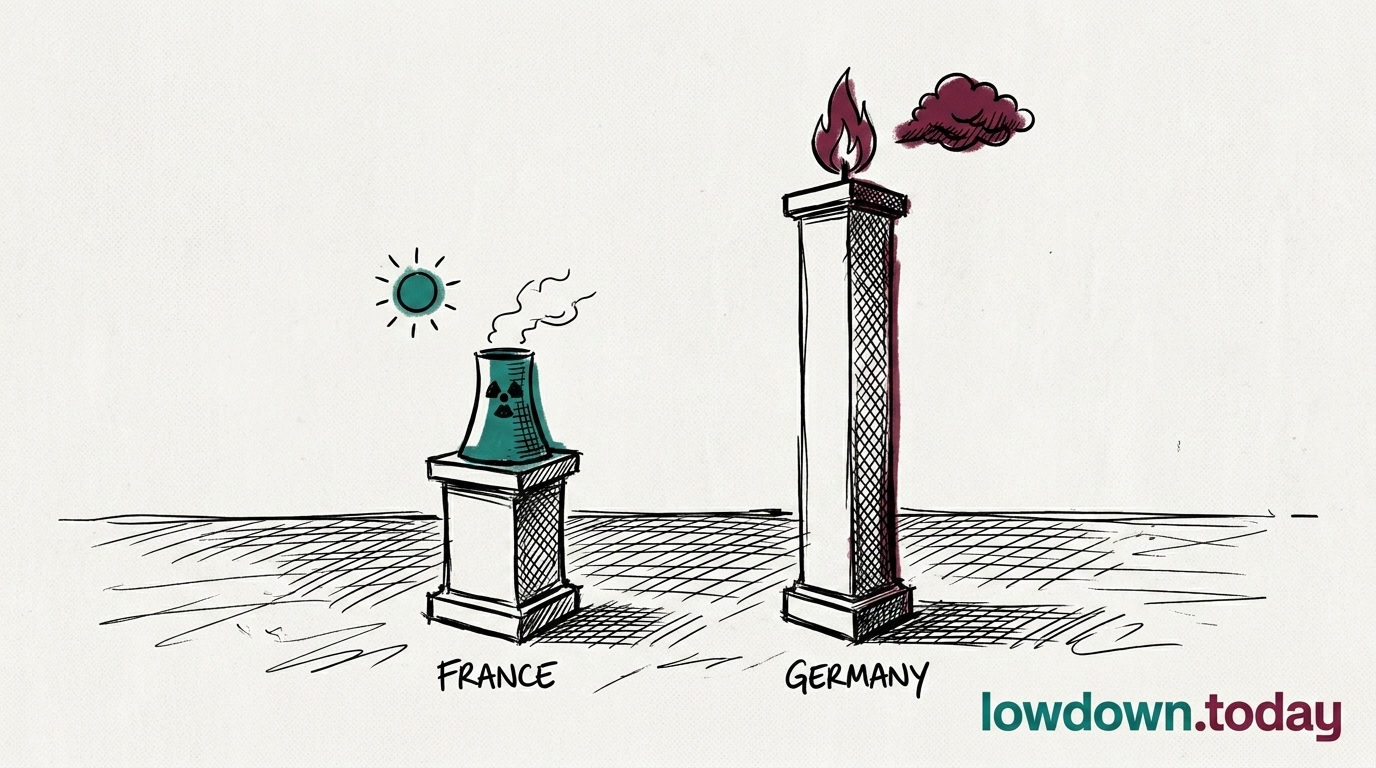
France cleared EUR 106.80/MWh against Germany on 22 June, the cheaper leg by EUR 17.29, as EDF nuclear output held French spot below the threshold that would trigger the dormant VNU windfall levy.

EconomicDeveloping
Key takeaway

EDF nuclear floors French power while the VNU windfall levy stays dormant all year.

The FR-DE day-ahead spread normalised to France cheaper by EUR 17.29/MWh on 22 June, France clearing EUR 106.80 1. FR-DE is the France-Germany day-ahead power spread, the core cross-border basis trade on the continent. Set against the EUR 96.20 record struck the other way, France the dearer leg, on 8 June , the seven-day swing runs to about EUR 113/MWh.

That is basis risk no standard hedge captures cleanly. The structural floor under France is EDF's nuclear output, which suppresses French clearing whenever the reactors run hard, and on 15 June the two-month trend that had flipped France into the dearer leg began reversing back .

The Versement Nucleaire Universel (VNU, France's universal nuclear-revenue levy) reinforces that floor by what it does not do. VNU only redistributes when EDF nuclear revenues clear EUR 78/MWh, and French spot near EUR 65-70 keeps it dormant through 2026, CRE having confirmed it inactive for the year 2. CRE is the French energy regulator that administers the threshold.

Because the windfall clause never bites at these revenue levels, the upside from cheap nuclear clearing stays entirely inside EDF's accounts rather than redistributing to industrial buyers. The mechanism designed to dampen the spread is switched off precisely when the spread is most volatile.


Deep Analysis

In plain English

France and Germany trade electricity across their shared border via high-voltage interconnectors. France typically has cheaper electricity because it runs a large fleet of nuclear power stations with very low fuel costs, while Germany clears on gas-fired stations that cost more to run. The price gap between the two countries on any given day is called the FR-DE spread. In early June, something unusual happened: France's electricity became more expensive than Germany's for a brief period, because of concerns about whether French nuclear plants could run safely in warm weather. Then it flipped back. On 22 June, France was EUR 17.29 cheaper per unit than Germany. Just two weeks earlier it had been EUR 96.20 more expensive. That EUR 113 swing in two weeks is the largest ever recorded for this electricity price gap. France has a rule called the VNU; a windfall tax that kicks in only when France's nuclear electricity earns above EUR 78 per unit. Because prices have stayed just below that level, EDF keeps all the profit. The rule is meant to protect consumers when nuclear power gets very profitable, but it has not been triggered because prices have stayed just below the threshold.

Deep Analysis
Root Causes

The VNU mechanism's EUR 78/MWh trigger is structurally set too high to activate under current market conditions. CRE set the average nuclear revenue benchmark at EUR 65.90/MWh in April 2026; with French day-ahead near EUR 65-70 at nuclear-heavy baseload hours, EDF captures margin but stays well below the redistribution threshold. The trigger is not a price ceiling on nuclear profit; it is only activated at levels 20% above current market.

The structural cause of the basis volatility is the complete absence of baseload competition in France. EDF's 350-370 TWh guidance is met almost entirely by nuclear capacity with marginal cost near zero; when the fleet runs without curtailment, it suppresses French clearing to the low EUR 100s while Germany's gas-and-carbon stack clears at EUR 120-125. There is no market instrument; not VNU, not an interconnector constraint, not a capacity obligation; that limits the spread magnitude.

September introduces a mechanical reversal: Flamanville-3 enters a one-year overhaul, removing roughly 1.6 GW of French nuclear output. This is the calendar event that will close the spread, not any market mechanism; and when it arrives, desks long the current France-cheaper position face the unwind pressure.

What could happen next?
  • Risk

    The September Flamanville-3 overhaul removes 1.6 GW of French nuclear output from heating-season start, mechanically narrowing or reversing the France-cheaper spread at the same time winter gas demand builds in Germany.

    Medium term · Reported
  • Consequence

    EUR 113/MWh basis volatility in 14 days exceeds standard hedge assumptions for cross-border utilities; bilateral OTC exposure in FR-DE spread books without liquid futures cover is creating mark-to-market losses for desks short France.

    Immediate · Assessed
  • Precedent

    The VNU EUR 78 trigger setting has proven too high to activate under 2026 market conditions; CRE may face political pressure to lower the redistribution threshold before the 2026-27 winter reset.

    Medium term · Suggested
First Reported In

Update #20 · Spark spread now feeds the winter deficit

euenergy.live (ENTSO-E data)· 22 Jun 2026
Read original
Different Perspectives
Marine insurers and AIS trackers covering Hormuz
AIS data shows severe curtailment on 20 July, 479 vessels anchored, 36 dark, 123 still broadcasting inside the strait, not the closure the IRGC claims. War-risk premiums move on the unresolved CENTCOM-IRGC contest itself, since underwriters price the dispute as much as the count.
QatarEnergy
QatarEnergy
Ras Laffan has run at minimum output under force majeure into August since 9 July, a constraint already priced before this week's claim. The 17-20 July move is risk premium stacked on that standing loss, not a new physical loss at the plant.
ACER and the European Commission
ACER opened the REMIT reporting consultation on schedule on 16 July, giving firms to 11 September before a quarter to build systems against Regulation 648/2012. Brussels' separate silence on StromVKG state-aid clearance leaves Berlin's own capacity mechanism without legal authorisation.
EDF and French grid operator RTE
France's discount to Germany rests on an ASNR derogation from the 28C river-cooling limit at Bugey that expires today, not on a nuclear recovery; Chooz, Golfech and Bugey restarts run to 25 July. The cheap leg holds only as long as regulators keep waiving the limit each heatwave.
German CCGT operators and grid balancers
German gas plants went off-merit on 20 July as the clean spark spread inverted to minus EUR 15 to minus EUR 21/MWh, sidelining the flexible capacity storage injection needs. Operators are pricing 2027-28 capacity revenue against Bundesnetzagentur's own admission that Brussels has not cleared the 9 GW StromVKG auctions.
LNG spreads desk
LNG spreads desk
The JKM-TTF arb flipped to a TTF premium of roughly USD 0.6/MMBtu on 15 July, the first time this cycle Europe has outbid Asia, yet no Atlantic cargo has rerouted west. Until a cargo actually moves, the desk reads the Hormuz premium as unconfirmed and the EUR 55 print as vulnerable to a fast reversal.
