Skip to content
You can now search across every topic, entity and event.What's new
European Energy Markets
4JUN

Eirin field starts; 27.6 mmboe to Gassled

3 min read
10:45UTC

Equinor brought the Eirin gas field into production on 5 May, routing 27.6 mmboe of recoverable resources via Gina Krog and Sleipner A into the Gassled pipeline to Continental markets.

EconomicDeveloping
Key takeaway

Eirin adds 27.6 mmboe of mostly-gas resources via Gassled and extends Gina Krog's life to 2036.

Equinor brought the Eirin gas field into production on 5 May, the company's newsroom confirms. Recoverable resources sit at 27.6 mmboe (million barrels of oil equivalent), mainly gas, tied back to the Gina Krog platform 250 km west of Stavanger and routed via Sleipner A into the Gassled pipeline system. ORLEN Upstream Norway holds 41.3% of the licence, Equinor 58.7%, and the development extends Gina Krog's operational life by seven years to 2036.

Gassled is the Norwegian offshore pipeline network connecting North Sea production to UK and Continental reception terminals. ORLEN Upstream Norway is the Norwegian subsidiary of Poland's state energy group PKN ORLEN, and a 41.3% partner share at first production reads as Polish supply diversification continuing past the closures that reshaped European gas in the early 2020s.

No daily volume rate accompanied the start. Sodir, the Norwegian Offshore Directorate, publishes monthly production figures around the 20th of the following month, so April's print, expected ~20 May, is the first official data series that will incorporate Eirin's contribution against the 10.8 bcm March baseline of 349.3 mcm/day. The tie-back design also matters for the cycle ahead. Gina Krog's seven-year life extension converts a near-term decommissioning candidate into infrastructure that absorbs the next wave of small-field tie-backs, the format Norway is increasingly using to extend NCS output as larger fields decline.


Deep Analysis

In plain English

Norway is one of Europe's most important gas suppliers. The Eirin field is a new Norwegian gas source that just started producing on 5 May. It sends its gas through an existing offshore pipeline network, Gassled, to reach European countries, mostly Germany, France, and the UK. Eirin's 27.6 million barrels of recoverable resources translates at plateau to roughly 2-3 million cubic metres per day of gas equivalent. That is a useful increment during a tight injection season, but it does not shift the European supply picture on its own. Its bigger strategic value is extending the life of the Gina Krog platform, which can then host future small-field tie-backs from the surrounding Norwegian licences.

Deep Analysis
Root Causes

Eirin's development reflects Norway's regulatory and fiscal framework: the special petroleum tax framework provides 78% uplift on capital expenditure, effectively socialising most of the development risk and incentivising small-field tie-backs that would be sub-economic under standard corporate tax structures.

ORLEN Upstream Norway's 41.3% participation is a direct consequence of Poland's post-2022 upstream diversification strategy, in which PKN ORLEN allocated capital to Norwegian NCS positions as a hedge against gas-supply dependence on Russian pipeline volumes.

The Gina Krog seven-year life extension to 2036 matters beyond Eirin itself: it keeps a processing hub available for subsequent tie-backs across the surrounding licences, compounding the resource recovery from the same infrastructure. Norway's NCS tie-back pipeline depends on platforms remaining economically operational; Gina Krog's extension is the enabling infrastructure for the next cohort of small fields in the same area.

What could happen next?
  • Consequence

    Sodir's April production print, expected around 20 May, will be the first data series to show Eirin's contribution against the March 349.3 mcm/day baseline and Hammerfest's April absence, providing the net Norwegian production balance for the first month of the injection season.

    Immediate · 0.9
  • Precedent

    Gina Krog's seven-year life extension to 2036 converts the platform into the hosting infrastructure for the next cohort of NCS small-field tie-backs, setting a template for Norwegian plateau maintenance through the late 2020s.

    Long term · 0.78
  • Risk

    Eirin's plateau contribution of roughly 2–3 mcm/day gas-equivalent is insufficient to offset Hammerfest LNG's 14–16 mcm/day absence; the net Norwegian supply balance remains negative through the Hammerfest maintenance window regardless of Eirin's ramp-up.

    Short term · 0.85
First Reported In

Update #8 · Storage 34.3 as 12 May test nears; Hammerfest silent

Equinor· 8 May 2026
Read original
Different Perspectives
Marine insurers and AIS trackers covering Hormuz
AIS data shows severe curtailment on 20 July, 479 vessels anchored, 36 dark, 123 still broadcasting inside the strait, not the closure the IRGC claims. War-risk premiums move on the unresolved CENTCOM-IRGC contest itself, since underwriters price the dispute as much as the count.
QatarEnergy
QatarEnergy
Ras Laffan has run at minimum output under force majeure into August since 9 July, a constraint already priced before this week's claim. The 17-20 July move is risk premium stacked on that standing loss, not a new physical loss at the plant.
ACER and the European Commission
ACER opened the REMIT reporting consultation on schedule on 16 July, giving firms to 11 September before a quarter to build systems against Regulation 648/2012. Brussels' separate silence on StromVKG state-aid clearance leaves Berlin's own capacity mechanism without legal authorisation.
EDF and French grid operator RTE
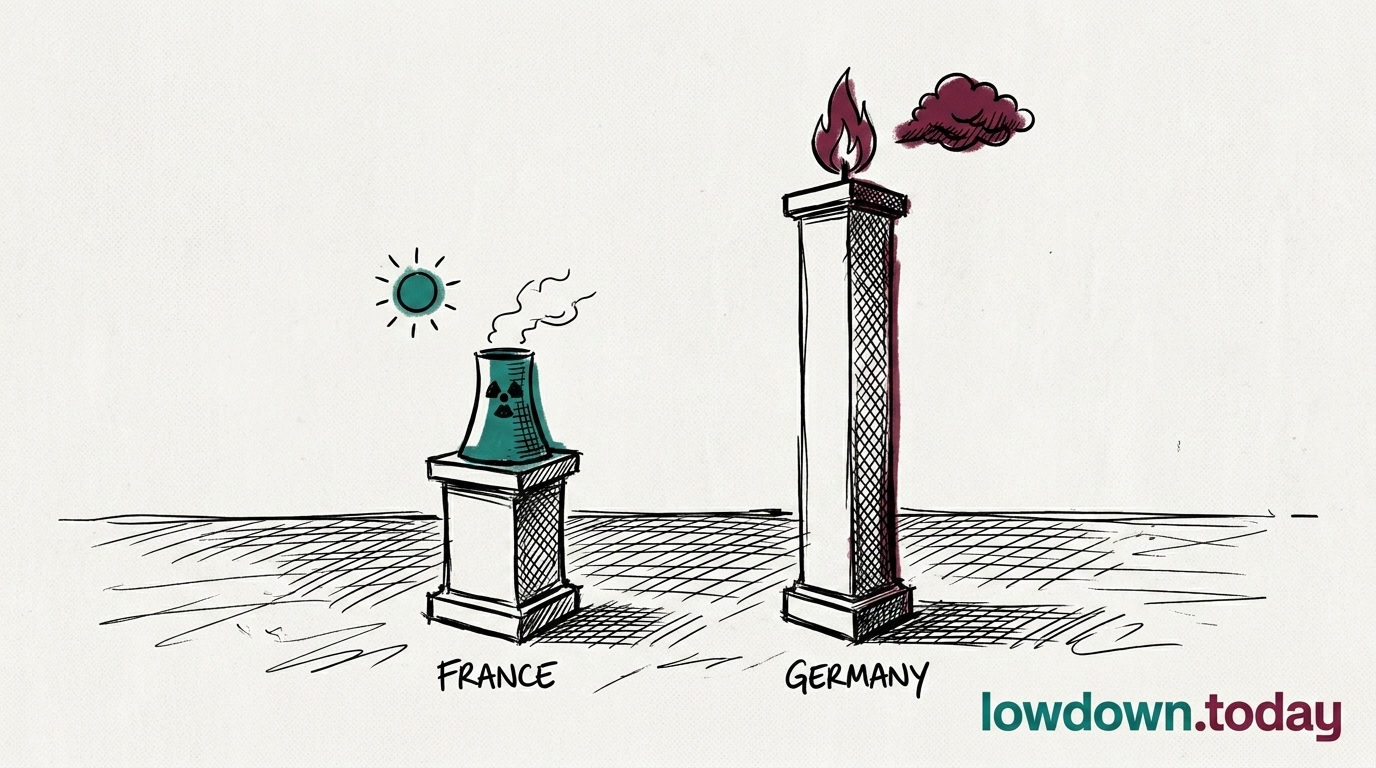
France's discount to Germany rests on an ASNR derogation from the 28C river-cooling limit at Bugey that expires today, not on a nuclear recovery; Chooz, Golfech and Bugey restarts run to 25 July. The cheap leg holds only as long as regulators keep waiving the limit each heatwave.
German CCGT operators and grid balancers
German gas plants went off-merit on 20 July as the clean spark spread inverted to minus EUR 15 to minus EUR 21/MWh, sidelining the flexible capacity storage injection needs. Operators are pricing 2027-28 capacity revenue against Bundesnetzagentur's own admission that Brussels has not cleared the 9 GW StromVKG auctions.
LNG spreads desk
LNG spreads desk
The JKM-TTF arb flipped to a TTF premium of roughly USD 0.6/MMBtu on 15 July, the first time this cycle Europe has outbid Asia, yet no Atlantic cargo has rerouted west. Until a cargo actually moves, the desk reads the Hormuz premium as unconfirmed and the EUR 55 print as vulnerable to a fast reversal.
