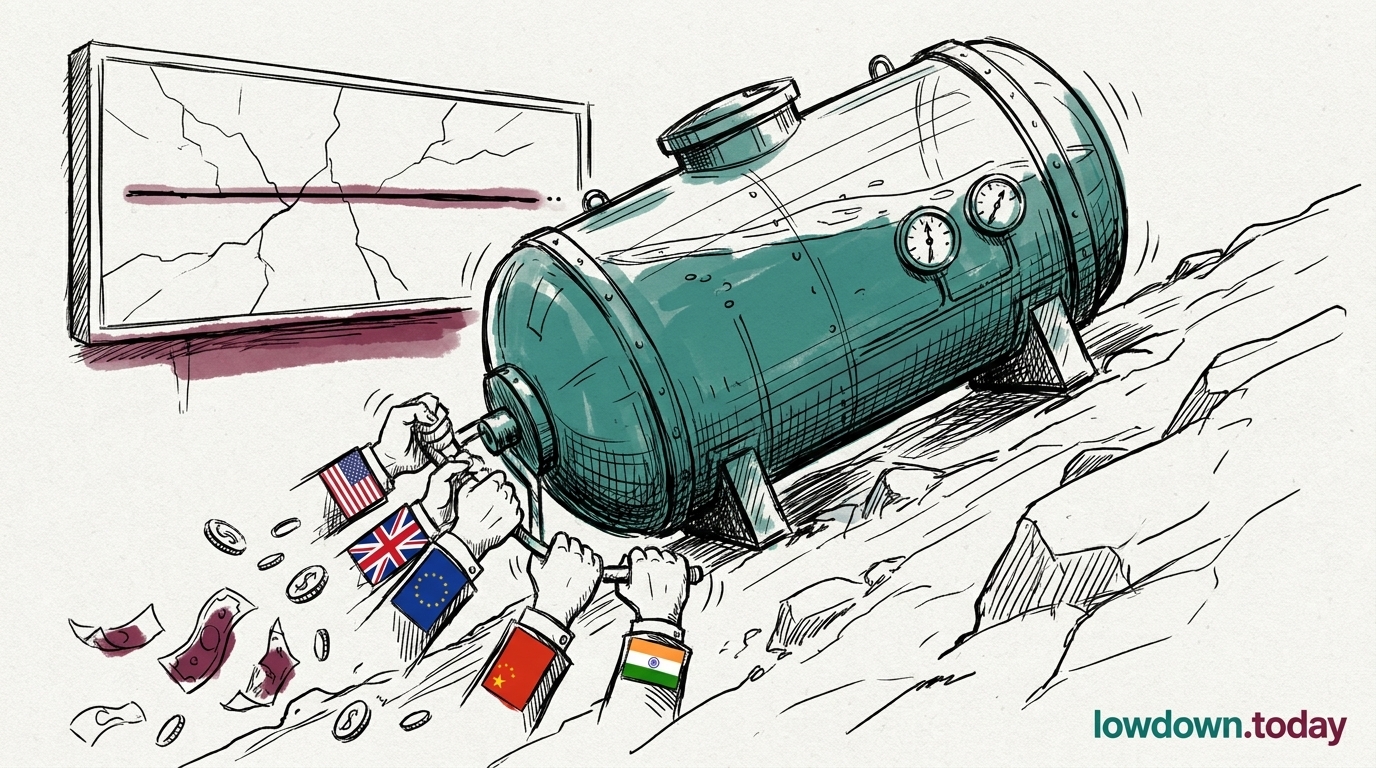
Goldman Sachs revised its Hormuz LNG normalisation timeline to end-July from end-June on 17 June, citing roughly 500 commercial vessels still anchored outside the strait despite the US-Iran memorandum1. The bank held its 2H 2026 TTF forecast at €41/MWh but flagged an upside tail above €100/MWh if the blockade persists. A two-to-three-month mine-clearing and security-assessment tail means the physical cargo benefit arrives after the heart of the July injection window2, with Qatar's partial restart clock (covered in event 5) layered behind that.
The arbitrage tells the same story. The JKM-TTF spread, the gap between the Japan-Korea Marker for Asian spot LNG and the European benchmark, compressed to roughly $4.35/MMBtu by 18 June from $5.26 on 12 June as TTF fell faster than JKM on the Hormuz deal3. The compression is real but partial: the arb still sits above the $2.50 to 3.00 freight-adjusted diversion threshold, so uncommitted Atlantic cargoes still route east rather than into European terminals.
The physical flow confirms the routing. The Disha, the first LNG carrier to cross Hormuz after the conflict, transited on 15 June bound for Dahej in India, not a European berth4. The first post-conflict cargo cleared an Asian terminal while Europe's regas berths stayed the losing bid. The narrowing margin is the early signal of European storage re-entering the cargo auction, not yet its return: front-month TTF has fallen on a diplomatic deal that the physical cargo flow has not yet routed to a European regas berth.




