Skip to content
Briefings are running a touch slower this week while we rebuild the foundations.See roadmap
European Energy Markets
18MAY

Spain power jumps 148% in two days on low wind

3 min read
11:11UTC

Spanish day-ahead cleared at EUR 71.91/MWh, up from EUR 29 on 13 April, as a generation-side shortfall pushed gas peakers into the stack.

EconomicDeveloping
Key takeaway

Iberian insulation is real over a year and fragile over a day.

Spain cleared at EUR 71.91/MWh in day-ahead power on 15 April, up 148% from EUR 29/MWh on 13 April and compressing the Italy-Spain spread from EUR 104 on Monday to EUR 70 on Wednesday, a 33% narrowing in two sessions 1. Italy cleared at EUR 141.90/MWh, France at EUR 72.41, Germany at EUR 117.53; the ENTSO-E feed shows the Italy-Germany gap widening while the Franco-Iberian pair moved to near-parity.

The prior briefing had positioned the Italy-Spain gap as the canonical case of merit-order divergence, with gas setting Italy's price the majority of hours and wind plus solar setting Spain's . A 148% one-way move over two sessions is the mechanism in reverse: a low-wind day compounded by hydro de-rating pushed Spanish gas-fired peakers up the merit order, clearing into a gas-set stack. Iberian insulation is a probability-weighted advantage across a year, not a constant across a day.

France printing EUR 45 beneath Germany on the same day points to the setup through Q2: French nuclear surplus behaves like a southern-European asset, and the Franco-Iberian interconnector becomes the arbitrage of the week on any repeat low-wind print.

The implication for industrial relocation arguments that lean on Iberian power-cost structure is that those arguments survive only if the user can tolerate the dispersion around the mean. On a low-wind day Spain prices into the gas stack; on a high-wind day it prices off the renewables stack. The day-ahead print, not the monthly average, is what settles P&L.


Deep Analysis

In plain English

Spain's electricity system runs mainly on wind and solar power, which in a normal week means Spanish electricity is among the cheapest in Europe. On 15 April, the wind effectively stopped. In the European electricity market, the price is set by the most expensive generator needed to meet demand at any given hour. When wind generation drops, Spain needs to fire up gas power stations instead, and those stations charge what the gas costs them to run. At current gas prices, that is roughly EUR 70/MWh. Two days earlier, Spain was running almost entirely on renewables and paying EUR 29/MWh. The 148% jump is entirely the result of weather, not any policy or supply disruption. It will reverse once wind picks up.

Deep Analysis
Root Causes

Spain's power price architecture creates an inherent volatility asymmetry. On high-renewables days, Spain is largely insulated from gas prices (gas sets the clearing price only 15% of hours per year per Ember/). On low-renewables days, the transition to gas-clearing is total and abrupt because no intermediate generation stack exists between renewables and peakers.

The Iberian peninsula's limited interconnection with France (approximately 2.8 GW southbound capacity) means French nuclear surplus cannot fully absorb demand during merit-order switches, so gas peakers are forced into merit rather than imports covering the gap.

What could happen next?
  • Consequence

    The Italy-Spain spread compression from EUR 104 to EUR 70 on 15 April demonstrates that weather volatility can narrow the insulation benefit Spain's renewable buildout provides, temporarily making Spain's price profile resemble gas-heavy markets.

First Reported In

Update #2 · TTF EUR 42 as Russian LNG ban enters range

euenergy.live (ENTSO-E feed)· 15 Apr 2026
Read original
Different Perspectives
US LNG exporter (Sabine Pass / Corpus Christi)
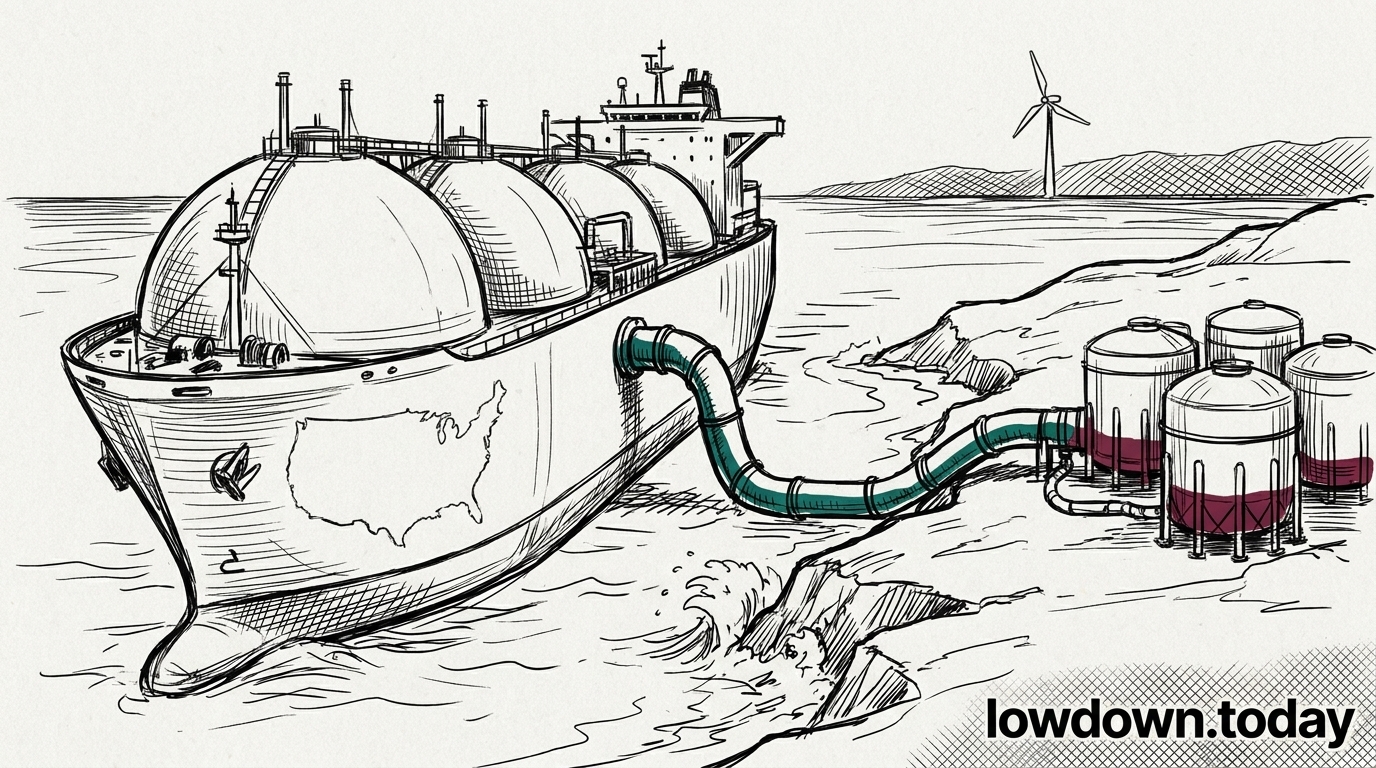
The 58% EU import share confirmed by ACER, heading toward 65% in 2026, represents a structural long-term offtake position that European terminal operators are now willing to underwrite against the German 2031 gas-demand floor. Ribera's warning lands inside a commercial relationship that is expanding, not contracting.
Teresa Ribera, European Commission EVP
Ribera warned Europe should 'avoid replacing one energy dependency with another', framing the ACER 58% US LNG figure as a supply-security risk in the same week TTF broke EUR 50. Her institution has spent EUR 117 billion on US LNG since 2022.
Yara International (ammonia producer)
Front-month TTF at EUR 50+ touches the demand-destruction threshold at which ammonia output curtailments have historically been triggered. Yara faces the same lock-or-ride binary as financial desks, but the downside is production loss rather than mark-to-market exposure.
Katherina Reiche, German Economy Minister
Reiche confirmed the 12 GW hydrogen-ready gas tender is formally agreed with the EU Commission, with first auctions in 2026 and all units operational by 2031. The confirmation closes three years of SPD environment-ministry obstruction and anchors German gas demand through the early 2030s.
European gas trader (Amsterdam desk)
The EUR 50 break is a watershed signal, not a squeeze: the forward curve at EUR 55.21 twelve months out implies the market has repriced structural winter risk, not a positioning overshoot. The lock-or-ride decision on winter hedges closes in June when injection-pace data for May lands.
Hungarian and Slovak gas buyers and regulators
Hungary cleared EUR 123.23/MWh on 12 May, EUR 54 above Spain's same-day clearing and the largest single-market premium of the briefing series, as ACER named it among seven NRAs in TurkStream derogation opinions with the 5 August EC ruling pending. A denial of derogation removes the only available pipeline substitute for Russian LNG banned since 25 April.
