Skip to content
Briefings are running a touch slower this week while we rebuild the foundations.See roadmap
European Energy Markets
18MAY

Power prices split EUR 131 north-south

3 min read
11:11UTC

Italy cleared at EUR 133/MWh while Spain paid EUR 29/MWh on the same day, the starkest intra-EU power price divergence of 2026.

EconomicDeveloping
Key takeaway

Gas sets the power price 90% of the time in Italy and 15% in Spain, producing a EUR 100+ spread.

Italy cleared at EUR 133/MWh in day-ahead power on 13 April 2026, while Spain settled at EUR 29/MWh on the same exchange day. The Netherlands matched Italy at EUR 128/MWh, Belgium at EUR 128/MWh. France surged 188% day-on-day. Then south and north: Spain at EUR 29/MWh, Portugal at EUR 28/MWh, Norway (northern zones) at EUR 2/MWh. A single market, five time zones apart in price.

Merit order mechanics explain the gap. In gas-dependent markets, gas-fired plants set the marginal clearing price. Ember data shows gas sets the electricity price most hours in Italy but a fraction of that in Spain, where wind and solar capacity has displaced gas from the stack. The result: a EUR 100+/MWh spread between Iberian and north-western European power markets.

For industrial consumers, the spread is a location arbitrage signal. Energy-intensive production in Spain operates at roughly one quarter of the power cost of an equivalent plant in Italy or the Netherlands. For policymakers, it is a live demonstration that renewables penetration translates directly into price shock insulation, not in theory or over a decade, but on a single trading day.


Deep Analysis

In plain English

Electricity prices in Europe vary by country because each national grid has a different energy mix. Countries that generate most of their power from wind, solar, and hydropower pay less when gas prices are high, because gas is not the primary source setting their prices. On 13 April, the gap between Italy (EUR 133/MWh) and Spain (EUR 29/MWh) showed this vividly. Italy relies heavily on gas-fired power stations, so when gas is expensive, Italian electricity is expensive too. Spain has invested heavily in wind and solar, so gas prices matter much less to Spanish electricity costs.

Deep Analysis
Root Causes

The Italy-Spain divergence reflects two decades of unequal investment in power system gas dependency. Italy built approximately 40 GW of gas-fired combined-cycle capacity between 1995 and 2010, primarily because gas was cheap and nuclear was politically blocked after the 1987 referendum. Spain, facing similar nuclear constraints, pivoted to wind and solar from 2005 onwards, accelerated by EU renewable energy directives.

The result is that Italian power dispatch depends on gas as the marginal clearing technology for approximately 90% of hours, while Spanish dispatch has largely moved gas to the peaking residual. This was a strategically advantageous position in 2015-20 when TTF was EUR 15-20/MWh; it is now a structural liability at EUR 47/MWh.

Escalation

The 188% France day-on-day surge is the most acute indicator: France, normally insulated by nuclear baseload, apparently lost significant nuclear generation on 13 April (likely a combination of planned outages and load constraints), exposing its residual gas dependency. If French nuclear availability remains below seasonal norms through April, French prices will continue to trade closer to the Dutch-Belgian range than the Spanish.

What could happen next?
  • Consequence

    Energy-intensive industrial production is shifting toward Iberia at an accelerating rate, creating a structural permanent loss of manufacturing activity in Germany, Italy, and Belgium that will not reverse even if gas prices normalise.

  • Opportunity

    The Pyrenean interconnector expansion, currently in ENTSO-E planning phases, has gained urgent political support from both French and Spanish governments as the EUR 100+ price gap makes the economic case undeniable.

First Reported In

Update #1 · Europe's thinnest gas cushion since 2018

Ember· 13 Apr 2026
Read original
Different Perspectives
US LNG exporter (Sabine Pass / Corpus Christi)
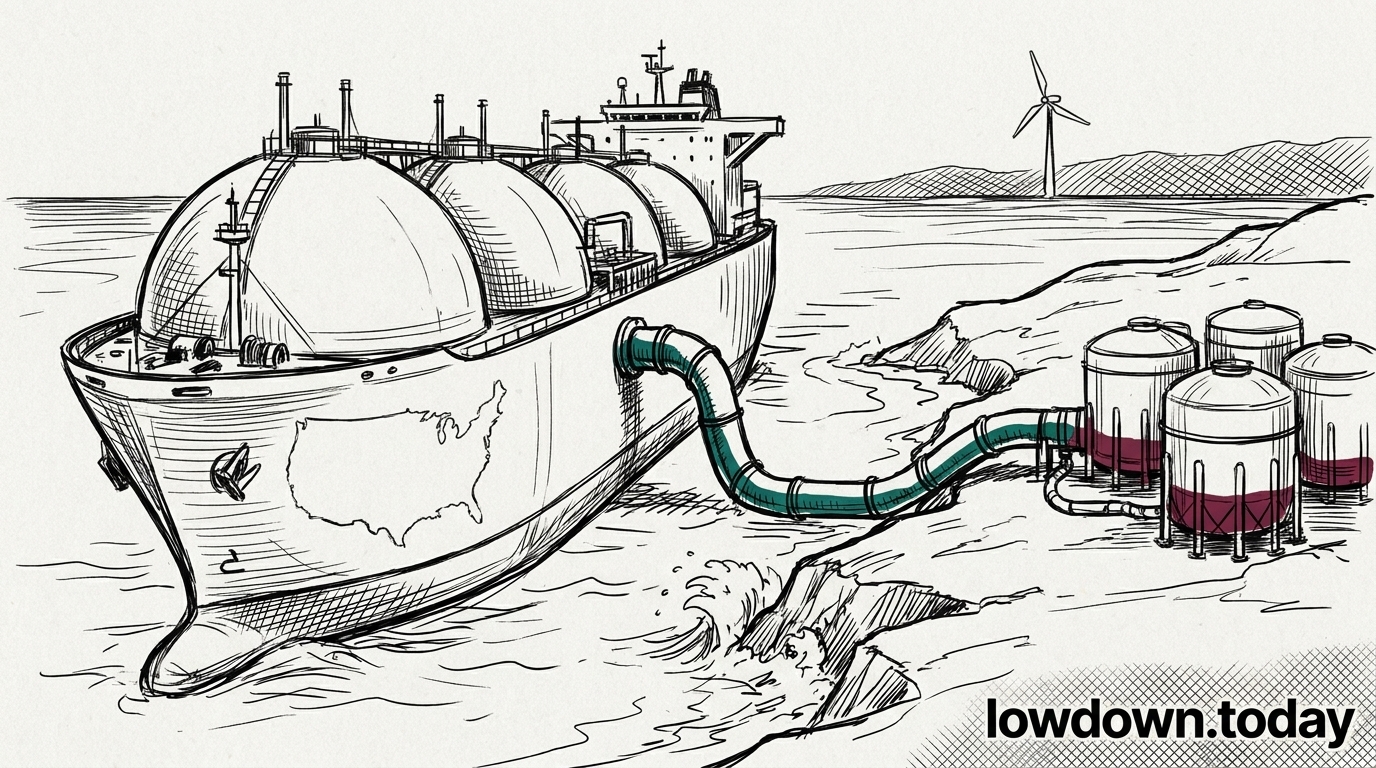
The 58% EU import share confirmed by ACER, heading toward 65% in 2026, represents a structural long-term offtake position that European terminal operators are now willing to underwrite against the German 2031 gas-demand floor. Ribera's warning lands inside a commercial relationship that is expanding, not contracting.
Teresa Ribera, European Commission EVP
Ribera warned Europe should 'avoid replacing one energy dependency with another', framing the ACER 58% US LNG figure as a supply-security risk in the same week TTF broke EUR 50. Her institution has spent EUR 117 billion on US LNG since 2022.
Yara International (ammonia producer)
Front-month TTF at EUR 50+ touches the demand-destruction threshold at which ammonia output curtailments have historically been triggered. Yara faces the same lock-or-ride binary as financial desks, but the downside is production loss rather than mark-to-market exposure.
Katherina Reiche, German Economy Minister
Reiche confirmed the 12 GW hydrogen-ready gas tender is formally agreed with the EU Commission, with first auctions in 2026 and all units operational by 2031. The confirmation closes three years of SPD environment-ministry obstruction and anchors German gas demand through the early 2030s.
European gas trader (Amsterdam desk)
The EUR 50 break is a watershed signal, not a squeeze: the forward curve at EUR 55.21 twelve months out implies the market has repriced structural winter risk, not a positioning overshoot. The lock-or-ride decision on winter hedges closes in June when injection-pace data for May lands.
Hungarian and Slovak gas buyers and regulators
Hungary cleared EUR 123.23/MWh on 12 May, EUR 54 above Spain's same-day clearing and the largest single-market premium of the briefing series, as ACER named it among seven NRAs in TurkStream derogation opinions with the 5 August EC ruling pending. A denial of derogation removes the only available pipeline substitute for Russian LNG banned since 25 April.
