Skip to content
Briefings are running a touch slower this week while we rebuild the foundations.See roadmap
European Energy Markets
18MAY

Bruegel resolves refill bill at EUR 26bn

4 min read
11:11UTC

Bruegel published a three-scenario refill model on Thursday 23 April: EUR 26 billion at TTF EUR 45/MWh, EUR 35bn at EUR 60/MWh, EUR 44bn at EUR 75/MWh. With TTF settling at EUR 44.86 on 25 April, the operative number is the lower one.

EconomicDeveloping
Key takeaway

At TTF EUR 44.86, the operative refill cost is EUR 26bn; the EUR 35bn anchor is EUR 60/MWh territory.

Bruegel, the Brussels economic policy think tank, published a three-scenario refill model on Thursday 23 April: EUR 26 billion at EUR 45/MWh TTF, EUR 35 billion at EUR 60/MWh, and EUR 44 billion at EUR 75/MWh 1. With TTF settling at EUR 44.86/MWh on 25 April , the operative number is EUR 26 billion, EUR 9 billion below the figure that has anchored EU policy debate since update #288 .

This matters because the EUR 35 billion figure has been quoted in finance-minister letters and in the consumer-relief framing of the Commission's AccelerateEU package, which was published on 22 April with no storage injection mechanism. At today's TTF print, AccelerateEU's gap looks smaller than its critics costed it; desks short summer and long winter against an EUR 60/MWh case have been pricing roughly EUR 9 billion of phantom buyer demand.

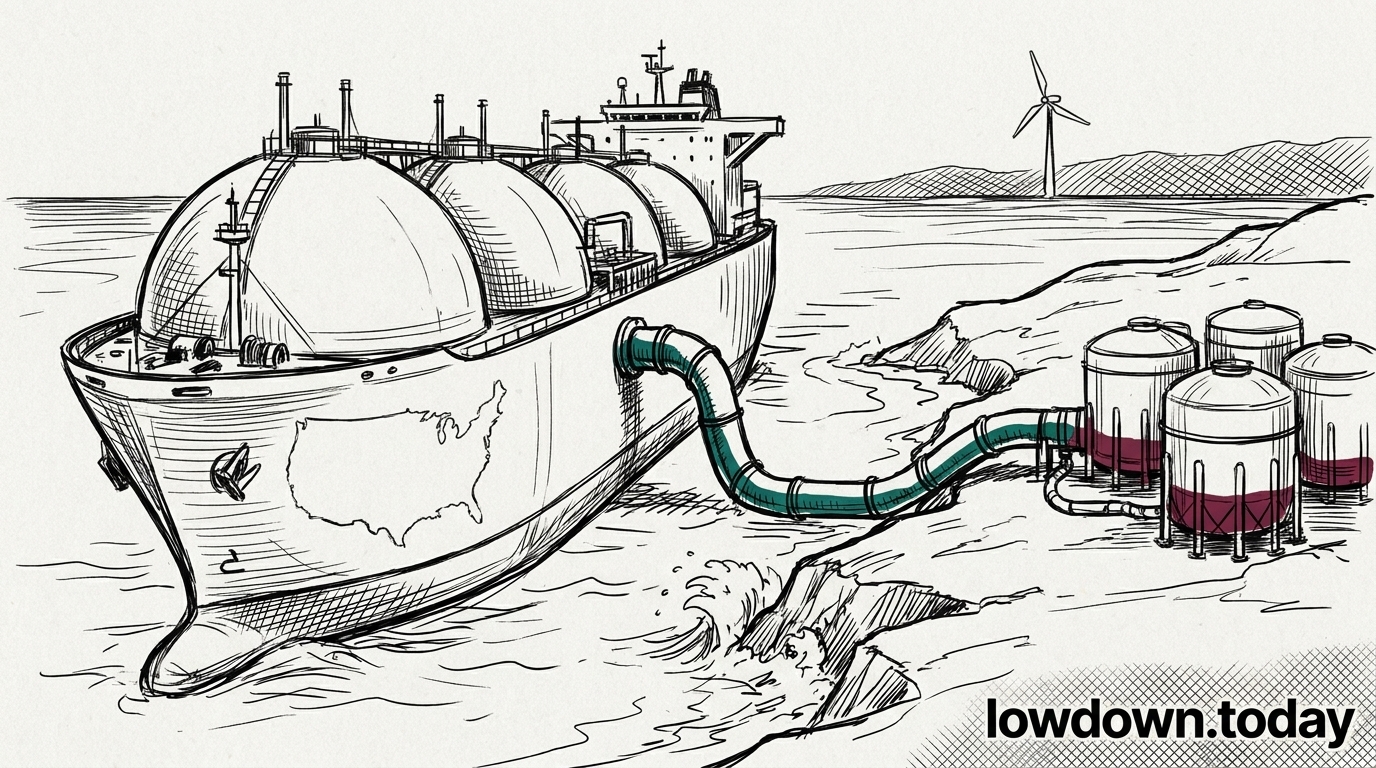
Bruegel itself stops short of endorsing the package. The same paper recommends against price caps, windfall instruments, and ETS (the EU Emissions Trading System, the bloc's carbon market) weakening, and flags Spain's drop in gas-price-setting hours from 75% in 2019 to 15% in 2026 as evidence that demand-side adjustment is doing the work caps would distort. Bruegel also notes Qatar supplies only 4% of Total EU gas imports and 8% of LNG imports, lower than commonly cited; US LNG carries two-thirds of EU LNG flow.

Spain's drop from 75% to 15% gas-set hours is what Bruegel uses to argue the policy position. When fewer than one in six Iberian power-market clearing intervals are set by gas, the marginal price-formation mechanism for EU electricity has migrated towards renewables and storage. A price cap on gas in 2026 hits a smaller fraction of European power-market hours than it would have in 2022. The EUR 26 billion case sits inside that picture; the EUR 35 billion case requires either a Hammerfest LNG overrun beyond 10 July or a renewed Hormuz escalation to land.

Deep Analysis

In plain English

Bruegel is a Brussels-based economics research institute whose analysis informs EU policymakers. On 23 April it published a three-scenario estimate for how much it will cost the EU to fill its gas storage from current levels to the target level by November 2026. The three scenarios depend on where gas prices go: EUR 26 billion if prices stay around EUR 45 per megawatt-hour (where they are now), EUR 35 billion if prices rise to EUR 60, and EUR 44 billion at EUR 75. Importantly, the EUR 35bn figure that has been widely cited in EU policy discussions was never Bruegel's base case, it was the middle scenario, which assumes prices significantly higher than today's.

Deep Analysis
Root Causes

The EUR 35bn anchor that dominated EU policy debate originated from Bruegel's initial modelling at EUR 60/MWh TTF, which was the forward curve midpoint in late March 2026 when AccelerateEU was being drafted. Commission officials anchored their refill cost framing to the middle scenario rather than the spot-price-at-time-of-calculation scenario, creating a policy cost estimate that was already EUR 9bn above the operative number by 25 April.

The underlying structural cause is that EU energy policy operates on a 2-3 month legislative cycle while commodity markets price continuously. Models frozen at a forward curve midpoint diverge from actual cost as prices move.

What could happen next?
  • Consequence

    Commission officials and finance ministers working from the EUR 35bn anchor are overstating refill costs by EUR 9bn at current TTF, which may lead to unnecessarily restrictive demand measures if the policy frame is not updated.

  • Precedent

    Bruegel's explicit recommendation against price caps, supported by the Spanish gas-price-setting hours data, strengthens the analytical case against the five-finance-minister windfall levy letter and sets a benchmark for Madrid Forum discussions.

First Reported In

Update #5 · Ban day muted; Germany doubles injection rate

Bruegel· 26 Apr 2026
Read original
Different Perspectives
US LNG exporter (Sabine Pass / Corpus Christi)
The 58% EU import share confirmed by ACER, heading toward 65% in 2026, represents a structural long-term offtake position that European terminal operators are now willing to underwrite against the German 2031 gas-demand floor. Ribera's warning lands inside a commercial relationship that is expanding, not contracting.
Teresa Ribera, European Commission EVP
Ribera warned Europe should 'avoid replacing one energy dependency with another', framing the ACER 58% US LNG figure as a supply-security risk in the same week TTF broke EUR 50. Her institution has spent EUR 117 billion on US LNG since 2022.
Yara International (ammonia producer)
Front-month TTF at EUR 50+ touches the demand-destruction threshold at which ammonia output curtailments have historically been triggered. Yara faces the same lock-or-ride binary as financial desks, but the downside is production loss rather than mark-to-market exposure.
Katherina Reiche, German Economy Minister
Reiche confirmed the 12 GW hydrogen-ready gas tender is formally agreed with the EU Commission, with first auctions in 2026 and all units operational by 2031. The confirmation closes three years of SPD environment-ministry obstruction and anchors German gas demand through the early 2030s.
European gas trader (Amsterdam desk)
The EUR 50 break is a watershed signal, not a squeeze: the forward curve at EUR 55.21 twelve months out implies the market has repriced structural winter risk, not a positioning overshoot. The lock-or-ride decision on winter hedges closes in June when injection-pace data for May lands.
Hungarian and Slovak gas buyers and regulators
Hungary cleared EUR 123.23/MWh on 12 May, EUR 54 above Spain's same-day clearing and the largest single-market premium of the briefing series, as ACER named it among seven NRAs in TurkStream derogation opinions with the 5 August EC ruling pending. A denial of derogation removes the only available pipeline substitute for Russian LNG banned since 25 April.

