Skip to content
You can now search across every topic, entity and event.What's new
Drones: Industry & Defence
20AUG

DHS, Shield AI and a Section 232 clock still running

4 min read
16:38UTC

DHS staged $250 million in FEMA counter-drone grants across 11 World Cup host states on Thursday 14 May. Five days later, Shield AI was contracted onto LUCAS for an autumn swarm demo. The Section 232 UAS tariff decision passed 54 days overdue with no Commerce report.

TechnologyDeveloping
Key takeaway

DHS funded World Cup security, Shield AI bridged onto attritable strike, and the tariff lever stayed cold.

The Department of Homeland Security announced on Thursday 14 May that FEMA had staged $250 million in counter-drone grants across 11 FIFA World Cup host states and the National Capital Region ahead of the 11 June tournament start 1. The grants flow through DHS sub-agencies including CBP, ICE and the Programme Executive Office for UAS/C-UAS, and they sit inside a broader $1.5 billion DHS C-UAS contract vehicle disclosed earlier in the spring. World Cup security has acted as the forcing function for DHS counter-drone procurement in the same way the Iran Gulf campaign acted as the Pentagon's.

Shield AI was contracted on Tuesday 19 May to integrate its Hivemind Foundation Model onto LUCAS, the $35,000 Low-Cost Uncrewed Combat Attack System reverse-engineered from Iran's Shahed-136, for an operational swarm demo planned in autumn 2026 2. The contract extends Hivemind from its earlier home on V-BAT, where Shield AI built the autonomous-flight stack as a CCA-wingman tier, into the attritable attack swarm. LUCAS's lineage is the structural detail: a US drone built from the airframe Iran flew against Saudi Aramco in 2019 and Russia flew against Ukraine from October 2022 has now been wired into the Pentagon's autonomy stack of record.

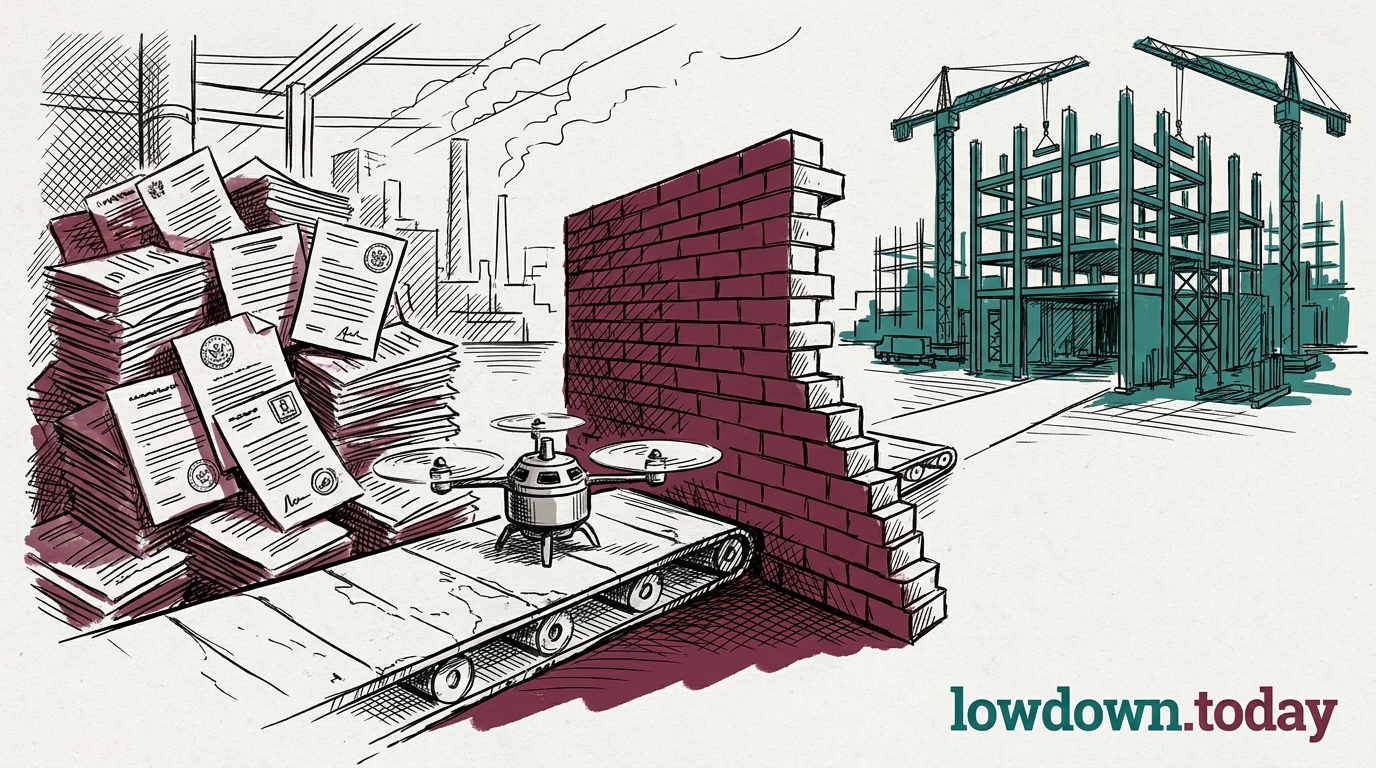
The Section 232 UAS Investigation remained 54 days overdue as of 21 May, against the 28 March statutory deadline, with no Commerce report transmitted to the President. The tariff route the administration opened in July 2025 has now been visibly overtaken by the federal procurement bar and FCC Covered List exclusions covered in the Autel filing above, which together cut DJI and Autel from federal contracts and FCC equipment authorisations regardless of any tariff. The longer Commerce holds the report, the more the executive branch tacitly concedes the regulatory work is being done elsewhere .

Deep Analysis

In plain English

Three separate US counter-drone stories moved in the same week. First, the government gave $250 million to the 11 states hosting 2026 World Cup matches to buy equipment that can detect and jam drones over stadiums. The football starts on 11 June. Second, a company called Shield AI agreed to connect its autonomous flight software, Hivemind, to LUCAS, a cheap American strike drone that was originally reverse-engineered from an Iranian drone design. The plan is to demonstrate a swarm of these attack drones flying autonomously in autumn 2026. Third, a government investigation into whether Chinese drones should face additional trade tariffs passed its legal deadline by 54 days with no decision announced. The investigation was opened in July 2025 and was supposed to report back to the President by March 2026.

What could happen next?
  • Opportunity

    Shield AI's Hivemind integration on LUCAS, if the autumn 2026 swarm demo succeeds, creates the first publicly confirmed US attritable-autonomy swarm capability; success would accelerate Drone Dominance procurement timelines and potentially position Hivemind as the mandatory software stack on Group 1 FPV strike drones.

    Short term · Assessed
  • Meaning

    The Section 232 investigation running 54 days overdue, alongside active FCC Covered List litigation from both DJI and Autel, signals the administration is managing Chinese drone market access through regulatory instruments rather than tariffs, avoiding the trade-retaliation risk a formal tariff proclamation would carry.

    Medium term · Assessed
  • Risk

    FEMA counter-drone grants deployed without a civil-impact framework may leave permanent RF-jamming infrastructure in 11 US cities operating under state police authority rather than a federal regulatory standard, creating spectrum-management conflicts with medical devices and licensed non-military drone operators.

    Medium term · Suggested
First Reported In

Update #9 · Schmidt's Perennial wins $500M drone deal

Punchbowl News· 21 May 2026
Read original
Causes and effects
This Event
DHS, Shield AI and a Section 232 clock still running
Three separate US drone-security actions ran in parallel: domestic event security funded, attritable autonomy bridged, and the executive tariff lever quietly idle.
Different Perspectives
South Korea's Defense Acquisition Program Administration
DAPA folded drone and roadside-bomb jammers into an 18-year, KRW 3.448 trillion K2 tank upgrade approved 11 August, rather than fund counter-drone kit as its own programme. Seoul is treating the threat as permanent enough to write into a platform's lifecycle, not urgent enough to buy ahead of it.
NATO Support and Procurement Agency
NSPA named five pre-qualified counter-drone suppliers under new framework contracts on 27 July, giving allies a purchasing route with no published budget attached. A framework without committed money is an instrument waiting for a spending decision, not a guarantee one is coming.
Ukraine's Ministry of Defence
Ukraine's forces strike with more than 70 AI and computer-vision systems drawn from over 200 domestic producers, the ministry said on 18 August, a supplier base neither Washington's tariff fight nor Beijing's export licence touches. Kyiv is scaling capability faster than either government is writing rules for it.
A European drone-component manufacturer
A European manufacturer selling components into the United States faces the same 100 per cent tariff and 3 September deadline as any other foreign supplier, with the duty-free onshoring carve-out available only to firms building on American soil. That leaves it to absorb the cost, relocate assembly, or cede the US market rather than shop around a rival supply chain.
Chinese drone component exporters
Exporters now need a case-by-case licence for each US-bound dual-use shipment after MOFCOM's 5 August order, with no published review clock. The same week Shenzhen logged nearly 200,000 domestic logistics-drone sorties and Hunan reported record spraying coverage, a home market large enough to absorb what the licence regime slows from leaving the country.
US drone manufacturers
The onshoring carve-out protects Performance Drone Works' $820 million War Department loan, but the same 3 September deadline hits Red Cat Holdings and Unusual Machines, both filing over 500 per cent revenue growth on 6 August, on Chinese-sourced components with no qualified domestic substitute yet.
