Skip to content
You can now search across every topic, entity and event.What's new
Data Centres: Boom and Backlash
8SEP

Ireland codes a 900 MW load-loss limit

2 min read
13:06UTC

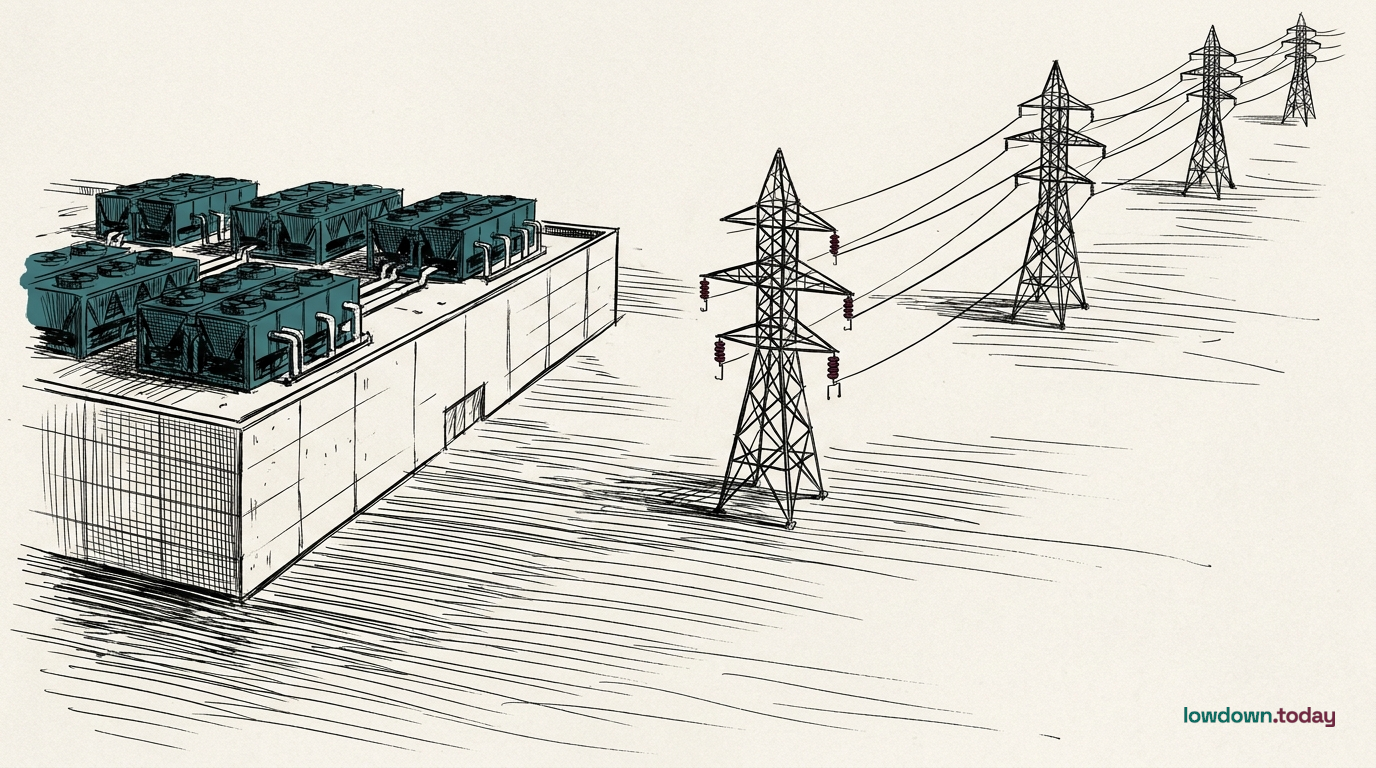
EirGrid and SONI issued a grid-fault curtailment procedure to data centres on 30 June, capping instantaneous demand loss at 900 MW to stop synchronised backup-power trips destabilising the grid.

IndustryDeveloping
Key takeaway

Ireland made data-centre curtailment a permanent grid rule, while the US still declares an emergency each time.

EirGrid and SONI, the grid operators for the Republic of Ireland and Northern Ireland, issued a fault-ride-through (FRT) demand-curtailment procedure to affected data-centre customers on Tuesday 30 June, live from July. 1 fault-ride-through is the grid-code requirement that a large load stay connected through a brief voltage dip rather than trip to its own backup generators. Their MPID345 paper set a 900 MW ceiling on how much demand the grid can afford to lose at once, warning that a single fault could otherwise knock more than 1,150 MW of data-centre load offline together.

The physics matches a risk the beat has tracked mostly in America. The US Department of Energy (DOE) used Section 202(c) emergency powers to let PJM, the largest US grid operator, curtail backup-equipped data centres twice in 2026 , and Ireland's energy regulator, the CRU, reopened large-load connections in June even as EirGrid warned of shortfalls .

The two systems reached the same class of ceiling from opposite legal directions. Washington must declare a statutory emergency event by event; Dublin has written a standing grid-code rule that runs on its own. Both treat concentrated data-centre load as a single point of failure the grid must be able to shed, and the build-out is what created that risk.

Deep Analysis

In plain English

Ireland's electricity grid operators, EirGrid and SONI, have told data-centre customers there is now a hard limit on how much power demand can suddenly vanish from the grid at once, for example if a big data centre trips offline during a fault. That limit is 900 megawatts; above roughly 1,150 megawatts of sudden loss, the grid itself could become unstable. This matters because Dublin's data centres already use about half of the region's electricity. The rule does not stop new data centres connecting, but it does mean big campuses now have to prove they will not destabilise the grid if something goes wrong.

Deep Analysis
Root Causes

EirGrid's 900 MW ceiling exists because Ireland's data-centre demand, now about 32% of national electricity against 22% in 2024, grew faster than CRU's 2025 reconnection conditions anticipated; the regulator required 80% renewable supply and full on-site backup from new entrants, but did nothing to cap the instantaneous demand loss a fault at a large Dublin campus could cause across the whole system.

The 1,150 MW imbalance warning is the gap between what EirGrid judges the system can absorb without mitigation and what a cluster of large Dublin sites tripping simultaneously would actually cost; the 900 MW ceiling is the operator drawing a line just below that failure threshold rather than waiting for CRU to write a new connection rule.

Escalation

The procedure is a defensive grid-code measure, not evidence of an imminent shortfall; escalation would be a live curtailment event or a further tightening of the ceiling if Dublin campus growth continues.

What could happen next?
  • Risk

    Operators unable to demonstrate fault-ride-through compliance may face new engineering costs or curtailment exposure even after clearing CRU's 2025 connection conditions.

  • Precedent

    A standing grid-code ceiling, rather than a one-off emergency order, gives European grid operators a template that does not require new legislation to enforce.

First Reported In

Update #10 · New York freezes data centres by decree

EirGrid / SONI· 15 Jul 2026
Read original
Different Perspectives
NVIDIA
NVIDIA
NVIDIA told the Securities and Exchange Commission on 26 August it had signed memorandums aiming to mobilise over $500bn for buyers' equipment purchases, then said in the same filing the arrangements may not become definitive. It may also carry limited residual-value risk on the equipment itself.
IREN Limited
IREN Limited
IREN signed $2.4bn of financing on 25 August that only releases cash once its Mackenzie GPU servers are accepted, and only through 31 December 2026. A shipping delay from here now creates a funding problem as well as a revenue one.
Energy Commission (Malaysia)
Malaysia's Energy Commission recorded data centres at 9.3% of national power in one hot week in August, against a 7% year-to-date average, and is projecting 31% of peninsular demand by 2035. It wants roughly 9 GW of new gas-fired capacity by 2032 to cover the gap.
Economic Development Board and Infocomm Media Development Authority
Singapore's EDB and IMDA rationed 200 MW across four operators on 21 August and followed with a tropical liquid-cooling standard six days later, fixing the terms before construction starts. The agencies will decide within 18 to 24 months whether to run a third call.
Legal Resources Centre
The Legal Resources Centre put the water and power draw of two approved Cape Town Equinix sites in public, at roughly 4.4 billion litres and 1.4 to 1.5 billion kWh a year, because the city and the operator would not. It wants a cumulative assessment before any more of the five approvals proceed.
Ministerio de Minas e Energia
Brazil's energy ministry published Redata's five conditions after the Senate passed PL 278/2026 on 1 September, betting a repeatable annual water test enforces cooling design better than a one-off approval. Redata now needs President Lula's signature before any of it takes effect.

