Skip to content
You can now search across every topic, entity and event.What's new
Autonomous Systems: Land & Sea
11JUL

Undersea robots go core at BALTOPS

3 min read
10:27UTC

The US Navy ran the Iver3 autonomous underwater vehicle off Latvia from 8 June, the first time in 55 years that uncrewed undersea systems were a core part of NATO's Baltic exercise rather than a side trial.

TechnologyDeveloping
Key takeaway

NATO drilled both hunting mines with robots and stopping enemy ones, the usual precursor to a buying wave.

The US Navy operated the Iver3 autonomous underwater vehicle (AUV) off Liepaja, Latvia between 8 and 10 June, the first time in BALTOPS's 55-year history that uncrewed undersea systems ran as a core capability and not an experiment 1. BALTOPS is NATO's annual Baltic Sea exercise; this year it drew 15 nations across 4 to 19 June. The Iver3 mapped the seabed, hunted mines and ran electronic surveillance over a Baltic floor laced with the cables and pipelines that have been cut and dragged repeatedly since 2022.

NATO also drilled the harder half of the problem: stopping a hostile robot. Crews tested counter-AUV measures and ran a multinational detect-to-remediate chain, with Netherlands explosive-ordnance-disposal (EOD) teams and Latvian personnel working behind the vehicle that made each detection 2. The same shift showed up a week earlier, when NATO sent uncrewed systems to watch the Greenland-Iceland-UK (GIUK) gap . In a single fortnight, seabed defence moved from a doctrine paper to a rehearsed core task across two exercises.

For suppliers, the detect-to-remediate chain carries the procurement signal. NATO is no longer shopping for a single clever sensor; it is buying a networked pipeline that runs from detection through to an EOD response. That favours firms able to integrate across the chain over those selling one vehicle, and it turns a rehearsed workflow into a procurement specification others must now build to.

Deep Analysis

In plain English

BALTOPS (Baltic Operations) is a NATO naval exercise held every year since 1971. In 2026, for the first time in that 55-year history, the alliance used an autonomous underwater vehicle (AUV) as a core part of the exercise rather than just a demonstration add-on. The Iver3 is an autonomous underwater vehicle (AUV): a submersible robot that navigates on its own, uses sonar to scan the seabed for objects like mines or sabotaged pipelines, and sends its findings back to a control team. The US Navy deployed the Iver3 AUV off Liepaja, Latvia, where it mapped the seabed and hunted mines. NATO also practised counter-AUV drills, rehearsing how to detect and neutralise enemy underwater robots, and ran a multinational 'detect-to-remediate' chain where the AUV's findings were handed off to Dutch explosive-ordnance disposal (EOD) teams and Latvian personnel for follow-on action.

Deep Analysis
Root Causes

Two structural factors drove the BALTOPS 2026 integration.

The 2023 Balticconnector pipeline rupture and subsequent Nord Stream investigation exposed NATO's persistent surveillance deficit under the Baltic Sea; the IISS documented fewer than six maritime patrol aircraft sorties per day over Baltic seabed infrastructure, insufficient to detect or attribute slow-moving subsea threats. This created a standing unfunded requirement for persistent, low-cost seabed sensing.

The Iver3 AUV's entry into routine US Navy operations, rather than experimental programmes, gave BALTOPS planners a platform with a maintenance and training baseline already established; deploying a fielded system requires a force integration decision rather than an acquisition decision, which shortened the doctrinal adoption path significantly.

Escalation

Doctrinal consolidation, not escalation. Running counter-AUV drills signals NATO acknowledges potential adversary use of similar systems; this is prudent capability mirroring rather than a provocation. The exercise ran within established Baltic frameworks.

What could happen next?
  • Consequence

    Running undersea uncrewed systems as core BALTOPS capability for the first time creates a standing NATO requirement that drives procurement across allied navies; the 15-nation participation means the demand signal reaches defence budgets in multiple European capitals simultaneously.

  • Precedent

    The multinational detect-to-remediate chain run at BALTOPS 2026 establishes a NATO interoperability standard for AUV-to-EOD handoff; future exercises will test compliance with that standard rather than demonstrate the concept.

First Reported In

Update #4 · Allied robot minehunters reach the Gulf

DVIDS / US Department of Defense· 24 Jun 2026
Read original
Causes and effects
This Event
Undersea robots go core at BALTOPS
A standing NATO requirement for seabed protection reads to European yards as the start of a procurement wave for undersea robots.
Different Perspectives
China (military commentary)
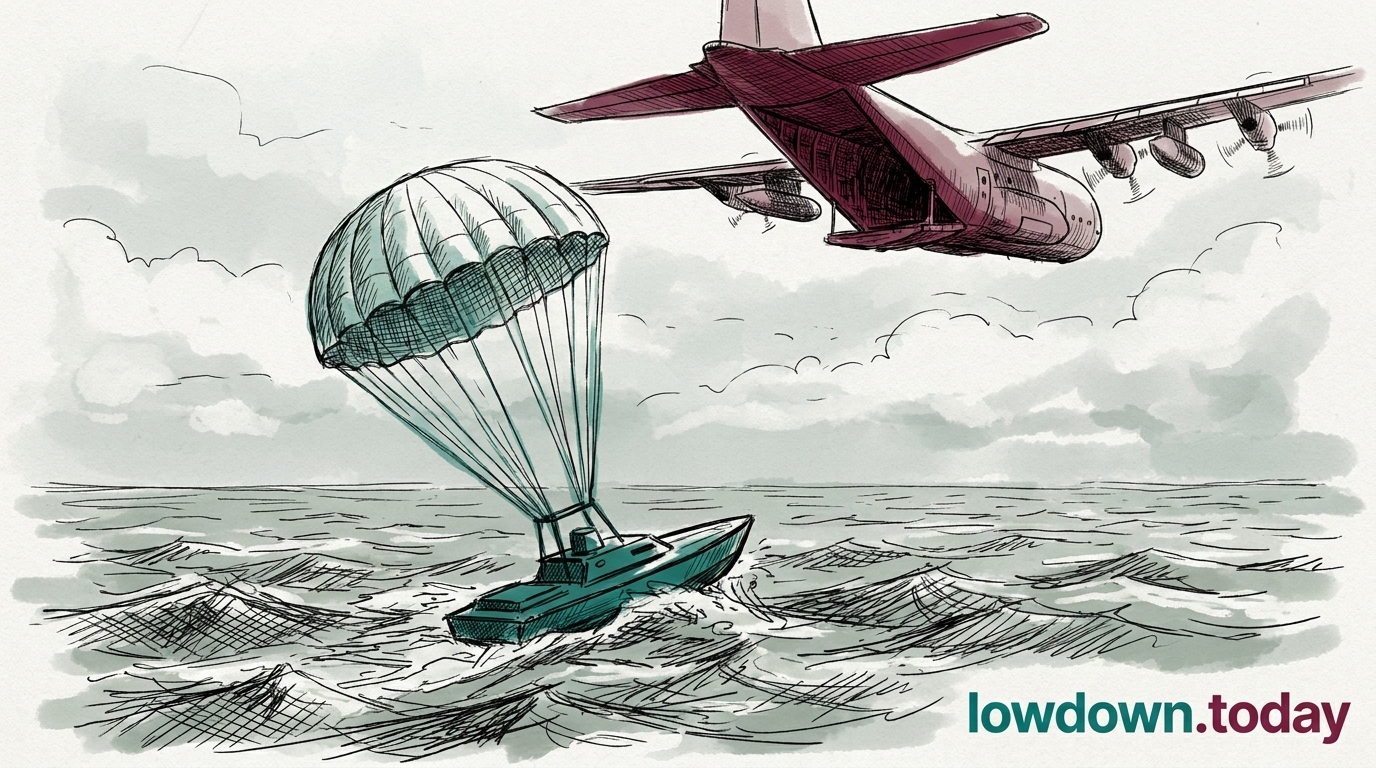
Chinese military commentary has called uncrewed maritime equipment 'an excellent force multiplier' that cannot overturn the fundamental logic of naval warfare, the lone voice against the Western consensus that autonomy is the central axis of naval modernisation. Beijing reads the airdrop trial as an incremental logistics fix, not London's claimed doctrinal breakthrough.
Iran (Ministry of Foreign Affairs)
Spokesman Kazem Gharibabadi said clearance of the Hormuz mines is 'Iran's sole responsibility', rejecting the Omani-authorised allied mine-clearance mission as a jurisdictional dispute rather than a technical favour. Tehran has not ratified UNCLOS, the treaty that would otherwise settle transit-passage rights through the strait.
Norway (Kongsberg Discovery)
Kongsberg Discovery's Camilla Kiss said the subsea-protection contract shows the industry 'moving from recognising the need to implementing solutions', selling fused sonar and C-Scope software to an unnamed buyer because fragmented cable, pipeline and platform ownership means no single navy commissions this the way it commissions a warship.
Ukraine (Trinity Robotics)
Trinity Robotics doubled its Konyk One production target to 2,200 units and opened French joint-venture talks, co-founder Oleksii Konik said, because wartime demand outpaces what factories inside a live-fire war zone can safely hold. Ukraine is answering the authority gap other actors face by manufacturing around it.
United Kingdom (Ministry of Defence and Royal Navy)
The Royal Navy proved it can airdrop a mine-hunting robot from any A400M into Sea State 4 waters, working round a front line of just six Type 45 destroyers and eight Type 23/26 frigates rather than waiting for more hulls. First Sea Lord Gwyn Jenkins's 'uncrewed wherever possible' doctrine gets a delivery method; it still lacks a named operational deployment.
Nautilus International
Nautilus International pressed the unresolved liability gaps as the MASS Code entered force, noting a master stays legally responsible without saying who answers when ashore. Entry into force changed nothing an operator may legally do, leaving the seafarer-displacement question open.