Skip to content
You can now search across every topic, entity and event.What's new
Autonomous Systems: Land & Sea
12AUG

Pentagon's drone buy lands a third short

4 min read
14:17UTC

The Pentagon's first attack-drone phase closed about 10,000 units below its 30,000 target, and lead vendor Neros cleared only 43% of the 2,400 Archer drones it shipped.

TechnologyDeveloping
Key takeaway

What clears inspection, not what gets ordered, now measures the Pentagon's mass-drone programme.

Phase 1 of the Pentagon's first-person-view (FPV) attack-drone buy finished about 10,000 units below its 30,000-drone target 1. FPV drones are cheap, camera-guided airframes a pilot steers onto a target. The original programme ordered 30,000 of them at $5,000 each . Lead vendor Neros shipped every one of its 2,400 ARCHeR drones; the military accepted only 1,040, a 43% acceptance rate 2. Other vendors delivered roughly 560 more, still awaiting sign-off. For months the order volume drove the headlines. The count that clears inspection drives them now.

The gap sits in industrial maturity rather than design. Neros shipped its full contract, then watched more than half the airframes fail the quality gate, the wall that historically separates a prototype shop from a production prime. Accepting half of what one lead supplier delivers tells a buyer the bottleneck has moved from invention to repeatable manufacture at volume. That is a harder problem to fund away, and it reshapes who wins the next round.

The Phase 2 qualifier is already running. The Gauntlet Stage 1 fly-off, the Pentagon's competitive ranking exercise that orders drones by performance, opened at Camp Grayling, Michigan on 8 June and runs to 20 June, with 49 companies fielding around 79 designs . The pressure sits in the price card. Phase 2 caps long-range strike drones at $4,500 and urban-assault drones at $3,500, down from the flat $5,000 of Phase 1 3. Vendors that could not hit the target at the higher price must now hit a sharper one.

A second filter runs underneath. From August 2026, programme drones must strip out Chinese motors and batteries to stay eligible, a supply-chain gate the trade calls the Chinese cliff 4. That deadline binds every entrant, including the Ukrainian firms that joined Phase 2 alongside London's Skycutter ; combat pedigree does not exempt a bill of materials. A shortfall at the start of a production ramp can read as friction rather than a ceiling, and Phase 2 still promises at least $300m in fresh orders. The yardstick has simply moved from units ordered to units the Pentagon will accept.

Deep Analysis

In plain English

The Pentagon ran a competition to buy 30,000 cheap camera-guided attack drones, the kind Ukrainian soldiers have used to destroy Russian tanks. It ordered them from 11 companies. When the drones arrived, inspectors checked each one against strict quality standards. Only about 20,000 passed. The main supplier, Neros, sent all 2,400 it had promised but inspectors accepted fewer than half. The Pentagon now wants a new round of orders with lower prices and a rule that drones must be built without parts from China. Both conditions make it harder for smaller manufacturers to compete.

Deep Analysis
Root Causes

The acceptance gap has two distinct structural causes.

First, the programme selected on price and performance at fly-off, not on production-line audit. The Gauntlet ranked drones by flight score; it did not inspect manufacturing facilities or require suppliers to demonstrate repeatable production at contract volume before orders were placed. A vendor that can produce 50 exemplary units for a fly-off faces a different engineering challenge producing 2,400 identical units under a five-month delivery constraint.

Second, the supply-chain constraint behind the August 2026 Chinese-component deadline was already present in Phase 1 but not enforced. Vendors sourcing Chinese motors and batteries could ship technically capable units that would fail a bill-of-materials audit.

Phase 2 makes the materials gate explicit before contracts land, which changes the economics for any supplier relying on Chinese components to hit the price cap. The gap between ordering price and manufacturable cost at Western-sourced components is the number Phase 2 will expose.

What could happen next?
  • Consequence

    Phase 2's lower price caps combined with the August 2026 Chinese-component deadline will eliminate vendors that cannot source Western motors and batteries at margins viable below $3,500 per unit, accelerating consolidation to three to five well-capitalised survivors.

    Short term · Reported
  • Risk

    If Phase 2 acceptance rates track Phase 1 at 40-50%, the Pentagon will receive fewer than half the battlefield-ready units it orders, creating a second consecutive shortfall against the 300,000-drone-by-2027 programme target.

    Medium term · Assessed
  • Precedent

    The Phase 1 result establishes unit-acceptance rate rather than contract-delivery volume as the primary programme performance metric, shifting future defence drone procurement toward pre-qualification of production lines before orders are placed.

    Long term · Assessed
First Reported In

Update #12 · Pentagon's drone buy lands a third short

TechTimes· 15 Jun 2026
Read original
Different Perspectives
Conservative opposition
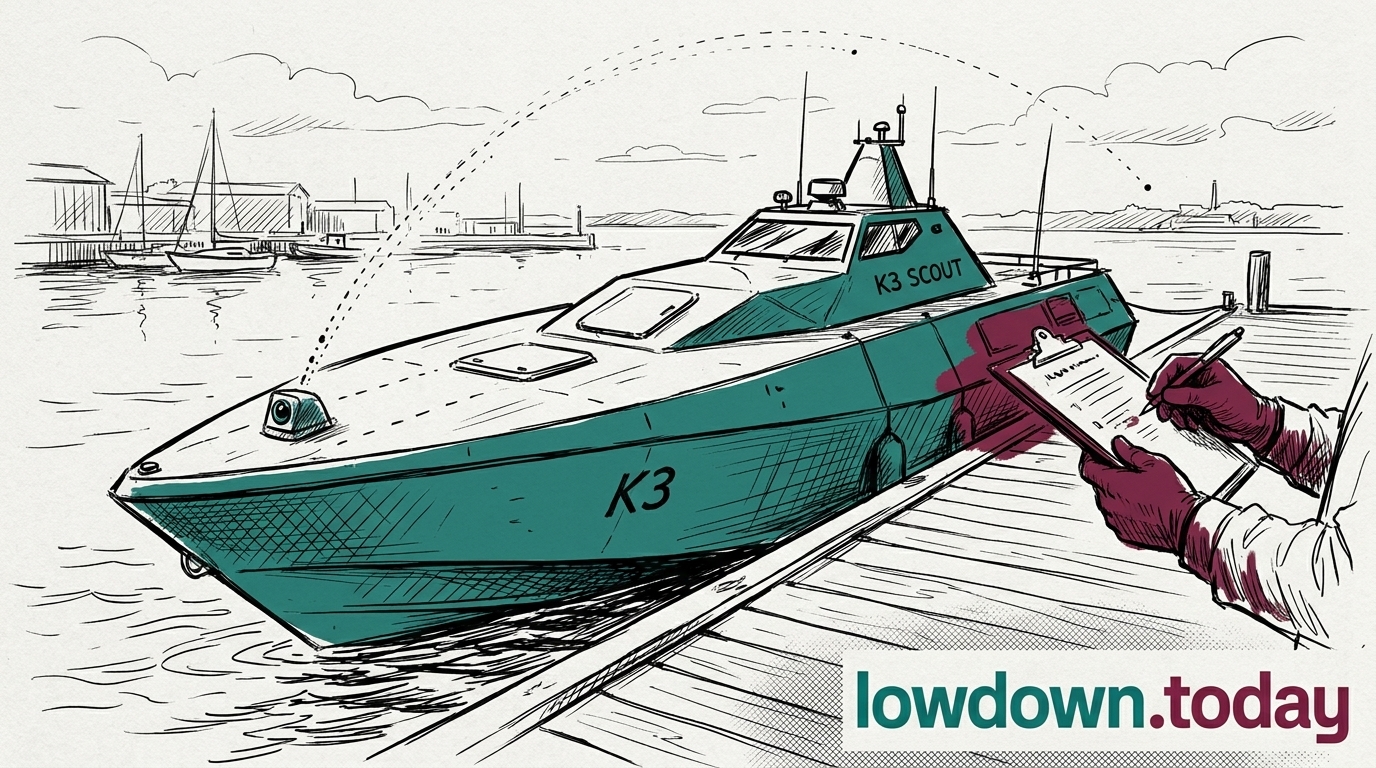
The Conservative opposition called on the Government on 9 August to 'urgently audit' equipment for hidden Chinese components, after the Telegraph's K3 SCOUT report. No named MP has been quoted on the record; the call came at party level, alongside the Ministry of Defence's own 10 August statement that no data had been compromised.
Netherlands Ministry of Defence
The Netherlands Ministry of Defence authorised Dutch Naval Design on 4 August to design 12-metre anti-submarine warfare uncrewed vessels for the Dutch-Belgian frigate programme, and to buy an adapted Compact FLASH dipping sonar from Thales Underwater Systems France. The order commits money and a named supplier while Britain's own certification body remains at the market-engagement stage.
Kraken Technology Group
Kraken Technology Group is a UK maritime-defence company based in Portsmouth that builds the K3 SCOUT, and crossed a $1bn valuation in July on a single-sourced $175m raise. The camera components reached the fleet under a third party's written security assurance, which the Platform Authority, which does not yet exist, was never positioned to check.
Navy Commercial
Navy Commercial
Navy Commercial at Whale Island published two notices on 5 August: 074032-2026, asking industry how to build a Platform Authority to certify uncrewed vessels, and 074351-2026, a GBP10m multi-role USV testbed for the Defence Chief Technology Officer. Responses on the Platform Authority close 19 August, ten days after the cameras were found transmitting to China.
Ministry of Defence
Ministry of Defence
The Ministry of Defence said on 10 August that a routine cyber vulnerability assessment found the camera fault, and a thorough investigation found no evidence that MoD data or systems had been accessed, compromised or transmitted externally. It stripped the cameras of internet connectivity but did not say whether it acted against the supplier.
Thales
Thales
Thales converted its 6 July engaging accord with Exail into a definitive combination agreement on 30-31 July, but the tender offer for Exail's remaining shares now closes by early 2028, later than July's timetable implied. Thales integrates its new undersea prime while still bidding against Kongsberg and DRASS's 2027 target for the AUKUS Pillar II contest.
