Skip to content
You can now search across every topic, entity and event.What's new
Autonomous Systems: Land & Sea
12AUG

30,000 attack drones at $5,000 each

3 min read
14:17UTC

Eleven companies split a $150 million Phase 1 order with five months to deliver. The long-term target: $2,000 per drone.

TechnologyDeveloping
Key takeaway

The Pentagon has formally reclassified attack drones as consumable munitions, not capital weapons systems.

Eleven companies received delivery orders from the Drone Dominance programme's $150 million Phase 1 allocation for 30,000 one-way attack drones at $5,000 per unit, programme manager Travis Metz confirmed 1. Delivery is required within five months. The Pentagon's lifetime target is $2,000 per drone.

The $5,000 unit cost breaks sharply from traditional munitions pricing. A Javelin anti-tank missile costs approximately $178,000; a Switchblade 600 loitering munition roughly $55,000. At $5,000, these drones are expendable by design — the economics favour saturating a target area over preserving individual platforms. The five-month delivery window tests production capacity and supply chain readiness as much as technical performance. Companies that can manufacture at rate will advance; those still scaling from prototype will not.

2 The structure mirrors commercial venture practice: broad initial bets, performance-based down-selection, and concentrated investment into proven suppliers. For the eleven Phase 1 winners, $150 million split across the field amounts to a qualifying round.

The harder test is whether any competitor can achieve the 60% cost reduction from $5,000 to $2,000 at the volumes the Pentagon ultimately requires. That trajectory demands manufacturing innovation — automated assembly, simplified componentry, design-for-production engineering — capabilities the traditional defence industrial base has been slow to develop. The companies best positioned may be those with commercial manufacturing DNA rather than defence contracting heritage.

Deep Analysis

In plain English

The US military has ordered 30,000 small attack drones roughly the way it would order ammunition — in bulk, at a fixed price, with a tight delivery deadline. Each drone costs $5,000 now, but the Pentagon wants the price to fall to $2,000, which is less than many commercial laptops. This is a significant doctrinal shift. Historically, military aircraft — even small ones — were expensive, maintained, and reused. The new model treats them as single-use weapons: fly once, hit a target, gone. Eleven different companies won orders deliberately — the Pentagon wants competition to drive costs down rather than locking in a single supplier with pricing power.

Deep Analysis
Synthesis

The $2,000 lifetime target implicitly benchmarks against Chinese commercial drone production economics — DJI and peers produce comparable airframes at sub-$500 cost. Achieving that target using only NDAA-compliant components, given the FCC Covered List restrictions, creates a structural contradiction at the programme's core: the cost goal requires supply chain approaches that current security policy prohibits.

Root Causes

Two structural drivers are absent from the body. The use of eleven competing suppliers rather than a sole-source award is a deliberate departure from traditional defence acquisition — DoD is using competitive pressure as the cost-reduction mechanism rather than negotiation. The five-month fulfilment window tests whether the US industrial base can operate at consumer-electronics production tempo, a capability the defence system has historically lacked.

Escalation

The programme's architecture — eleven competing suppliers, rising competition values through 2027, and a $2,000 long-run target — signals deliberate commoditisation rather than programme stability. Three further Gauntlets with increasing contract values imply DoD expects both volume growth and supplier consolidation, with Phase 4 likely dominated by two or three survivors who achieved the cost target.

What could happen next?
  • Meaning

    DoD has formally adopted attritional drone warfare doctrine, treating expendable UAS as the functional equivalent of artillery shells in peer conflict planning.

    Immediate · Assessed
  • Consequence

    US defence primes must restructure for high-volume, low-margin drone production or cede Phase 2–4 contracts to agile entrants who can achieve the $2,000 target.

    Short term · Assessed
  • Opportunity

    Contract manufacturers with automotive or consumer-electronics experience could enter the defence supply chain for drone airframes, where volume economics rather than security clearances are the primary competitive factor.

    Medium term · Suggested
  • Risk

    The five-month fulfilment window may expose capacity constraints in the US small-drone industrial base that only become visible under sustained production pressure.

    Short term · Assessed
First Reported In

Update #2 · UK startup tops Pentagon's drone gauntlet

Defense One· 19 Mar 2026
Read original
Causes and effects
This Event
30,000 attack drones at $5,000 each
The $150 million order for 30,000 expendable attack drones at $5,000 per unit establishes commodity-scale pricing and a competitive procurement model designed to drive unit costs to $2,000 through successive evaluation rounds.
Different Perspectives
Conservative opposition
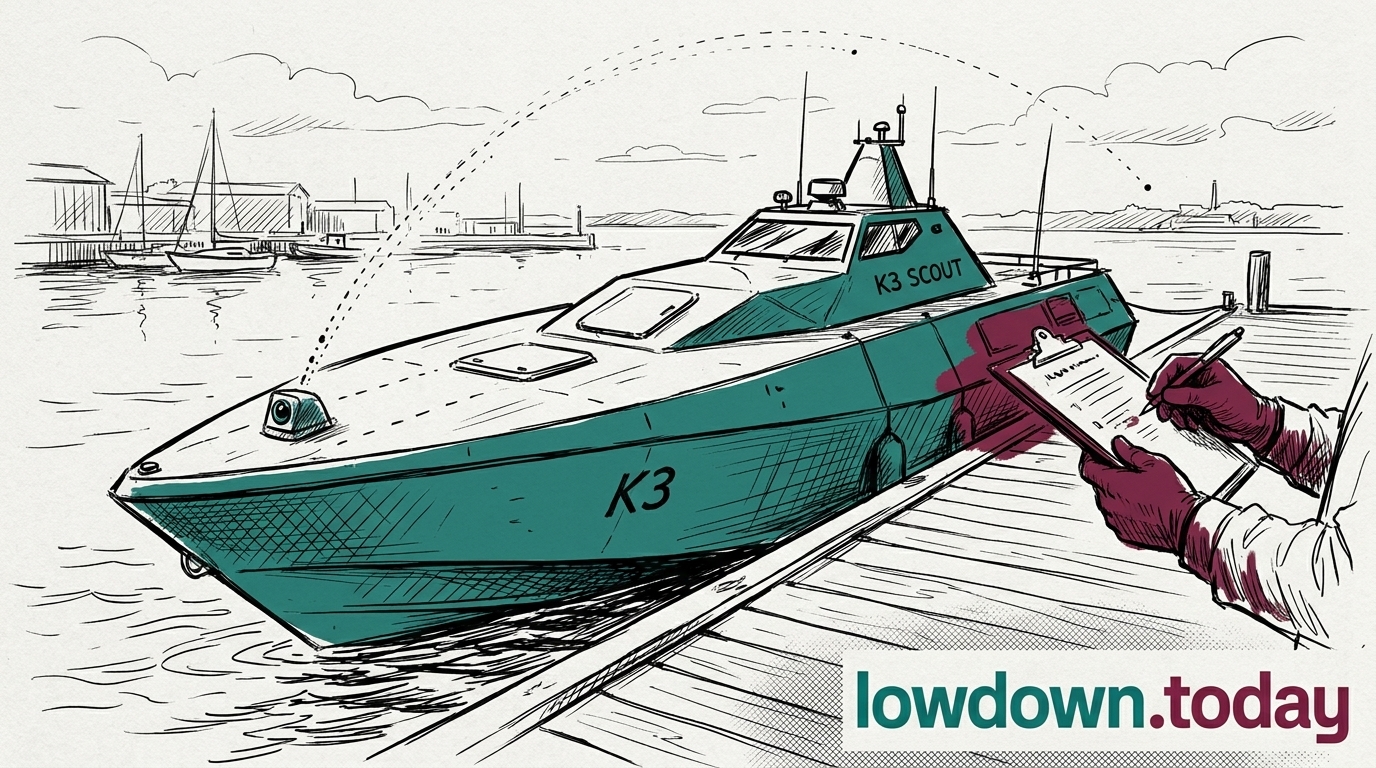
The Conservative opposition called on the Government on 9 August to 'urgently audit' equipment for hidden Chinese components, after the Telegraph's K3 SCOUT report. No named MP has been quoted on the record; the call came at party level, alongside the Ministry of Defence's own 10 August statement that no data had been compromised.
Netherlands Ministry of Defence
The Netherlands Ministry of Defence authorised Dutch Naval Design on 4 August to design 12-metre anti-submarine warfare uncrewed vessels for the Dutch-Belgian frigate programme, and to buy an adapted Compact FLASH dipping sonar from Thales Underwater Systems France. The order commits money and a named supplier while Britain's own certification body remains at the market-engagement stage.
Kraken Technology Group
Kraken Technology Group is a UK maritime-defence company based in Portsmouth that builds the K3 SCOUT, and crossed a $1bn valuation in July on a single-sourced $175m raise. The camera components reached the fleet under a third party's written security assurance, which the Platform Authority, which does not yet exist, was never positioned to check.
Navy Commercial
Navy Commercial
Navy Commercial at Whale Island published two notices on 5 August: 074032-2026, asking industry how to build a Platform Authority to certify uncrewed vessels, and 074351-2026, a GBP10m multi-role USV testbed for the Defence Chief Technology Officer. Responses on the Platform Authority close 19 August, ten days after the cameras were found transmitting to China.
Ministry of Defence
Ministry of Defence
The Ministry of Defence said on 10 August that a routine cyber vulnerability assessment found the camera fault, and a thorough investigation found no evidence that MoD data or systems had been accessed, compromised or transmitted externally. It stripped the cameras of internet connectivity but did not say whether it acted against the supplier.
Thales
Thales
Thales converted its 6 July engaging accord with Exail into a definitive combination agreement on 30-31 July, but the tender offer for Exail's remaining shares now closes by early 2028, later than July's timetable implied. Thales integrates its new undersea prime while still bidding against Kongsberg and DRASS's 2027 target for the AUKUS Pillar II contest.
