Skip to content
You can now search across every topic, entity and event.What's new
Autonomous Systems: Land & Sea
12AUG

ASIC opens DroneShield probe before 29 May AGM

3 min read
14:17UTC

The Australian Securities and Investments Commission has opened an investigation into DroneShield's November 2025 market announcements and the share sales by its departing founder-CEO and chairman, eight days before shareholders vote on the new CEO's pay and the new chairman's ratification.

TechnologyDeveloping
Key takeaway

DroneShield's institutional reset AGM is now a confidence vote held under an active ASIC investigation.

DroneShield faces its 29 May annual general meeting in Sydney with a fresh Australian Securities and Investments Commission (ASIC) investigation hanging over the board. ASIC is examining DroneShield's November 2025 market announcements, including a now-corrected US government contract package, and the share sales by departing founder-CEO Oleg Vornik and former chairman Peter James in the same period 1. The 10am AEST meeting will also vote on Angus Bean's long-term incentive package of 290,375 Performance Options and on Hamish McLennan's formal ratification as chairman 2.

The probe is what is new since Update #8 set the watch. It links the founder double-exit to a regulator-led inquiry into the same announcements that the market priced at minus 20 per cent on 8 April, and it reframes McLennan's chairmanship as ratification under an active investigation rather than the clean institutional reset the Q1 numbers had implied. DroneShield's Q1 2026 Appendix 4C, filed on 22 April, reported A$74 million in quarterly revenue, A$24 million in operating cash inflow and A$154.8 million in committed FY2026 revenue . The operating engine is strengthening at the same time the disclosure architecture is under regulator review.

Bean's LTI vote becomes, in effect, a referendum on board confidence in the post-Vornik administration: proxy advisers ISS and Glass Lewis will issue their recommendations against the ASIC overhang, not against a quiet quarterly result. The structural test is whether the C-UAS category has matured into enterprise-procurement-grade governance or remains founder-led relationship management with audit-committee discipline bolted on later. The Amsterdam expansion and the Q1 revenue cadence show the engine institutionalising; the ASIC probe shows the disclosure architecture has not yet caught up.

Deep Analysis

In plain English

DroneShield is an Australian company listed on the ASX (Australian Stock Exchange) that makes equipment to detect and jam rogue drones. It has grown rapidly on the back of military contracts, especially from the US. In November 2025, DroneShield announced some US government contracts, then had to correct those announcements. Australia's financial regulator, ASIC (the Australian Securities and Investments Commission), is now investigating whether those announcements misled investors, and whether the company's founders sold shares while knowing the announcement might need correcting. In eight days, shareholders will vote on the new chief executive's pay package and on whether to formally ratify the new chairman. The investigation hangs over both votes.

Deep Analysis
Root Causes

ASIC's investigation traces to a specific structural vulnerability in DroneShield's disclosure architecture: the company's revenue recognition for US government contracts depends on milestone-based announcements, and any gap between internal knowledge of a contract revision and the ASX announcement timing creates potential continuous-disclosure exposure.

The corrected November 2025 package suggests a revision occurred between the announcement and the public correction, and it is that gap that ASIC is examining.

The founder double-exit accelerated the timeline. Vornik and James departed on 8 April, which means any ASIC inquiry into November 2025 announcements could extend to whether the founders had knowledge of the ASIC review that was not disclosed to the market prior to their departure and share sales. The question extends beyond whether the contract announcement was accurate: ASIC is also examining whether the departure timing was informed by awareness of the regulatory inquiry.

What could happen next?
  • Risk

    If ISS or Glass Lewis issue supplemental proxy recommendations against Bean's LTI or McLennan's ratification, a failed AGM vote would force DroneShield to reconvene governance processes during an active ASIC investigation, extending institutional uncertainty through Q3 2026.

    Short term · Assessed
  • Meaning

    ASIC's focus on the announcement-plus-share-sale timing, rather than on product performance, signals the investigation is a disclosure-governance matter rather than a fraud case; the distinction matters for DroneShield's US customer relationships.

    Short term · Assessed
  • Precedent

    A resolution clearing DroneShield would establish that a defence-tech company can sustain an ASIC investigation, a founder double-exit, and a governance transition simultaneously without losing its institutional revenue base, a precedent relevant to every other ASX-listed drone company facing similar governance pressure.

    Medium term · Suggested
First Reported In

Update #9 · Schmidt's Perennial wins $500M drone deal

DroneShield ASX disclosure· 21 May 2026
Read original
Causes and effects
This Event
ASIC opens DroneShield probe before 29 May AGM
A regulator-led inquiry under McLennan's incoming chairmanship turns the post-Vornik institutional reset into a confidence vote held under active investigation.
Different Perspectives
Conservative opposition
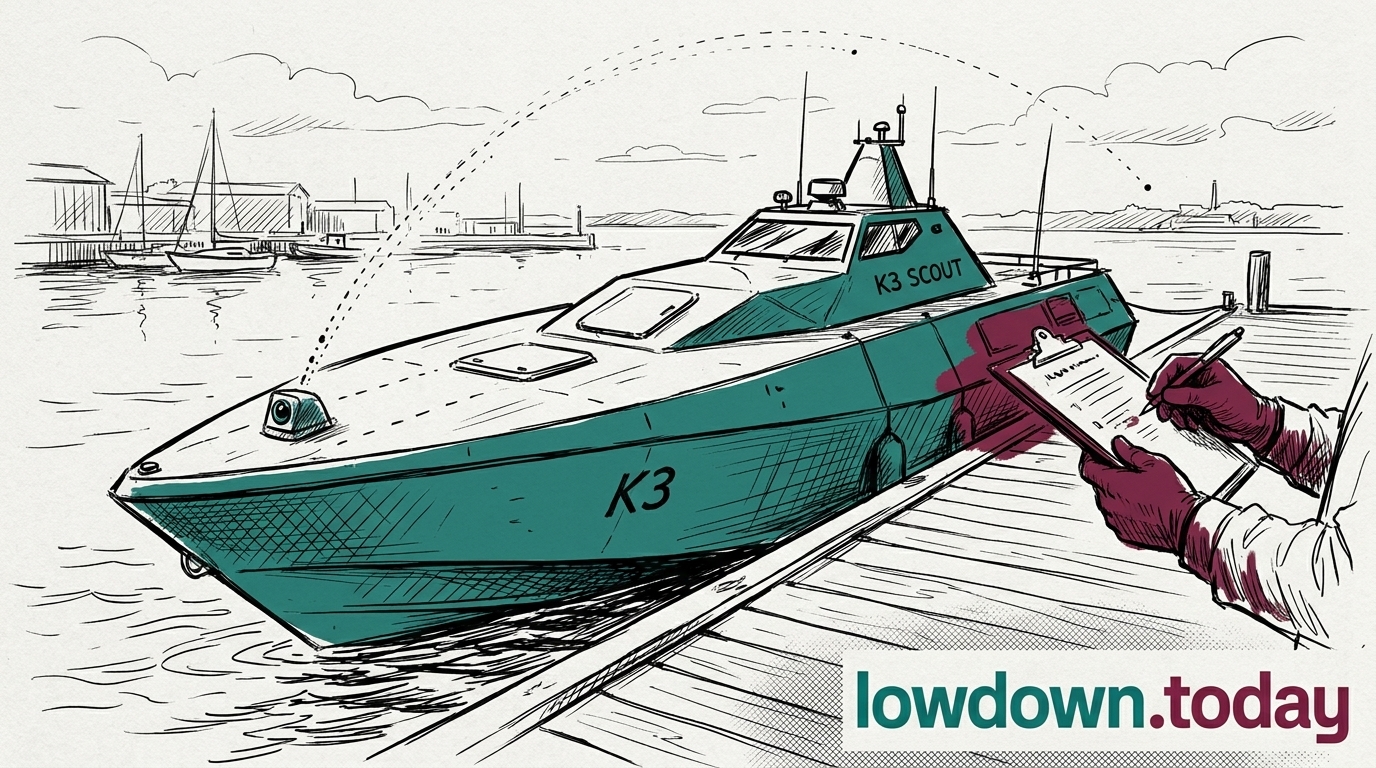
The Conservative opposition called on the Government on 9 August to 'urgently audit' equipment for hidden Chinese components, after the Telegraph's K3 SCOUT report. No named MP has been quoted on the record; the call came at party level, alongside the Ministry of Defence's own 10 August statement that no data had been compromised.
Netherlands Ministry of Defence
The Netherlands Ministry of Defence authorised Dutch Naval Design on 4 August to design 12-metre anti-submarine warfare uncrewed vessels for the Dutch-Belgian frigate programme, and to buy an adapted Compact FLASH dipping sonar from Thales Underwater Systems France. The order commits money and a named supplier while Britain's own certification body remains at the market-engagement stage.
Kraken Technology Group
Kraken Technology Group is a UK maritime-defence company based in Portsmouth that builds the K3 SCOUT, and crossed a $1bn valuation in July on a single-sourced $175m raise. The camera components reached the fleet under a third party's written security assurance, which the Platform Authority, which does not yet exist, was never positioned to check.
Navy Commercial
Navy Commercial
Navy Commercial at Whale Island published two notices on 5 August: 074032-2026, asking industry how to build a Platform Authority to certify uncrewed vessels, and 074351-2026, a GBP10m multi-role USV testbed for the Defence Chief Technology Officer. Responses on the Platform Authority close 19 August, ten days after the cameras were found transmitting to China.
Ministry of Defence
Ministry of Defence
The Ministry of Defence said on 10 August that a routine cyber vulnerability assessment found the camera fault, and a thorough investigation found no evidence that MoD data or systems had been accessed, compromised or transmitted externally. It stripped the cameras of internet connectivity but did not say whether it acted against the supplier.
Thales
Thales
Thales converted its 6 July engaging accord with Exail into a definitive combination agreement on 30-31 July, but the tender offer for Exail's remaining shares now closes by early 2028, later than July's timetable implied. Thales integrates its new undersea prime while still bidding against Kongsberg and DRASS's 2027 target for the AUKUS Pillar II contest.
