Skip to content
You can now search across every topic, entity and event.What's new
Autonomous Systems: Land & Sea
12AUG

DroneShield sensor joins US kill chain

3 min read
14:17UTC

Parsons confirmed on 10 June that its DroneArmor system folds DroneShield's electronic-warfare sensor into a single AI-driven kill chain now running at a US security agency's southern border.

TechnologyDeveloping
Key takeaway

DroneShield is wiring into a US prime's recurring pipeline while a shareholder revolt and regulator's probe persist.

Parsons Corporation (NYSE: PSN), a US defence and engineering prime, confirmed on 10 June that its DroneArmor command-and-control system folds DroneShield's electronic-warfare (EW) sensor, alongside HurleyIR electro-optical kit and commercial radars, into a single AI-driven kill chain now deployed at a US security agency's southern border 1. DroneShield is the Australian counter-drone firm whose detection and jamming gear armies and police forces already buy; a kill chain is the loop that spots a hostile drone, decides, and defeats it. The sensor's new position inside Parsons's system carries the significance here.

DroneShield has sold its hardware directly before. Here its sensor sits as a sub-component inside a prime contractor's integrated system at an active US site, and that placement changes the revenue shape. Once a sensor is certified into a fielded command architecture, swapping it out carries integration cost and re-certification risk, so the customer tends not to. That stickiness is the mechanism by which a component supplier earns recurring defence income rather than episodic sales, and it is the standard US value chain a direct-sale vendor cannot reach from outside.

The timing cuts against the company's governance. DroneShield's 29 May annual meeting drew a first strike, with 50.51% voting against the remuneration report , and an Australian regulator's probe into November 2025 share sales remains open . Strengthening commercial fundamentals and an unsettled boardroom are now running in parallel: the firm is wiring itself into a US prime's procurement pipeline at the same moment its own shareholders and a regulator are questioning how it is run. Buyers of integrated systems weigh supplier stability, so the governance overhang is not cosmetic; it sits beside the very contract momentum the integration creates.

Deep Analysis

In plain English

Parsons is a large US engineering company that built a drone-detection and defeat system called DroneArmor. It needed a sensor that could spot and jam hostile drones using electronic signals. It chose a sensor made by DroneShield, an Australian company, and put it inside its system. Parsons deployed DroneArmor, with DroneShield's sensor inside it, at a US government border security site in June 2026. This matters for DroneShield because, once your hardware is built into someone else's bigger system that is already deployed, it is expensive and time-consuming for the buyer to swap it out. DroneShield goes from making one-off sales to earning steady income as long as Parsons keeps its contract with the US government.

Deep Analysis
Root Causes

DroneShield's component-supplier position in DroneArmor reflects two structural features of the US defence sensor market.

First, US primes do not typically build EW sensor hardware in-house. Electronic warfare detection and jamming requires deep signal-processing expertise that sits in specialist firms. Parsons is an engineering and programme-management prime, not a sensor manufacturer.

It required an external EW sub-component and selected DroneShield's hardware, most likely on the basis of its existing deployments with US law enforcement and the border security community governance context aside. That gap in prime-contractor capability is the opening DroneShield exploited.

Second, the US southern border has been a pilot site for C-UAS (counter-unmanned-aircraft-system) technology since 2019, when CBP (Customs and Border Protection) began operating DroneShield equipment at several crossings. Parsons built DroneArmor to integrate that existing sensor heritage into a more capable AI-driven command architecture. DroneShield's inclusion is partly a legacy of its early border-market positioning, not solely a result of competitive selection in 2026.

What could happen next?
  • Consequence

    DroneShield's sensor embedding inside Parsons DroneArmor at an active US government site generates 6-9 years of structurally durable recurring revenue if Parsons retains the prime contract, reducing DroneShield's dependence on episodic one-off hardware sales that previously made its revenue lumpy.

    Medium term · Reported
  • Risk

    DroneShield's governance overhang, the open ASIC probe into November 2025 insider sales and the 50.51% first-strike AGM vote, may cause Parsons or its US government client to conduct heightened supplier-stability reviews at the next annual contract renewal, a risk not present in a direct government sale.

    Short term · Assessed
  • Opportunity

    If DroneShield replicates the L3Harris WESCAM model, it can convert sub-component status in DroneArmor into direct-sale agreements with US Customs and Border Protection for follow-on sensor deployments that bypass Parsons entirely, capturing the full margin rather than the sub-contractor share.

    Long term · Suggested
First Reported In

Update #12 · Pentagon's drone buy lands a third short

Parsons Corporation· 15 Jun 2026
Read original
Different Perspectives
Conservative opposition
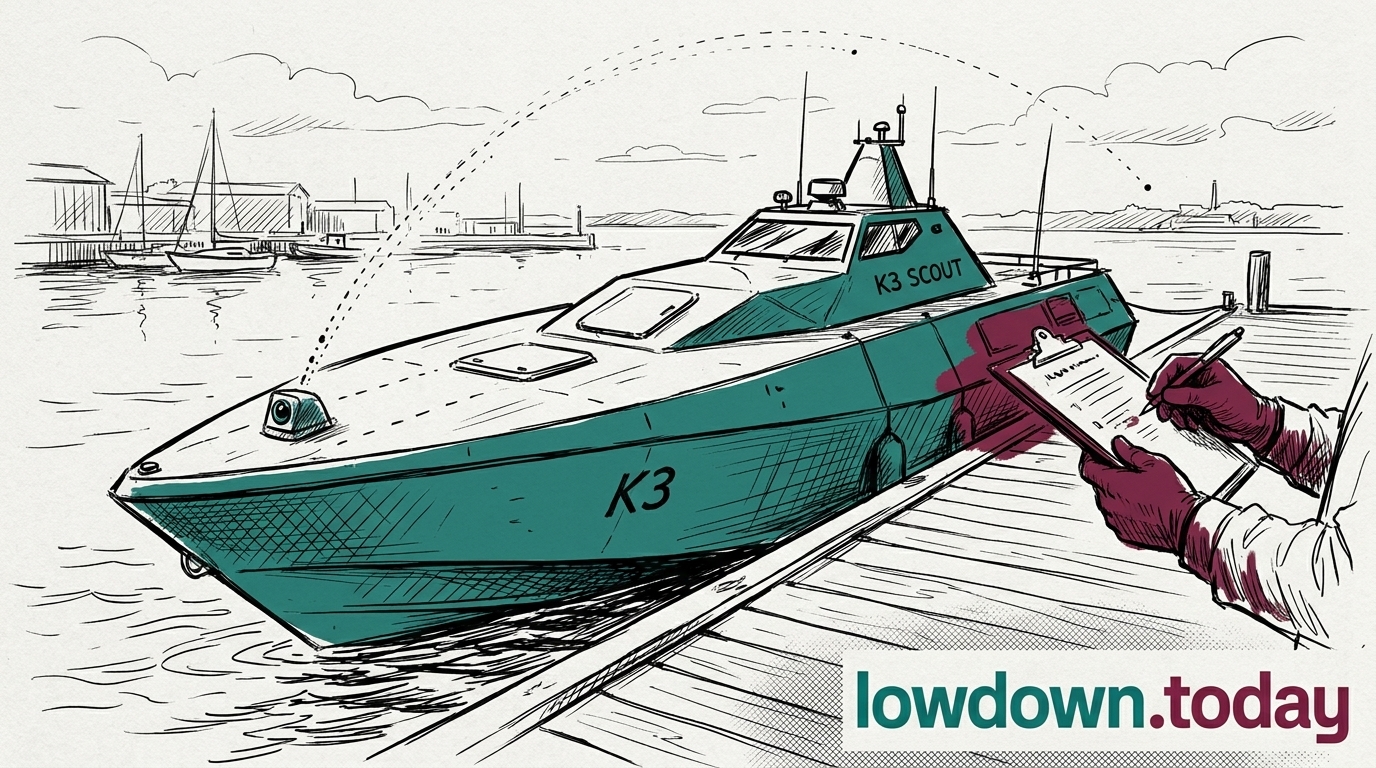
The Conservative opposition called on the Government on 9 August to 'urgently audit' equipment for hidden Chinese components, after the Telegraph's K3 SCOUT report. No named MP has been quoted on the record; the call came at party level, alongside the Ministry of Defence's own 10 August statement that no data had been compromised.
Netherlands Ministry of Defence
The Netherlands Ministry of Defence authorised Dutch Naval Design on 4 August to design 12-metre anti-submarine warfare uncrewed vessels for the Dutch-Belgian frigate programme, and to buy an adapted Compact FLASH dipping sonar from Thales Underwater Systems France. The order commits money and a named supplier while Britain's own certification body remains at the market-engagement stage.
Kraken Technology Group
Kraken Technology Group is a UK maritime-defence company based in Portsmouth that builds the K3 SCOUT, and crossed a $1bn valuation in July on a single-sourced $175m raise. The camera components reached the fleet under a third party's written security assurance, which the Platform Authority, which does not yet exist, was never positioned to check.
Navy Commercial
Navy Commercial
Navy Commercial at Whale Island published two notices on 5 August: 074032-2026, asking industry how to build a Platform Authority to certify uncrewed vessels, and 074351-2026, a GBP10m multi-role USV testbed for the Defence Chief Technology Officer. Responses on the Platform Authority close 19 August, ten days after the cameras were found transmitting to China.
Ministry of Defence
Ministry of Defence
The Ministry of Defence said on 10 August that a routine cyber vulnerability assessment found the camera fault, and a thorough investigation found no evidence that MoD data or systems had been accessed, compromised or transmitted externally. It stripped the cameras of internet connectivity but did not say whether it acted against the supplier.
Thales
Thales
Thales converted its 6 July engaging accord with Exail into a definitive combination agreement on 30-31 July, but the tender offer for Exail's remaining shares now closes by early 2028, later than July's timetable implied. Thales integrates its new undersea prime while still bidding against Kongsberg and DRASS's 2027 target for the AUKUS Pillar II contest.
