Skip to content
You can now search across every topic, entity and event.What's new
Autonomous Systems: Land & Sea
12AUG

DroneShield loses founding CEO and chairman on same day

3 min read
14:17UTC

Oleg Vornik and Peter James both departed 8 April; the stock fell 20% and Angus Bean steps up as incoming chief executive.

TechnologyDeveloping
Key takeaway

DroneShield's 29 May AGM will test whether this is a founder story or institutional.

DroneShield founding chief executive Oleg Vornik and Chairman Peter James both departed on 8 April, with the stock falling 20% on the day. Angus Bean, chief product officer since 2016, takes the CEO seat; Hamish McLennan is named incoming chairman pending the AGM on 29 May. The dual nature of the departure, rather than the fact of the CEO change alone, was what the market priced.

Context matters here. DroneShield opened its Amsterdam European headquarters on 30 March to position for EU counter-drone growth, building on a strong FY2025 revenue run that had established the firm as a credible scale story. A founding-team exit during that expansion phase introduces governance-continuity risk on both sides of the Atlantic-to-EU bridge the company had been building.

Bean brings a decade of internal product-leadership continuity, which tempers the discontinuity argument. The Q1 pipeline disclosure covered in the next event suggests the revenue engine is more institutionalised than any single executive relationship. McLennan's chairmanship, subject to AGM endorsement, will signal whether the board wants continuity or a break from the founder era.

Across the whole C-UAS sector, the DroneShield board has now posed the question of whether the category is maturing into enterprise procurement logic or remains dependent on founder-led relationship management. The next two quarterly reports, the AGM on 29 May, and the pace of European order conversion from the Amsterdam base will answer that. A 20% single-day fall is a severe first verdict, but it is a verdict on perceived risk, not on realised performance.

Deep Analysis

In plain English

DroneShield is an Australian company that makes systems to detect and destroy hostile drones. It is listed on the Australian stock exchange, meaning ordinary investors can buy shares in it. On 8 April, the company's founder and chief executive Oleg Vornik left, along with the chairman Peter James. Both at the same time. The share price dropped 20% on the day, which reflects investors pricing in the risk that a company built on the founder's relationships might struggle without him. Angus Bean, who has worked at the company for ten years in the product team, is taking over as chief executive. The question markets are asking is whether DroneShield's 88% Q1 revenue growth reflects Vornik personally, or whether demand for counter-drone systems runs independently of who leads the company.

Deep Analysis
Root Causes

The simultaneous nature of Vornik and James's departure suggests the proximate cause was a board-level governance event rather than individual resignation. DroneShield's rapid scaling from a boutique electronic-warfare supplier to a $2.4 billion production-capacity firm created structural pressure: the governance model that worked at $50 million annual revenue, a founder-led, relationship-intensive model, requires formalisation at $400 million run-rate.

Vornik's public communications style, which included social media posts during active contract periods that periodically moved the stock, was flagged in at least two analyst notes as a disclosure-risk factor for an ASX-listed firm. A board managing European institutional investors alongside Australian retail shareholders may have judged that governance normalisation at this revenue scale required a transition rather than a reform.

What could happen next?
  • Risk

    European defence ministry relationships built by Vornik personally over three years may require renegotiation or reaffirmation under Bean's leadership, with a short-term risk of pipeline slippage in Q2 EU deals.

    Short term · 0.65
  • Consequence

    McLennan's chairmanship, subject to AGM endorsement on 29 May, will define whether DroneShield pursues an institutional governance model or retains elements of the founder-led culture.

    Short term · 0.8
  • Opportunity

    A governance-normalised DroneShield with institutional disclosure practices becomes a more attractive acquisition target for a tier-one defence prime seeking listed C-UAS revenue with proven operational credentials.

    Medium term · 0.55
First Reported In

Update #6 · Britain's £752M Ukraine drone package

Primary Ignition· 18 Apr 2026
Read original
Causes and effects
This Event
DroneShield loses founding CEO and chairman on same day
DroneShield is one of the few listed pure-play counter-drone companies with a multinational order book, and the simultaneous departure of founding CEO and chairman breaks the continuity story investors had been underwriting. For the drone-industry beat this event tests whether counter-drone valuations rest on founder relationships or on institutional pipeline. With a 20% single-day fall, the market's first vote was on relationships. The AGM on 29 May, the incoming team's execution, and the Amsterdam expansion {{EVREF:/t/drones-industry-defence/4/droneshield-opens-amsterdam-hq-eyes-eu-market/}} will supply the second.
Different Perspectives
Conservative opposition
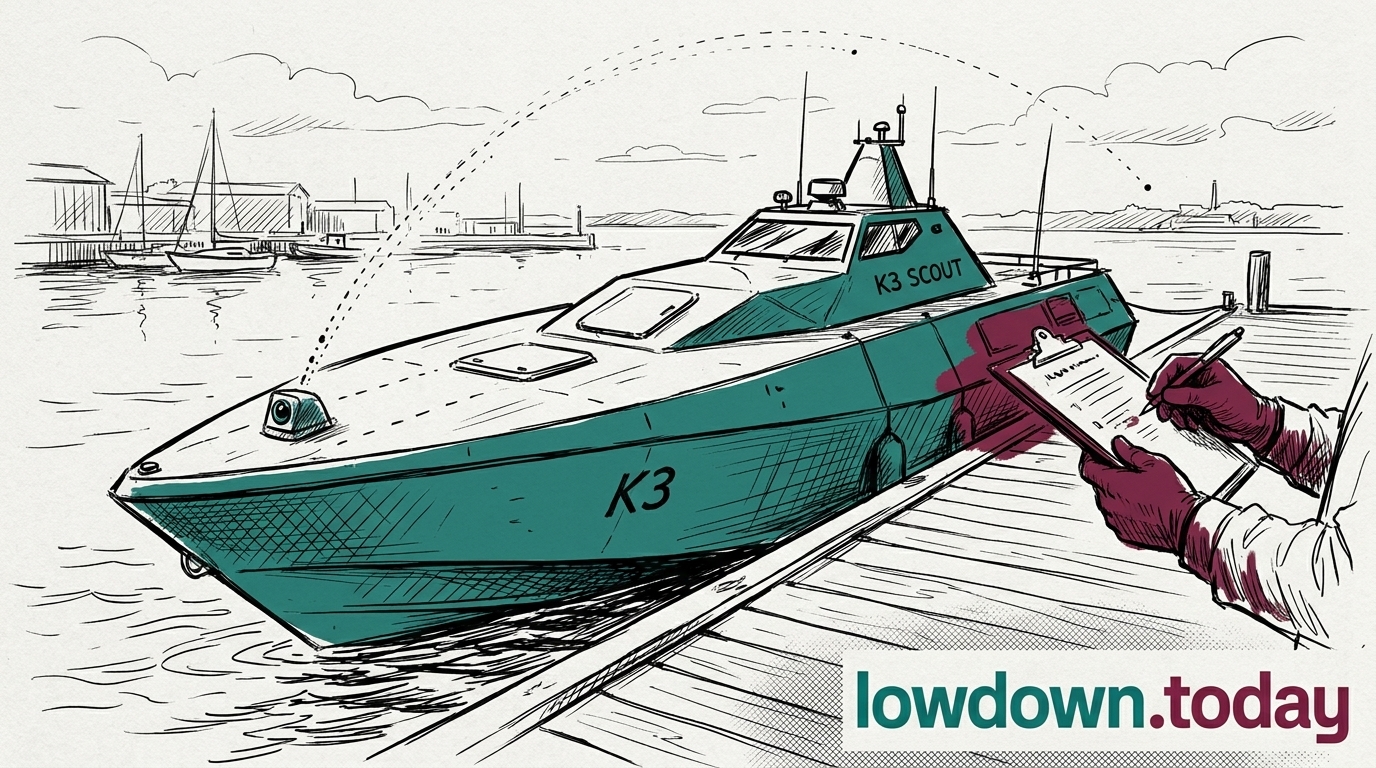
The Conservative opposition called on the Government on 9 August to 'urgently audit' equipment for hidden Chinese components, after the Telegraph's K3 SCOUT report. No named MP has been quoted on the record; the call came at party level, alongside the Ministry of Defence's own 10 August statement that no data had been compromised.
Netherlands Ministry of Defence
The Netherlands Ministry of Defence authorised Dutch Naval Design on 4 August to design 12-metre anti-submarine warfare uncrewed vessels for the Dutch-Belgian frigate programme, and to buy an adapted Compact FLASH dipping sonar from Thales Underwater Systems France. The order commits money and a named supplier while Britain's own certification body remains at the market-engagement stage.
Kraken Technology Group
Kraken Technology Group is a UK maritime-defence company based in Portsmouth that builds the K3 SCOUT, and crossed a $1bn valuation in July on a single-sourced $175m raise. The camera components reached the fleet under a third party's written security assurance, which the Platform Authority, which does not yet exist, was never positioned to check.
Navy Commercial
Navy Commercial
Navy Commercial at Whale Island published two notices on 5 August: 074032-2026, asking industry how to build a Platform Authority to certify uncrewed vessels, and 074351-2026, a GBP10m multi-role USV testbed for the Defence Chief Technology Officer. Responses on the Platform Authority close 19 August, ten days after the cameras were found transmitting to China.
Ministry of Defence
Ministry of Defence
The Ministry of Defence said on 10 August that a routine cyber vulnerability assessment found the camera fault, and a thorough investigation found no evidence that MoD data or systems had been accessed, compromised or transmitted externally. It stripped the cameras of internet connectivity but did not say whether it acted against the supplier.
Thales
Thales
Thales converted its 6 July engaging accord with Exail into a definitive combination agreement on 30-31 July, but the tender offer for Exail's remaining shares now closes by early 2028, later than July's timetable implied. Thales integrates its new undersea prime while still bidding against Kongsberg and DRASS's 2027 target for the AUKUS Pillar II contest.
