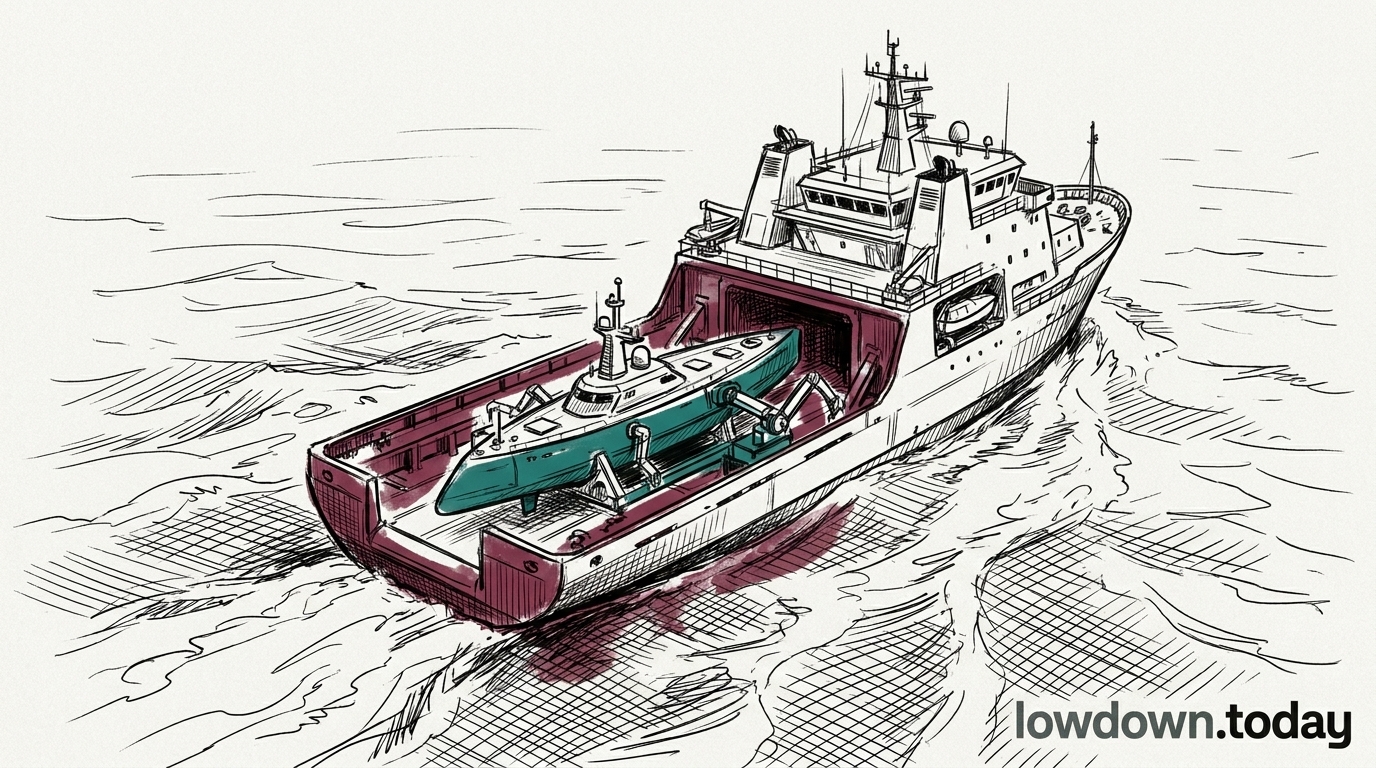
The US Navy operated the Iver3 autonomous underwater vehicle (AUV) off Liepaja, Latvia between 8 and 10 June, the first time in BALTOPS's 55-year history that uncrewed undersea systems ran as a core capability and not an experiment1. BALTOPS is NATO's annual Baltic Sea exercise; this year it drew 15 nations across 4 to 19 June. The Iver3 mapped the seabed, hunted mines and ran electronic surveillance over a Baltic floor laced with the cables and pipelines that have been cut and dragged repeatedly since 2022.
NATO also drilled the harder half of the problem: stopping a hostile robot. Crews tested counter-AUV measures and ran a multinational detect-to-remediate chain, with Netherlands explosive-ordnance-disposal (EOD) teams and Latvian personnel working behind the vehicle that made each detection2. The same shift showed up a week earlier, when NATO sent uncrewed systems to watch the Greenland-Iceland-UK (GIUK) gap. In a single fortnight, seabed defence moved from a doctrine paper to a rehearsed core task across two exercises.
For suppliers, the detect-to-remediate chain carries the procurement signal. NATO is no longer shopping for a single clever sensor; it is buying a networked pipeline that runs from detection through to an EOD response. That favours firms able to integrate across the chain over those selling one vehicle, and it turns a rehearsed workflow into a procurement specification others must now build to.


