Skip to content
You can now search across every topic, entity and event.What's new
AI: Jobs, Power & Money
23APR

Meta codes its own org chart

3 min read
14:51UTC

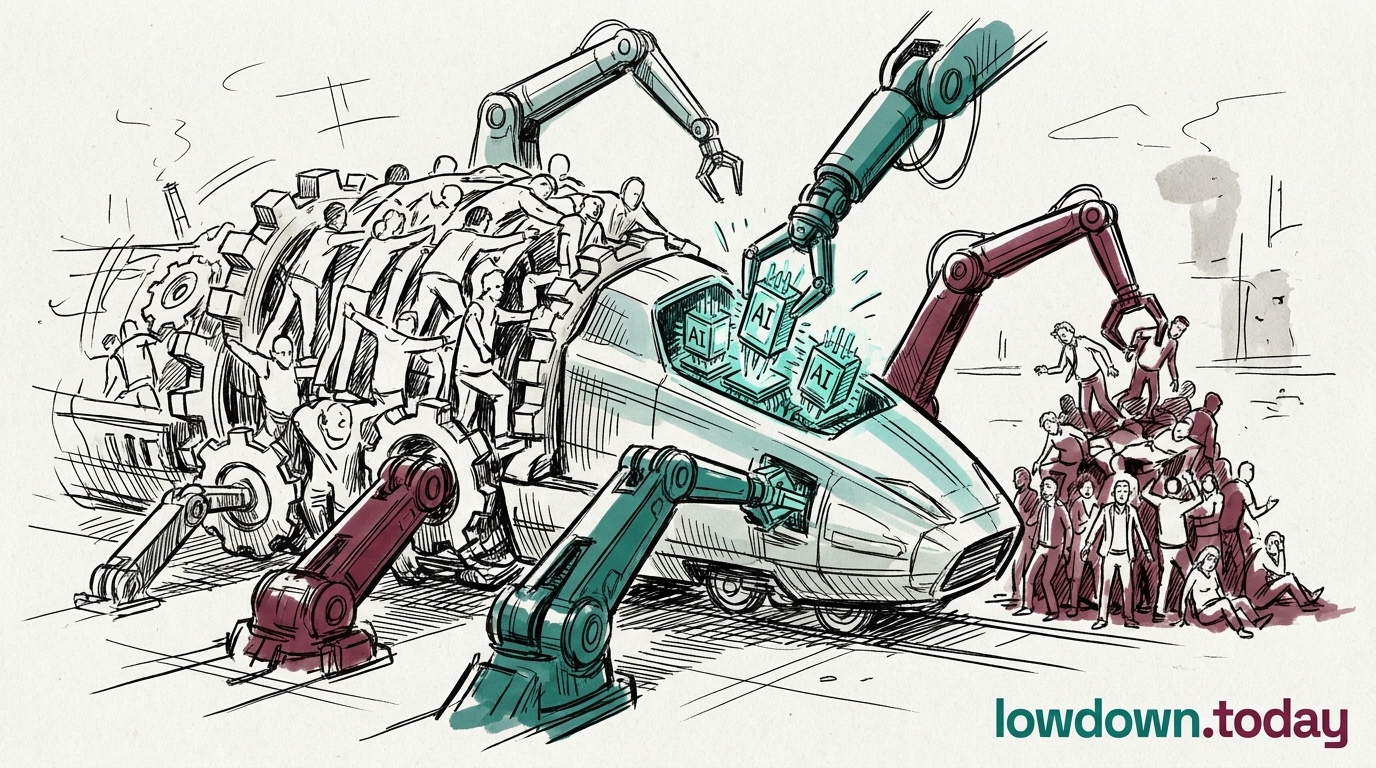
Meta will cut 8,000 engineers from 20 May and redesign itself around new roles called AI builder, AI pod lead and AI org lead, per an internal memo dated 14 April from Maher Saba. IBM's consulting miss and Wipro's zero fresher target point the same way: the displacement debate has moved from cost-cutting to corporate morphology. Hollywood begins negotiating the counter-draft on 27 April.

Key takeaway

Capital is writing the new org chart; labour meets 27 April to write the counter-draft.

This briefing mapped
Loading map…
Economic
Competitive
Domestic
Regulatory

An internal memo from Meta's head of Applied AI Engineering redesigns the company around three new titles, and removes 8,000 engineers to make room.

Sources profile:This story draws on mixed-leaning sources from United Kingdom
United Kingdom
LeftRight

Meta will cut around 8,000 engineers, about 10% of its engineering workforce, starting 20 May. An internal memo from Maher Saba scraps traditional titles in favour of three new ones: AI builder, AI pod lead, and AI org lead.

Meta earned $201 billion last year and is spending up to $135 billion on AI infrastructure in 2026, cutting from strength rather than stress. 

IBM reported Q1 2026 revenue above consensus, and the stock fell as much as 8% after hours on a $10m consulting shortfall.

Sources profile:This story draws on neutral-leaning sources

IBM beat Wall Street's Q1 2026 revenue target, reporting $15.92 billion against a $15.62 billion estimate, but shares fell 6 to 8% after hours. Investors focused on consulting revenue of $5.27 billion, a $10 million miss, and treated it as a structural warning.

IBM's own AI coding tool makes its engineers faster, which means clients need to buy fewer IBM hours per project. The consulting shortfall is the first earnings-cycle evidence that the market was pricing that mechanism correctly. 

On the same 22 April call, IBM disclosed its internal coding tool delivered 45% developer productivity and $4.5bn in savings since 2023, with GenAI now 30% of consulting backlog.

Sources profile:This story draws on neutral-leaning sources

Snap told staff on 15 April it would cut around 1,000 people, about 16% of its workforce, close more than 300 open roles, and target over $500 million in savings by H2 2026. The stock rose 6 to 9%.

The Information reported the underlying reason: AI now generates more than 65% of new code at Snap. Cutting 16% of headcount against a codebase where two-thirds of new lines are machine-written is the direct result of a throughput shift already absorbed. 

Sources:Snap Inc.

Wipro's chief HR officer told reporters on 17 April the Indian IT services firm has no fresher hiring target for the year starting 1 April, after 7,500 fresher hires the prior year.

Sources profile:This story draws on centre-leaning sources from India
India
LeftRight

Wipro, one of India's four largest tech services firms, has set its graduate hiring target for the financial year starting April 2026 at zero, down from 7,500 the previous year. Total headcount barely moved, rising by just 135 to 242,156.

India trains around 1.5 million engineers a year expecting to enter firms like Wipro. Combined headcount across India's Big-4 IT services firms has fallen by more than 42,000 over two years without a single mass-layoff event visible in Western datasets. 

Snap told staff on 15 April it would cut 1,000 jobs and close over 300 open roles, with external reporting that AI now generates more than 65% of new code.

Sources profile:This story draws on neutral-leaning sources

IBM disclosed on its 22 April earnings call that watsonx Code Assistant, known internally as Bob, delivers an average 45% productivity gain and has saved $4.5 billion since 2023, with $1 billion more expected in 2026. Generative AI now accounts for 30% of IBM's consulting backlog.

A tool that makes engineers 45% faster also reduces the billable hours clients need to buy, eroding the revenue base the productivity was supposed to expand. 

On 15 April, UKG notified 950 staff their roles were gone, framed as 'transformation toward AI-led operations', bringing the two-year total to roughly 20% of the workforce.

Sources profile:This story draws on neutral-leaning sources

UKG, the Blackstone-backed workforce-management software firm, cut 950 staff on 15 April, around 6% of its workforce. Six hundred left immediately; 350 will stay through 31 August for handover. CEO Jennifer Morgan called it a shift toward AI-led operations.

Combined with 2,200 cuts in 2024, UKG has shed roughly one in five employees in under two years, restructuring on the same AI-productivity logic it sells to its own customers. 

Sources:HR Executive

Chief negotiator Duncan Crabtree-Ireland told outlets 'airtight AI protections' are a precondition for any longer-term deal; the union resumes talks with studios on 27 April.

Sources profile:This story draws on neutral-leaning sources

SAG-AFTRA, the US union representing around 160,000 screen performers, will resume contract talks with Hollywood studios on 27 April. Chief negotiator Duncan Crabtree-Ireland has said airtight AI protections are a precondition for any longer-term deal.

The central demand is the Tilly Tax: a royalty studios would pay each time an AI-generated performer replaces a human actor, triggered per use rather than paid once as a flat licence fee. 

The Writers Guild reached a four-year tentative deal with studios on 4 April that resolved a $122m health fund shortfall with a record $321m contribution, while leaving AI training payment on the table.

The Writers Guild of America reached a tentative four-year deal with Hollywood studios on 4 April. Studios will put $321 million into the writers' health fund, resolving a $122 million shortfall, and streaming residuals improved.

On AI, studios agreed to notify the WGA when licensing writers' work for AI training, but refused to pay for it. The demand that writers share in the value their work generates as training data was left unresolved. 

Sources:Variety

As of 23 April, the Bureau of Labor Statistics has not rescheduled its 14 April GenAI workplace paper, leaving the New York Fed's household survey as the de facto federal measure.

Sources profile:This story draws on neutral-leaning sources

The Bureau of Labor Statistics was due to publish a paper on generative AI and the workforce on 14 April. It did not appear, and nine days later the agency still offered no public explanation.

With no federal figure available, the New York Fed's consumer survey, which found 62% of employed Americans expect AI to raise unemployment within 12 months, has become the de facto government measure of AI workplace impact. 

Closing comments

Corporate restructuring language shifted in one quarter from cost-cutting to capability-driven org redesign. The institutional response, BLS absent, EU trilogue pending, federal policy split, trails the corporate action by approximately two quarters. SAG-AFTRA's 27 April session is the nearest test of whether organised labour can write binding terms before the precedent is set without it.

Different Perspectives
Meta and US tech-capital
The Saba memo frames 8,000 cuts as capability-driven org redesign from a position of financial strength, with $115-135bn in 2026 AI capex already committed. The new pod-lead titles are intended to govern AI-generated throughput; the restructuring is presented as choosing to redesign while strong.
UK workers and consulting sector
Morgan Stanley found UK firms absorbed 8% net AI job losses in the past year, double the international average, while software developer vacancies fell 37% since ChatGPT launched. IBM's consulting miss confirms that the market is already pricing revenue compression from AI productivity tools against billable-hours business models.
Indian IT workers and 2026 graduates
Wipro's zero fresher target and TCS's 23,460 net cut compress the same cohort from both sides: either no entry-level role exists, or the mid-career role it leads to has been replaced. Neither decision appears in any Western labour dataset; the demographic absorbs the cost without generating a headline.
SAG-AFTRA and Hollywood labour
The WGA settled solvency and conceded AI training payment; SAG-AFTRA is now carrying the compensation principle the writers left on the table. Chief negotiator Duncan Crabtree-Ireland has made the Tilly tax a precondition, proposing a per-use royalty closer to a music performance right than a one-off licence.
China and state-planning governments
China's Ministry of Human Resources and Social Security recognised 42 new AI occupations in the same period Indian and US firms were cutting; transition is embedded in five-year planning. Beijing is writing the formal taxonomy while Bangalore absorbs the displacement and Washington is still trying to count it.
EU regulatory bloc
EU regulatory bloc
The second Digital Omnibus trilogue on 28 April will decide whether employer AI literacy obligations survive before the 2 December 2027 deadline. The European Parliament already voted 101-9 to delay AI Act employment rules by 16 months; if the literacy clause falls, the EU loses its only binding workplace AI protection currently on the table.
