Survey of Consumer Expectations
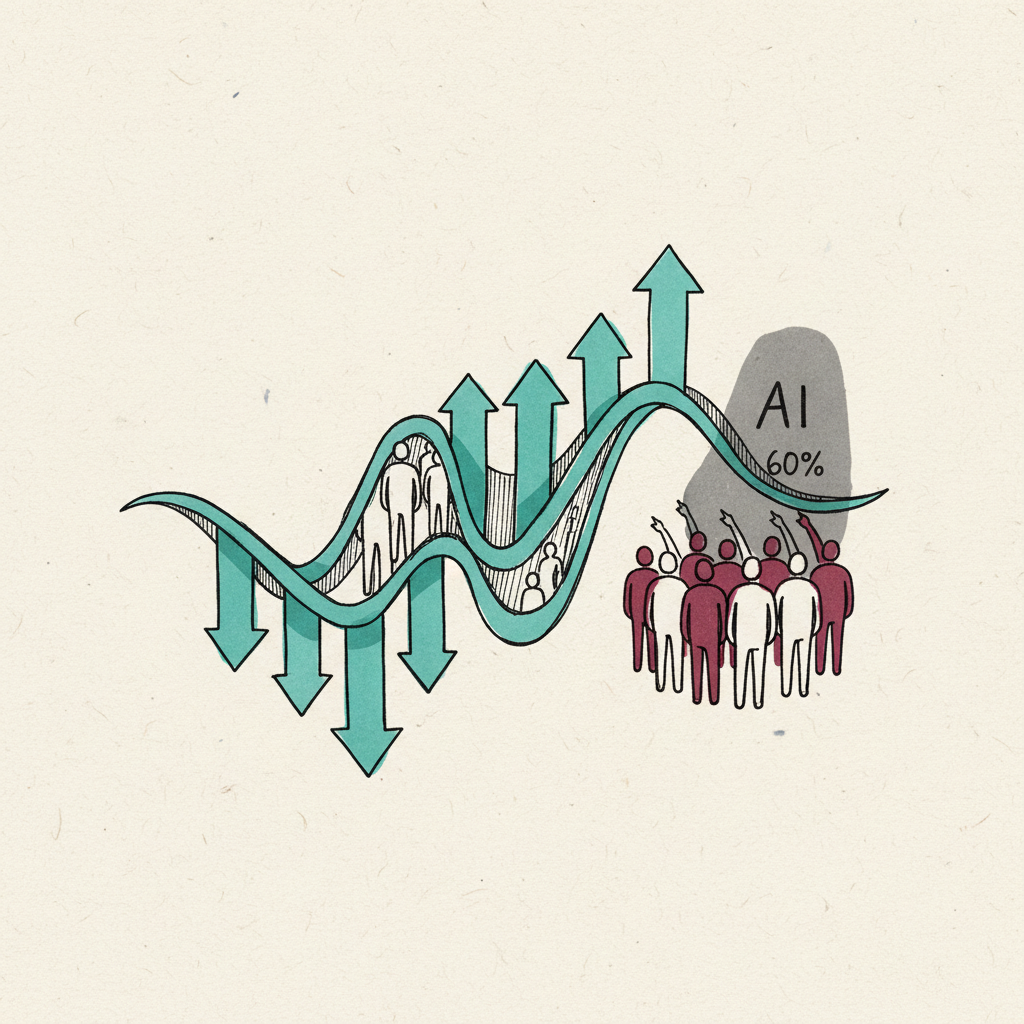
Monthly NY Fed household survey; April 2026 wave found 62% of workers expect AI to raise unemployment within 12 months.
Last refreshed: 28 July 2026 · Appears in 1 active topic
Why do 62% of American workers expect AI to destroy jobs when official data is unclear?
Timeline for Survey of Consumer Expectations
Mentioned in: BLS April report: tech absent, GenAI paper still missing
AI: Jobs, Power & MoneyMentioned in: BLS still absent; NY Fed fills the gap
AI: Jobs, Power & MoneyBLS skips; NY Fed fills the vacuum
AI: Jobs, Power & MoneyMentioned in: AI industry raises $125M v. regulators
AI: Jobs, Power & MoneyMentioned in: Fed admits: no single AI adoption figure
AI: Jobs, Power & MoneyBackground
The Survey of Consumer Expectations (SCE) is a monthly household survey run by the Federal Reserve Bank of New York through its Liberty Street Economics research Arm. Its April 2026 publication — released 14 April, the same day the Bureau of Labor Statistics skipped its scheduled GenAI workplace report — became the de facto federal measure of AI's impact on American workers. Key findings: 39% of employed workers use AI tools at work; 62% expect AI to raise unemployment within 12 months; and AI access is stratified 4.2 times by income, with 66.3% of workers earning over $200,000 using AI against 15.9% earning under $50,000.
The SCE is a broad household expectations survey covering credit conditions, income, inflation, and Labour market outlook. It is not specifically an AI survey; the AI findings emerged from an additional module on workplace technology. Workers without AI training access say they would give up 11.4% of salary to obtain it; those with access demand a 24.2% wage premium to move to a job without it. Only 15.9% of employers offer AI training, yet 11% actively prohibit tool use. The education stratification is Stark: 58.7% of college graduates use AI against 22.9% without a degree.
The SCE's significance on this beat is structural. The BLS had the mandate to measure AI in the workplace; when it skipped its April publication, a regional reserve bank's consumer survey became the headline number policymakers and journalists cited. The 62% unemployment-expectation figure is now widely cited as evidence that workers themselves price AI as a net job threat — a sentiment that neither the three conflicting federal surveys nor the Stanford JOLTS analysis can directly contradict, because it is forward-looking rather than measured.