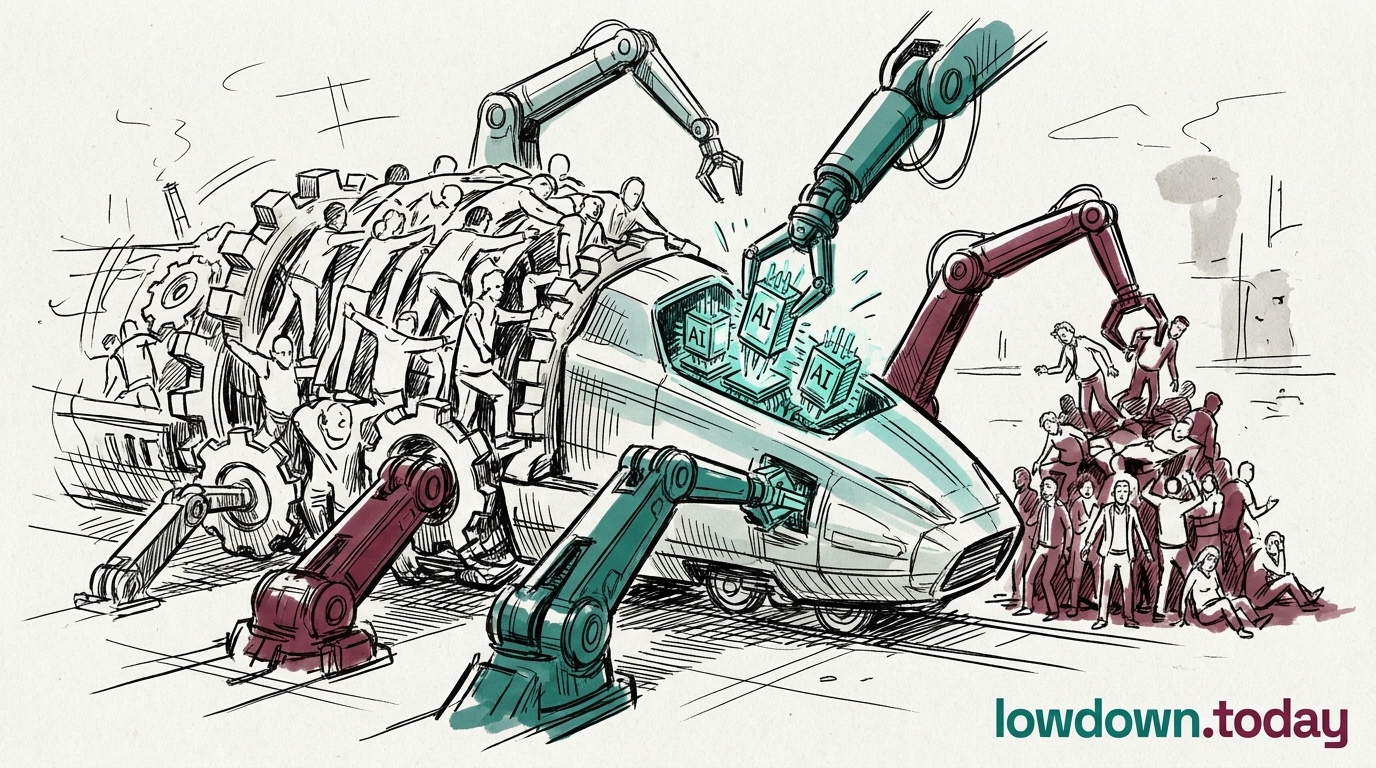
Maher Saba, head of Applied AI Engineering at Meta, wrote an internal memo dated 14 April telling staff the company was 'fundamentally rewiring how we operate', according to Reuters, which reviewed the document1. Roughly 8,000 engineering jobs, about 10% of the function, will go from 20 May, and traditional engineering ladders are being replaced with three titles: AI builder, AI pod lead and AI org lead2. All business units are being pulled under Alexandr Wang's Meta Superintelligence Labs division.
Meta posted 2025 revenue of $201bn and free cash flow of $43.6bn, and has guided 2026 AI capex of $115bn to $135bn, nearly double last year's $72.2bn. Meta is cutting while revenue is rising, not while the balance sheet is under stress.
Prior cycles of tech layoffs came with cost-of-capital stories attached: rate rises, ad-spend softness, activist investors. The Saba memo names a different driver. Meta is arguing that AI capability has shifted far enough to make the old engineering ladder redundant at scale.
No firm at Meta's size has previously written that language into its restructuring plans. Goldman Sachs's 40-year analysis of early-career displacement implied a generation of workers carrying a ten-percentage-point lifetime earnings drag if this wave ran at pace. Stanford's reading of JOLTS, the US Job Openings and Labor Turnover Survey, put the hidden cost at roughly one million American hires that never happened, a figure absent from any official dataset. Atlanta Fed chief financial officers projected AI-attributed cuts in 2026 at nine times 2025 levels; the Meta round is the first single firm of its size to publish language the model predicted.
Sceptics will read the memo as a rebrand. An AI pod lead could be a team lead with a new business card; Meta restructured in 2023 without redesigning the species. The Saba memo, however, ties the role change to a shift in what engineers now do: fewer people producing more code, with AI carrying the routine layer. Meta's Q1 2026 earnings on 29 April are the first verification point. If post-restructuring cost guidance matches the memo, the framing holds. If it does not, $115bn to $135bn of capex sits against an engineering function that has not actually changed shape.





