Skip to content
Briefings are running a touch slower this week while we rebuild the foundations.See roadmap
AI: Jobs, Power & Money
23APR

IBM's Bob quantifies its own paradox

4 min read
14:51UTC

On the same 22 April call, IBM disclosed its internal coding tool delivered 45% developer productivity and $4.5bn in savings since 2023, with GenAI now 30% of consulting backlog.

EconomicDeveloping
Key takeaway

IBM quantifies the productivity gain and the revenue paradox in the same release.

IBM disclosed on its 22 April 2026 Q1 earnings call that its internal coding tool watsonx Code Assistant, known internally as Bob, was delivering 45% average developer productivity gains and had contributed to $4.5bn in cumulative productivity savings since 2023, with another $1bn expected in 2026 1. GenAI, meaning generative AI, now accounts for 30% of the company's consulting backlog.

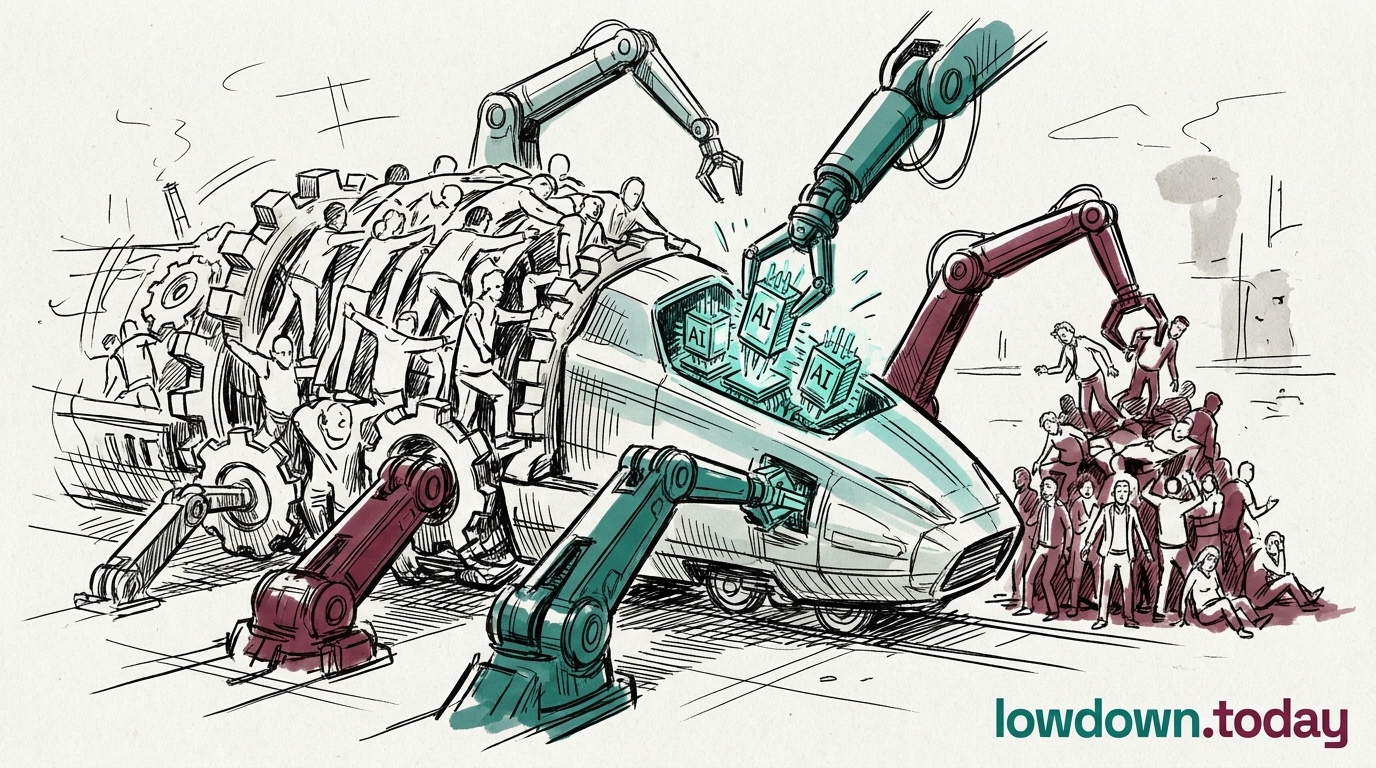
IBM prices consulting in billable hours. A tool that makes engineers 45% more productive reduces the hours a bank needs IBM for, at the same moment it reduces the hours IBM needs its own engineers. The same AI lifting IBM's internal productivity is eroding the revenue base that productivity was supposed to expand. Every productivity gain is a good number for margin and a threat to the revenue line in the same breath.

Before Bob, AI productivity claims at services firms sat in marketing decks rather than in 10-Q filings. IBM has now put a firm-level ratio, a dollar figure and a backlog share on the same page as the revenue line. That is the disclosure choice investors are parsing, and it is the disclosure peers will be asked about at their next earnings.

Goldman's monthly US AI substitution estimate was calibrated on aggregate public data. IBM's Bob number puts that substitution channel inside a single named internal deployment, running against the company's mainframe modernisation book. Stanford's JOLTS analysis gave the measurement context at population level; IBM's disclosure gives it at firm level, made directly comparable across quarters.

The GenAI share of consulting backlog is the number that will define the next four quarters. If the 30% line moves toward 50% through the year, the backlog itself is being recomposed toward a lower hours-per-engagement yield. Accenture and Capgemini trade on roughly the same consulting multiple. Their next-quarter earnings will likely draw the same scrutiny, and both will face questions on whether they can quantify an internal equivalent to Bob. Salesforce has already shown what 'AI agent' framing does to a support line; the IBM disclosure is the consulting equivalent.

Deep Analysis

In plain English

Snap, the company behind Snapchat, cut 1,000 jobs (about one in six of its full-time staff) and its share price went up when it announced the cuts. That seems strange, but it reflects what investors believe about AI and software engineering right now. External reporting suggests that AI tools now write more than 65% of new code at Snap. When two-thirds of the code is written by machines, the company needs far fewer human engineers. Closing 300 job openings on top of the cuts means Snap's management does not expect to need those positions even in the future. The EU Digital Omnibus second trilogue on 28 April (ID:2478) will determine whether employers in Europe face an obligation to inform workers about AI's role in their jobs; Snap's disclosure sits on the other side of that potential obligation.

Deep Analysis
Root Causes

Snap's headcount model historically priced engineering at a ratio calibrated to the volume of features required to maintain Snapchat's position against Instagram and TikTok. That ratio changes when AI generates two-thirds of the new code: the critical scarce resource shifts from raw engineering labour to product judgment (knowing which features to build) and AI integration quality, not coding throughput.

The 300 closed open roles are the more structurally significant figure. Open headcount represents planned future capacity. Closing those positions means Snap's leadership has concluded that expected product demand does not require those engineers even on a projected basis, a forecast about the future of the business rather than merely a response to current capability.

Snap's advertising revenue base also creates a specific pressure absent from verticals like consulting: ad-tech engineering cycles run in weeks, not months. A firm running 65% AI-generated code in a fast-cycle environment discovers the productivity shift in real time, while a slower-cycle firm might not see it for a year.

What could happen next?
  • Precedent

    Snap publicly disclosing a 65% AI code-generation rate, even via external reporting rather than its own release, turns that figure into a sector benchmark competitors must disclose or deny.

    Short term · 0.72
  • Risk

    Twitter's 2022 cuts showed that reducing engineering headcount sharply in a code-dependent consumer product produces service degradation over six to eighteen months; Snap's 16% reduction is smaller, but the 300 closed open roles remove the buffer capacity that would absorb outages.

    Medium term · 0.58
  • Consequence

    Ad-tech staffing models benchmarked to social media headcount, used by recruiters at Pinterest, Reddit, and Nextdoor, will need to be recalibrated downward to reflect the new engineering-output-per-head ratio Snap has disclosed.

    Short term · 0.65
First Reported In

Update #7 · Meta codes its own org chart

Snap Inc.· 23 Apr 2026
Read original
Causes and effects
This Event
IBM's Bob quantifies its own paradox
First primary-source corporate disclosure tying a quantified internal AI productivity metric directly to consulting revenue pressure.
Different Perspectives
UK financial regulators (BoE FPC / FCA)
The Bank of England's April FPC directive on agentic AI in payments was scoped around one frontier model; AISI confirmed a second model cleared the same 32-step threshold on 1 May. The supervisory architecture is one model behind the capability it was built to contain.
Indian IT sector workers (TCS, Infosys, Wipro)
TCS posted its first annual revenue decline in the modern era, Infosys shed 8,400 workers in a quarter, and Wipro hit its zero-fresher target. Western Big Tech's AI automation is cannibalising the offshored-services model that employs roughly five million Indian IT workers.
Chinese workers (Hangzhou and Beijing plaintiffs)
Workers Zhou and Liu won cases that established a two-court doctrinal chain: AI adoption is the employer's deliberate strategy, placing the cost of displacement on the employer rather than the worker. Any Chinese employee facing AI-driven dismissal now has a citable legal route that American, British, and European counterparts do not.
Chinese government, courts, and domestic employers
The Hangzhou rulings were released on Workers' Day eve alongside the Ministry of Human Resources' recognition of 42 new AI occupations. Domestic firms now face mandatory retraining obligations; the Orgvue estimate of 8-14 months added to displacement timelines will feature in employer compliance briefings throughout 2026.
EU regulators and European Parliament
The second Digital Omnibus trilogue collapsed without agreement on 28 April; the third is scheduled for 13 May with the binding employer AI-literacy obligation still contested. Brussels is arguing over a non-binding encouragement clause while Beijing's courts have already bound employers.
US legislators (Warner, Rounds, Hawley, Sanders)
Warner and Rounds produced the Economy of the Future Commission Act, the most concrete federal vehicle still moving, endorsed by the companies it would notionally regulate. The Sanders-AOC moratorium was killed by Democratic senators; the Hawley-Warner disclosure bill remains in committee with no floor date.
