Job Openings and Labor Turnover Survey
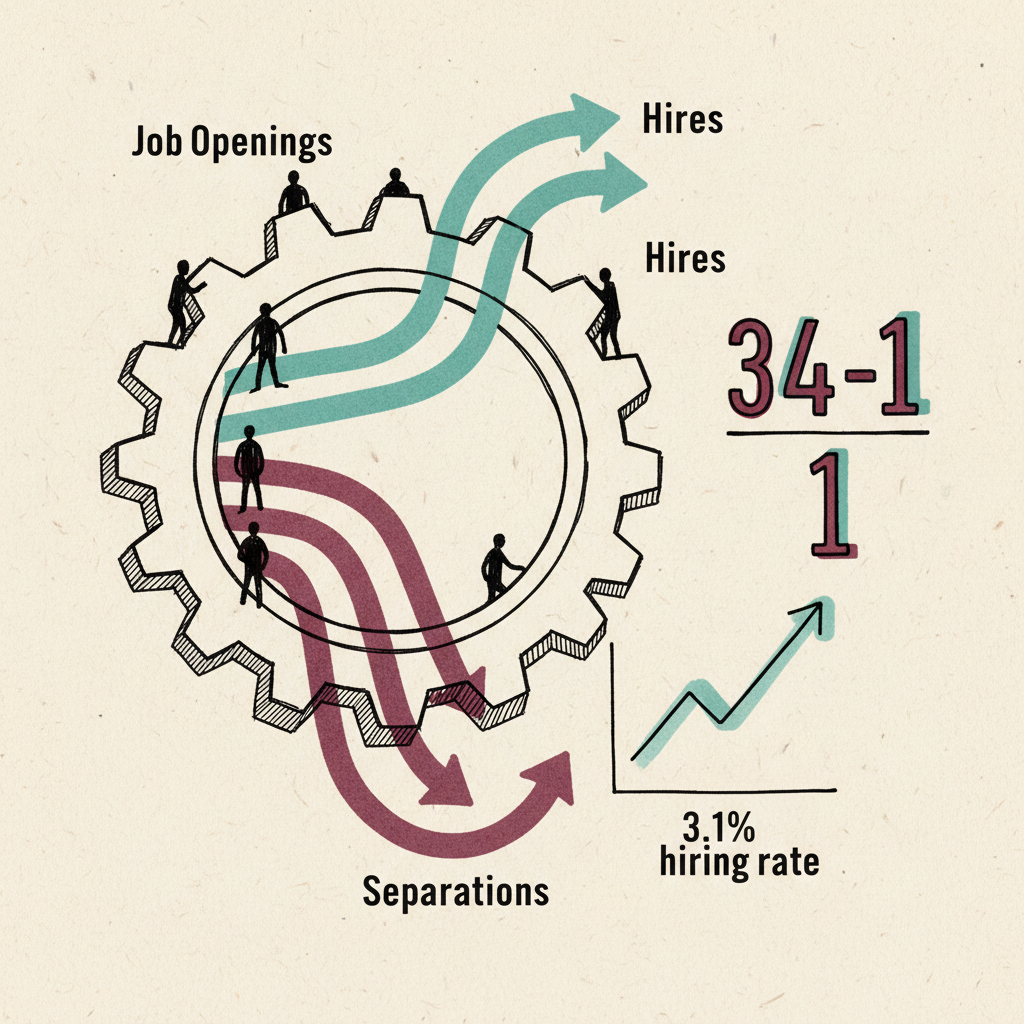
BLS monthly survey of job openings, hires, and separations; February 2026 hiring rate of 3.1% is the basis for Stanford's 34-to-1 AI displacement finding.
The Bureau of Labor Statistics' JOLTS survey underpins Stanford's April 2026 claim that AI is blocking a million hires a year, a reading the New York Fed's 14 May study says the same data does not support.
Last refreshed: 17 July 2026 · Appears in 1 active topic
Two federal institutions read JOLTS and reached opposite conclusions on AI jobs. Which is right?
Timeline for Job Openings and Labor Turnover Survey
Mentioned in: MIT economist: AI layoffs are a cover story
AI: Jobs, Power & MoneyMentioned in: India IT grows 140,000 as US firms cut
AI: Jobs, Power & MoneyMentioned in: India's GCCs absorb the offshored work
AI: Jobs, Power & MoneyTwo federal studies split on AI jobs
AI: Jobs, Power & MoneyMentioned in: Meta codes its own org chart
AI: Jobs, Power & MoneyBackground
The Job Openings and Labor Turnover Survey (JOLTS) is the Bureau of Labor Statistics' monthly measure of US Labour market flow, tracking job openings, hires, and separations across the nonfarm economy. It is published with roughly a six-week lag and is distinct from the headline unemployment rate: JOLTS measures flows into and out of jobs, not the stock of people employed.
That distinction matters for the AI-jobs debate because a declining hiring rate can show employers pulling back on recruitment without cutting existing staff, a pattern some economists treat as the primary channel through which automation suppresses employment. By contrast, Challenger, Gray & Christmas tracks declared redundancies, the visible surface of job losses.
Until the Bureau of Labor Statistics publishes its long-delayed paper on generative AI and the workforce, JOLTS remains the main federal data series analysts reach for when arguing about AI's effect on hiring, even though the same numbers have supported opposite conclusions from different institutions.
The same data splits federal readings
JOLTS' February 2026 release, published in March, recorded a 3.1% hiring rate, the lowest since April 2020. Stanford Digital Economy Lab applied that 0.6 percentage point drop from the 2023 baseline to the 158.6m nonfarm workforce on 10 April and calculated roughly 950,000 to 1 million fewer annual hires than the 2023 pace, a 34-to-1 ratio against declared AI layoffs.
On 14 May the New York Fed contested that reading directly: its occupation-level study found the decline in postings for AI-exposed roles began before ChatGPT shipped in December 2022, and that junior and senior roles fell at similar rates, undercutting both the timing and the under-25s concentration Stanford's causal story needs. JOLTS remains the only federal input either side agrees on; only the causal reading is contested.