Skip to content
AI: Jobs, Power & Money
16APR

Fed admits: no single AI adoption figure

4 min read
13:29UTC

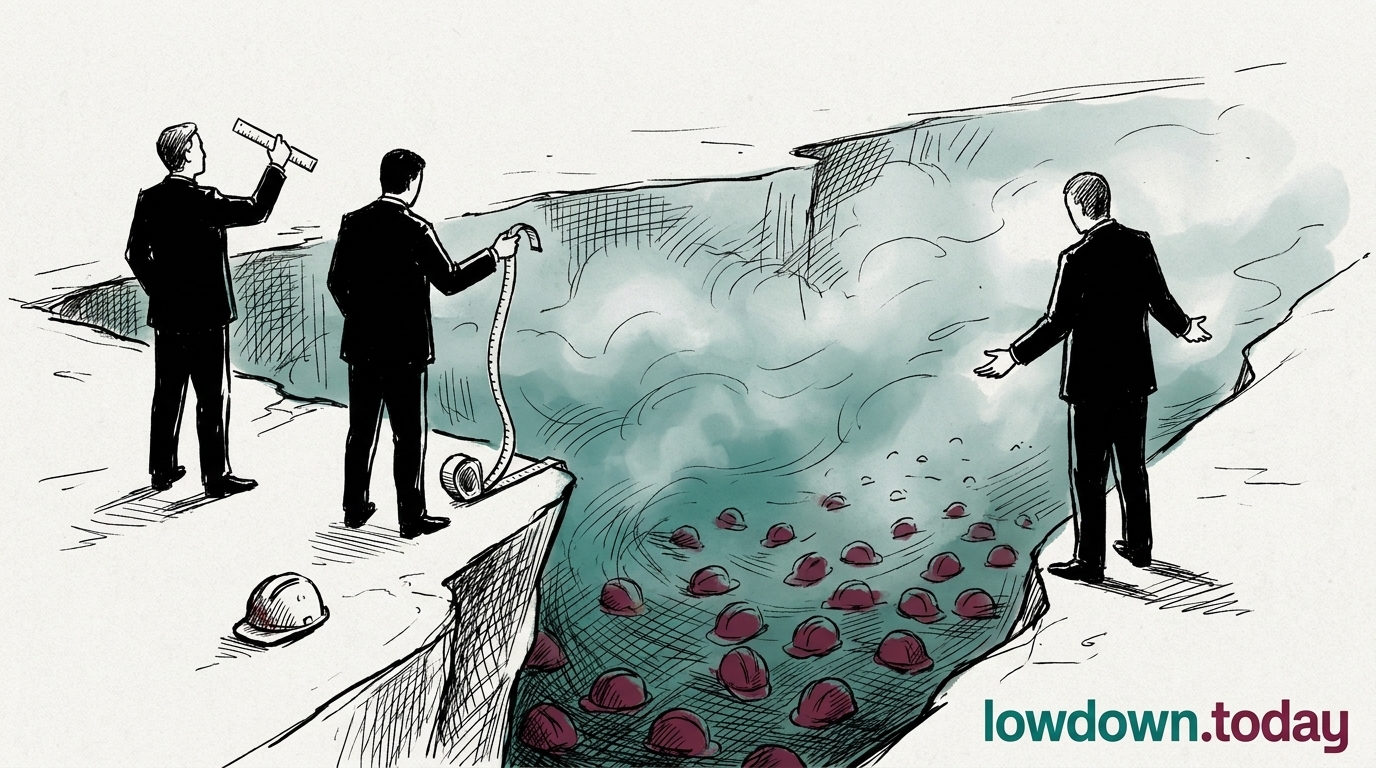
The Federal Reserve Board published a reconciliation paper on 3 April comparing three federal instruments that describe the same late-2025 economy as 18%, 41% or 78% AI-adopted. The gap is structural.

EconomyDeveloping
Key takeaway

Federal agencies disagree by 4.3x on AI adoption, leaving displacement policy without a statutory baseline.

The Federal Reserve Board published a survey reconciliation paper on 3 April 2026, authored by staff economist Jeffrey S. Allen for the FEDS Notes series, comparing three separate federal instruments that should describe the same US economy and do not. The Business Trends and Outlook Survey (BTOS), run by the Census Bureau on a firm-weighted basis, put AI adoption at 18% for late 2025. The Research on Practices Survey (RPS), which asks individuals whether they personally use AI at work, returned 41%. The Survey of Business Uncertainty (SBU), which weights by how many workers are employed at AI-using firms, came in at 78%. Daily AI use across the US workforce sits at 12%; weekly use at 35.2%.

The three figures measure different things: the share of firms using AI, the share of workers personally using AI, and the share of the workforce employed at firms that have adopted it. The Fed paper's point is not that the surveys are faulty; it is that no federal agency has formally chosen between firm-weighted, individual-weighted and employment-weighted units, so the same quarter can be described as roughly one-in-five, two-in-five or four-in-five AI-adopted depending on which federal instrument is cited.

Forty-six days earlier, the bipartisan nine-senator coalition led by Josh Hawley and Mark Warner had written to the Department of Labor and the Bureau of Labor Statistics urging expanded AI workforce data collection . The Fed Board's reconciliation is effectively the federal answer: there is no single figure, and none of the three existing instruments will produce one until an agency chooses a canonical unit. The BLS itself has so far chosen none, skipping a separately scheduled GenAI workplace publication eleven days later.

In practice, private datasets set the headline number by default. Challenger, Gray & Christmas counts announced AI layoffs; Stanford's JOLTS-based analysis puts the real labour impact at a far higher multiple; Goldman Sachs's earlier monthly substitution model sat between the two. None of those are federal. None can be legislated against without a statutory benchmark that the reconciliation paper has just confirmed does not exist.

The 4.3x divergence is also the quantitative foundation for the Hawley-Warner demand: a letter asking for one number has been met by a paper documenting that the government currently produces three, none of them designated as authoritative. Whether the BLS is resourced to build a fourth, harmonised instrument, or whether the NY Fed's Survey of Consumer Expectations becomes the de facto federal measure by attrition, is likely the first concrete thing the next US Congress will have to decide on AI workforce policy.

Deep Analysis

In plain English

The US government tried to measure how many workers are using AI at work and got three completely different answers: 18%, 41%, and 78%, all for the same period. Each answer came from a different official survey asking a slightly different question. This matters because the same data is used to set policy on jobs, training budgets, and unemployment support. Right now, no one in government can agree on the most basic fact: how widely AI has spread through the American workplace.

Deep Analysis
Root Causes

The 4.3x gap traces to a structural decision each agency made independently: BTOS asks whether a firm has 'adopted' AI (binary, firm-level), RPS asks whether an individual 'uses' AI tools (self-report, individual-level), and SBU weights by employment rather than firm count. No interagency protocol required these to be compatible before deployment.

The deeper structural condition is that the US federal statistical system was designed in an era of physical goods and discrete employment events. AI is neither; it is a probabilistic workflow layer whose adoption is continuous, partial, and contested even within firms. The BLS's Occupational Employment Statistics programme, which underpins most workforce policy, still classifies jobs by task bundles last revised in the O*NET 2010 review cycle.

First Reported In

Update #6 · Three federal surveys, one 34-to-1 gap

Federal Reserve Board (FEDS Notes, Jeffrey S. Allen)· 16 Apr 2026
Read original
Causes and effects
This Event
Fed admits: no single AI adoption figure
This is the first federal acknowledgement that no canonical AI adoption measure exists. Without an agreed baseline, Congress cannot legislate against a figure, and the Hawley-Warner measurement coalition retains political legitimacy as the only realistic path to better data.
Different Perspectives
Oxford Economics
Oxford Economics
Concluded AI's role in recent layoffs is 'overstated,' finding companies are not replacing workers with AI at scale. Identified slowing growth, weak demand, and cost pressure as the actual drivers.
Ambrish Shah, Systematix Group
Warned AI coding tools will erode Indian IT firms' labour-arbitrage growth model by reducing enterprise dependency on large vendor teams.
South Korean government
Enacted the world's second comprehensive AI law, choosing an innovation-first framework over prescriptive employment protections — a deliberate contrast to the EU's regulatory approach.
Corporate executives executing AI-driven cuts
Frame workforce reductions as existential necessity. Crypto.com CEO Kris Marszalek and Block CEO Jack Dorsey both described AI adoption as a survival imperative, with equity markets reinforcing the message through immediate share-price gains.
Chinese government (Wang Xiaoping)
Positions AI as a job-creation engine to absorb 12.7 million annual graduates and offset 300 million retirements, directly contradicting domestic economist Cai Fang's warning that AI job destruction precedes creation.
Klarna and companies reversing AI cuts
Klarna's public reversal — rehiring the human agents it replaced with AI after customer satisfaction collapsed — validates Gartner's prediction that half of AI-driven service cuts will be undone by 2027.
