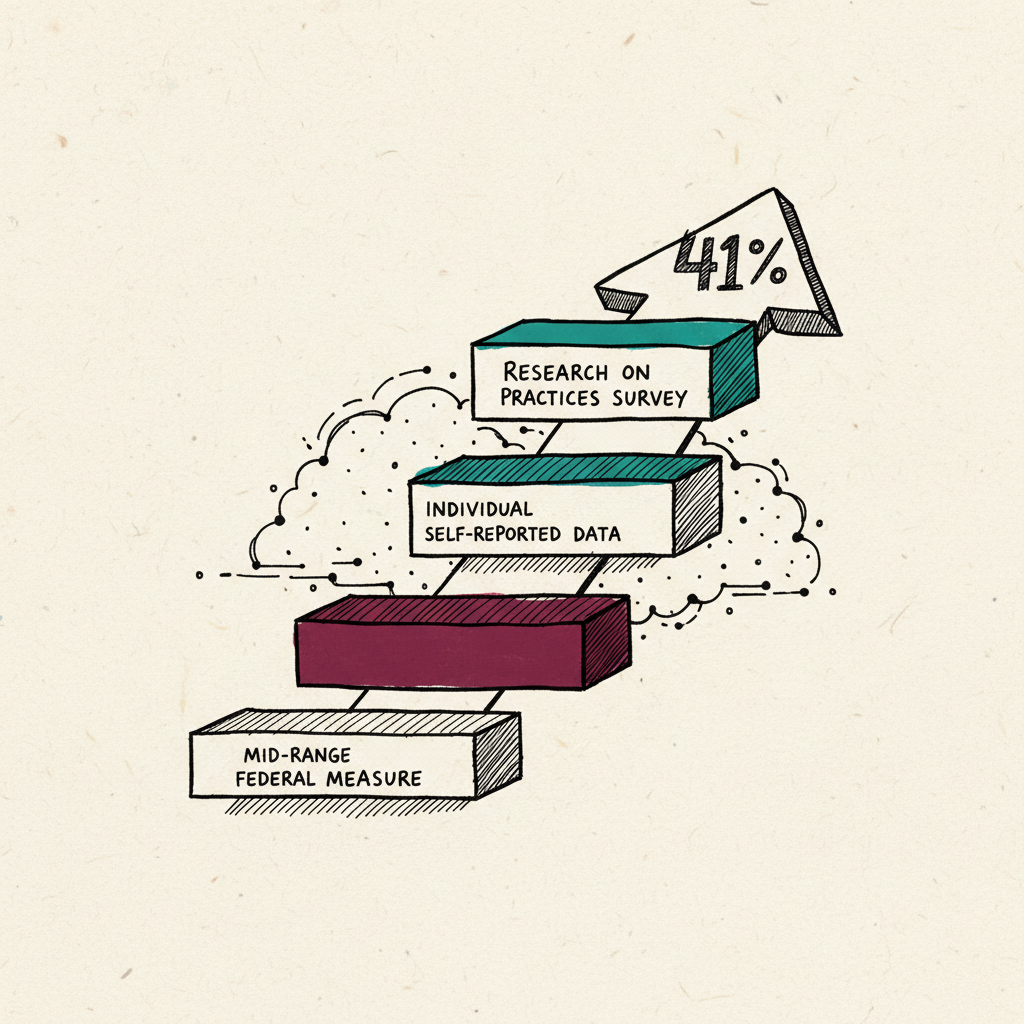
Research on Practices Survey
Federal survey measuring individual self-reported AI adoption; produced 41% adoption rate for late 2025 — the mid-range federal measure.
Last refreshed: 16 April 2026 · Appears in 1 active topic
Why does individual workers' self-reported AI use come in at 41% when firms report only 18%?
Timeline for Research on Practices Survey
Fed admits: no single AI adoption figure
AI: Jobs, Power & MoneyBackground
The Research on Practices Survey (RPS) measures individual self-reported AI adoption in the workplace, asking respondents whether they personally use AI tools in their job. In its late-2025 wave, the RPS recorded 41% adoption — the middle figure in the three-way comparison published by the Federal Reserve Board on 3 April 2026. Where the BTOS counts firms and the SBU weights by employment, the RPS captures whether individual workers say they use AI, making it arguably the most direct measure of lived experience at the point of work.
The 41% figure sits between The Firm-weighted 18% (BTOS) and the employment-weighted 78% (SBU). The Fed reconciliation paper framing is that all three are measuring different things: firm adoption, individual experience, and workforce exposure respectively. None is wrong; together they produce a 4.3x spread that renders meaningful policy comparison impossible. The RPS 41% is the figure closest to consumer self-report, which may explain why it roughly correlates with the NY Fed SCE finding that 39% of employed workers use AI tools at work.
Because the RPS asks individuals rather than firms, it is susceptible to over-reporting (workers WHO have experimented with AI once may count themselves as users) and under-reporting (workers in firms that prohibit AI use may not count their informal use). The methodological debate matters because the gap between 18% and 78% is not measurement error — it is measurement choice, and Congress has not chosen.