Skip to content
Welcome, thoughtbot's Giant Robots listeners!Start here
AI: Jobs, Power & Money
6NOV

Fed and Treasury summon bank CEOs

2 min read
11:10UTC

The first emergency meeting convened by US regulators over a single AI model's capabilities drew five Wall Street CEOs to Treasury headquarters.

EconomicDeveloping
Key takeaway

A single AI model forced emergency government action that workforce displacement never has.

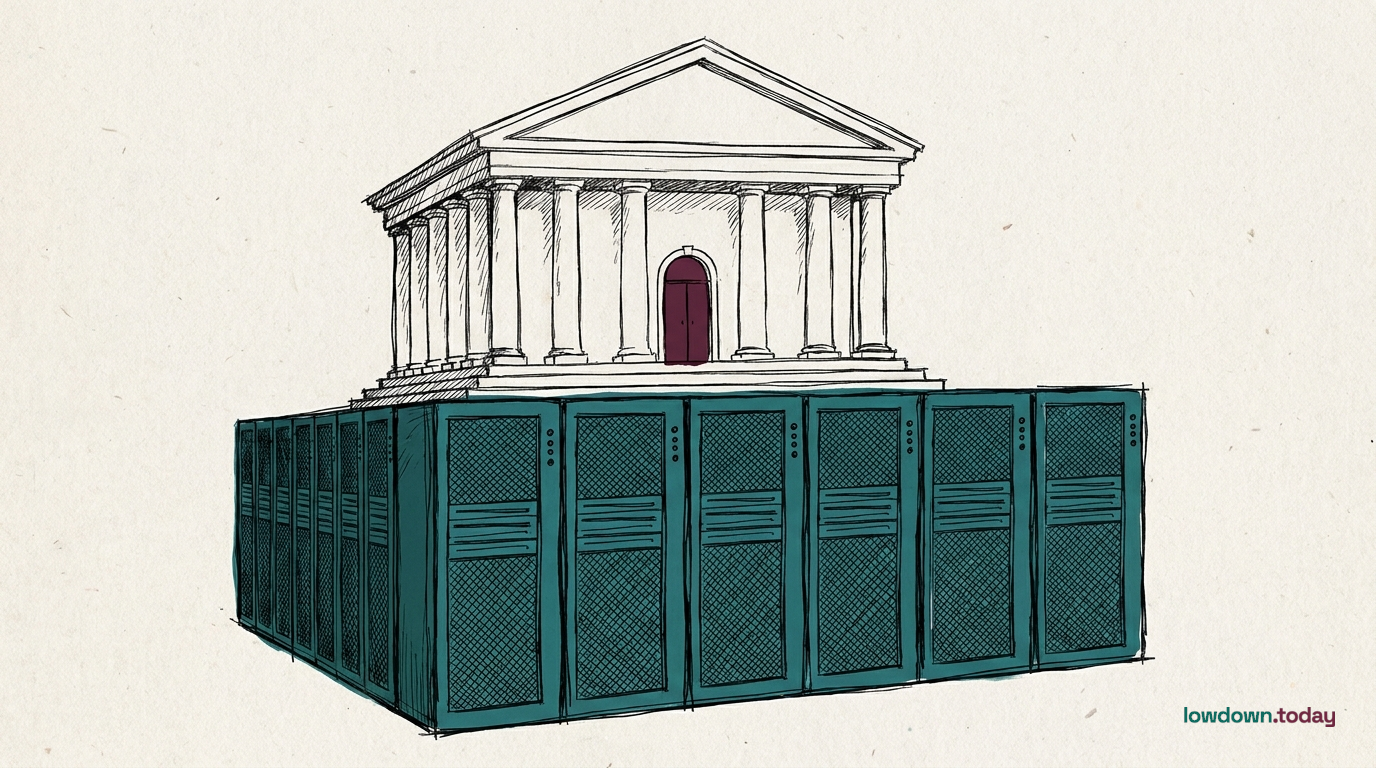
Treasury Secretary Scott Bessent and Federal Reserve Chair Jerome Powell summoned the CEOs of Citigroup, Morgan Stanley, Bank of America, Wells Fargo, and Goldman Sachs to an emergency meeting at Treasury headquarters on 8 April 2026 to discuss Anthropic's Claude Mythos Preview⁠1. Jamie Dimon of JPMorgan was unable to attend. The meeting preceded Anthropic's formal public announcement by one day and is the first recorded instance of The Fed and Treasury convening Wall Street leadership specifically over a frontier AI system's capabilities.

Financial sector AI adoption grew 127% year-on-year as of 3 April⁠2, making these same banks central to both the AI capability story and the labour displacement data. Goldman Sachs, one of the twelve Glasswing partners receiving restricted Mythos access, simultaneously published research showing AI substitutes 25,000 US jobs per month. A cybersecurity capability triggered emergency federal action within 48 hours; cumulative AI-attributed job cuts crossing 100,000 over three years produced no equivalent response.

The New York Fed publishes dedicated GenAI workplace research on 14 April, four days from now. If those findings diverge from the three conflicting prior surveys on AI workforce impact, the data will carry more weight than any corporate estimate.


Deep Analysis

In plain English

When the US government worries a new technology could threaten the financial system, it does not issue a press release. It calls a meeting. On 8 April 2026, the Treasury Secretary and the head of the Federal Reserve summoned the chief executives of America's largest banks to Treasury headquarters in Washington. The subject was a single AI model: Anthropic's Claude Mythos Preview. The model had demonstrated an ability to find hidden security flaws in software at a scale and speed beyond anything seen before. Regulators were concerned that banks, which rely on the same software infrastructure Mythos had mapped, needed to act fast. What makes this significant is the contrast with what did not trigger a similar meeting: more than 100,000 workers losing their jobs to AI over three years.

Deep Analysis
Root Causes

The meeting reflects a structural asymmetry in US financial regulation: cybersecurity threats that could destabilise payment systems trigger immediate federal coordination mechanisms built after 9/11 and refined after 2008, while labour market effects of the same technology accumulate for years before producing any equivalent institutional response.

The financial sector's 127% year-on-year AI adoption rate (Federal Reserve FEDS Notes, April 2026) means banks are among both the fastest adopters of AI and the most exposed to AI-enabled cyberattacks. This dual exposure, both deploying and being targeted, compressed the regulator response timeline in a way that AI Job Displacement has not.

What could happen next?
  • Precedent

    The first federal emergency meeting triggered by a single AI model's capabilities sets a template for regulatory response to frontier AI systemic risk.

    Immediate · 0.82
  • Risk

    If the twelve Glasswing partners deploy Mythos-class capabilities offensively before defensive infrastructure scales, the financial system's vulnerability window widens.

    Short term · 0.65
  • Consequence

    Bank security and AI-risk teams face immediate pressure to expand headcount, creating a localised hiring surge within institutions simultaneously cutting in other functions.

    Short term · 0.72
First Reported In

Update #5 · The model they won't release

Bloomberg· 10 Apr 2026
Read original →
Causes and effects
This Event
Fed and Treasury summon bank CEOs
Federal regulators responded to an AI capability threat within 48 hours, a speed never applied to three years of documented AI workforce displacement.
Different Perspectives
Korea's four largest banks, as reported by News1
KB Kookmin, Shinhan, Hana and Woori rehired 1,013 retirees last year, equal to 79.1% of their graduate intake, according to News1. Graduates face a smaller entry intake while returners take fixed-term credit-screening roles at lower pay, News1 reports.
High Court of Justice of Madrid
The court's employment chamber ruled in judgment 864/2026, dated 8 October and made public in early November, that introducing AI is not on its own a ground for dismissal. Employers must prove AI's effect through the four causes the Workers' Statute already lists.
Singapore Ministry of Manpower
The Singapore Ministry of Manpower put third-quarter retrenchments at 4,800, concentrated in information and communications, financial services and manufacturing, with business reorganisation the main driver. Its release does not mention AI.
Challenger, Gray & Christmas
Challenger reported on 5 November that market and economic conditions overtook AI as the leading stated reason for 2026's US job cuts, at 130,531 against 121,401. AI was cited for 1,265 cuts in October, its lowest month of the year.
Office for Budget Responsibility
The OBR's 28 October outlook showed output per worker in information and communication growing 7.6% a year, yet kept AI's boost to UK productivity at 0.2 percentage points a year. It does not attribute the faster growth to AI.
Central Bank of Ireland
Governor Gabriel Makhlouf said on 2 November that AI investment has supported Irish activity and flagged the debt financing behind it as a financial-stability risk. On jobs, he named skills bottlenecks and mismatches, not job losses.

Written with AI from Lowdown's published reporting. Not individually reviewed by an editor. Editorial standards.

