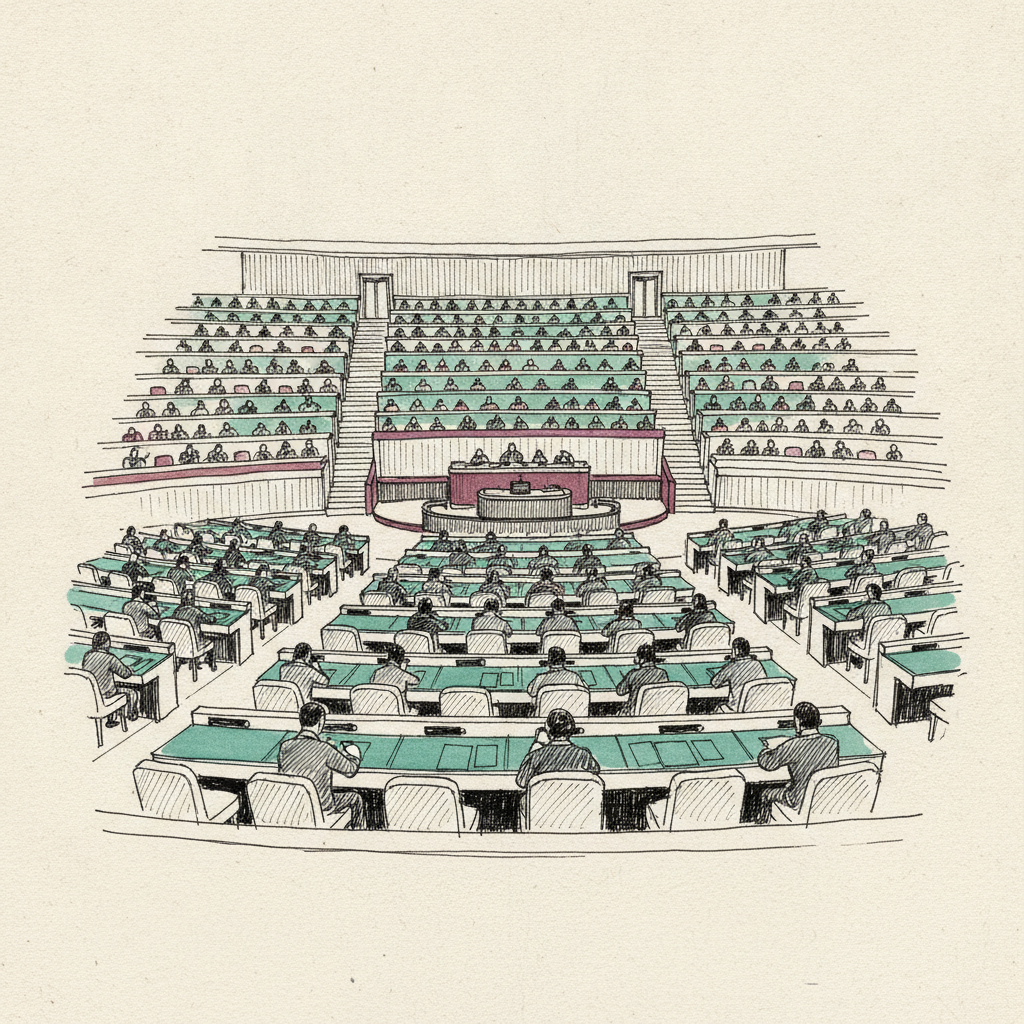
World Health Assembly
WHO's decision-making body of all member states, meeting annually.
Talks on the Pandemic Agreement's pathogen-sharing annex closed in Geneva on 13 November 2026 without agreed text, the third session in a row. The World Health Assembly must adopt the annex, by May 2027 or at a special session, before the treaty opens for signature.
Last refreshed: 21 November 2026 · Appears in 1 active topic
Timeline for World Health Assembly
Became the May 2027 target for adoption
Pandemics and Biosecurity: Pandemic talks close without PABS annexMentioned in: UN adopts a declaration on pandemics
Pandemics and BiosecurityRemained the May 2027 venue for adoption
Pandemics and Biosecurity: WHO talks on pathogen sharing fail againMentioned in: PABS annex slips a fourth deadline
Pandemics and BiosecurityMentioned in: PABS talks reopen under a deadline
Pandemics and BiosecurityBackground
The World Health Assembly is the World Health Organization's decision-making body. Delegations from every member state meet each year to set policy, approve the programme and budget, and appoint the director-general.
It turns negotiated texts into collective WHO commitments. In May 2025 it adopted the Pandemic Agreement, and in May 2026 its 79th session adopted a ten-year plan on antimicrobial resistance. Most of what it approves still depends on national governments to carry out.
When a framework leaves parts unfinished, the Assembly keeps the vote on the missing text. That is why the pathogen-sharing annex, and with it the Pandemic Agreement's opening for signature, waits on an Assembly decision expected by May 2027. The UN General Assembly's political declaration on pandemics, adopted on 12 October 2026, left that sequence unchanged.
The Assembly still owes an annex
The World Health Assembly adopted the WHO Pandemic Agreement in May 2025 without its Pathogen Access and Benefit-Sharing annex. On 19 May 2026 the 79th Assembly deferred that annex to its 80th session in May 2027, or to a special session sooner.
Negotiators have yet to give it a text to vote on. Sessions in Geneva ended without agreement on 17 July, 18 September and 13 November, and talks resume on 11 January. The dispute covers pathogen samples, genetic data and the benefits countries receive in return. Until the Assembly adopts the annex, the treaty it approved cannot open for signature.
The Assembly set a 2030 AMR target
On 23 May 2026 the 79th World Health Assembly adopted the Global Action Plan on Antimicrobial Resistance for 2026 to 2036. It aims to cut deaths from bacterial resistance by 10% by 2030 under a One Health approach linking human, animal and environmental health.
Like the 2015 plan before it, the text binds no one, so delivery rests with national governments. Days later, WHO surveillance covering 104 countries found that one in six bacterial infections no longer responds to standard first-line antibiotics, and some experts called the Assembly's target modest against that trend.
The annex vote now waits until 2027
Why can't the WHO Pandemic Agreement be signed yet?
When will the pathogen-sharing annex be adopted?
Reference
What is the World Health Assembly?







Written with AI from Lowdown's published reporting. Not individually reviewed by an editor. Updated 21 November 2026. Editorial standards.