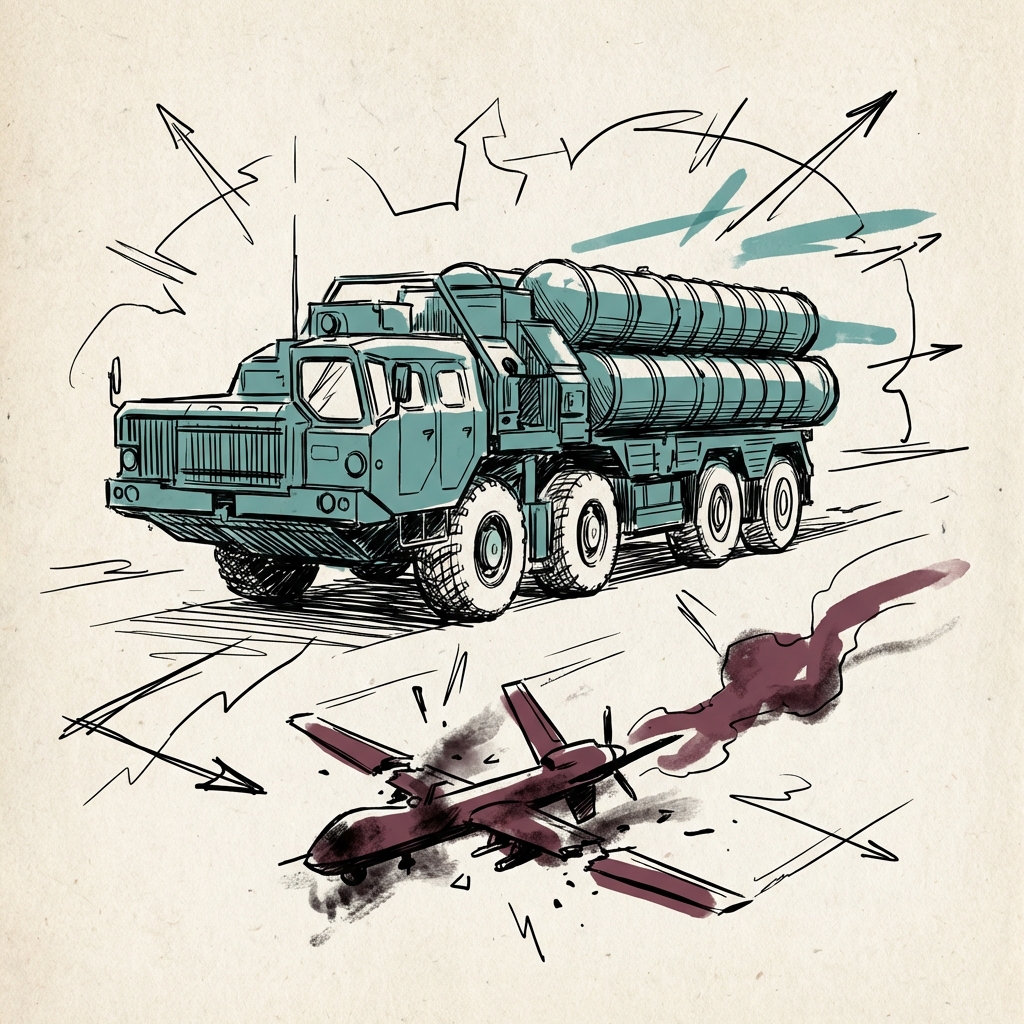
S-400
Russian long-range surface-to-air missile system developed by Almaz-Antey, in service since 2007.
Reports of the 10–11 July 2026 Russian barrage included S-400 missiles alongside Iskander-M missiles in a combined total of six. The air-defence system also appears in reporting on attacks against ground targets.
Last refreshed: 22 October 2026 · Appears in 1 active topic
Can Russia's front-line air defence survive systematic Ukrainian strikes on its S-400 network?
Timeline for S-400
Fired ballistic missiles at Ukraine on the night to 22 October
Russia-Ukraine War 2026: Russian jet drones reach half of salvoesMentioned in: Trump waives Graham Act's Russia tariffs
Russia-Ukraine War 2026Mentioned in: Trump signs Graham Russia sanctions law
Russia-Ukraine War 2026Overnight barrage shifts no front line
Russia-Ukraine War 2026Background
S-400 Triumf is a Russian mobile surface-to-air missile system. It combines surveillance and engagement radars, command equipment, launchers and missiles. NATO calls it SA-21 Growler. Its principal task is air defence: finding airborne targets and directing interceptors towards them. The Centre for Strategic and International Studies describes it as a successor to the S-200 and S-300 systems, entering service in 2007. CSIS system profile
The name covers a system with several components and missile options. CSIS notes that its early equipment shared features with the S-300 family. The radar, launcher and interceptor each perform a different part of an engagement; a battery's composition therefore matters when describing the equipment.
S-400 missiles appear in ground attacks
The 10–11 July 2026 barrage report named S-400 missiles among the weapons Russia fired at Ukraine. Its six-missile figure combined S-400 and Iskander-M missiles, so it gives no separate S-400 total. For a system developed for air defence, the reported ground-attack use extends its role beyond intercepting aircraft and missiles.
S-400 equipment also appeared among Ukrainian targets in March 2026. Reporting described strikes against more than 20 air-defence systems across several types, including S-300, Buk, Tor and Pantsir. That mixed tally cannot be read as 20 destroyed S-400 systems.
Reference
Who makes the S-400?
What is the S-400 missile system?
Why did the US sanction Turkey but not India over the S-400?
Which countries bought the S-400?
Why did Ukraine strike the Granit facility in Sevastopol?
Has Ukraine destroyed S-400 launchers?
How many S-400 systems has Ukraine destroyed?
How does the S-400 compare to the Patriot missile system?



Written with AI from Lowdown's published reporting. Not individually reviewed by an editor. Updated 22 October 2026. Editorial standards.