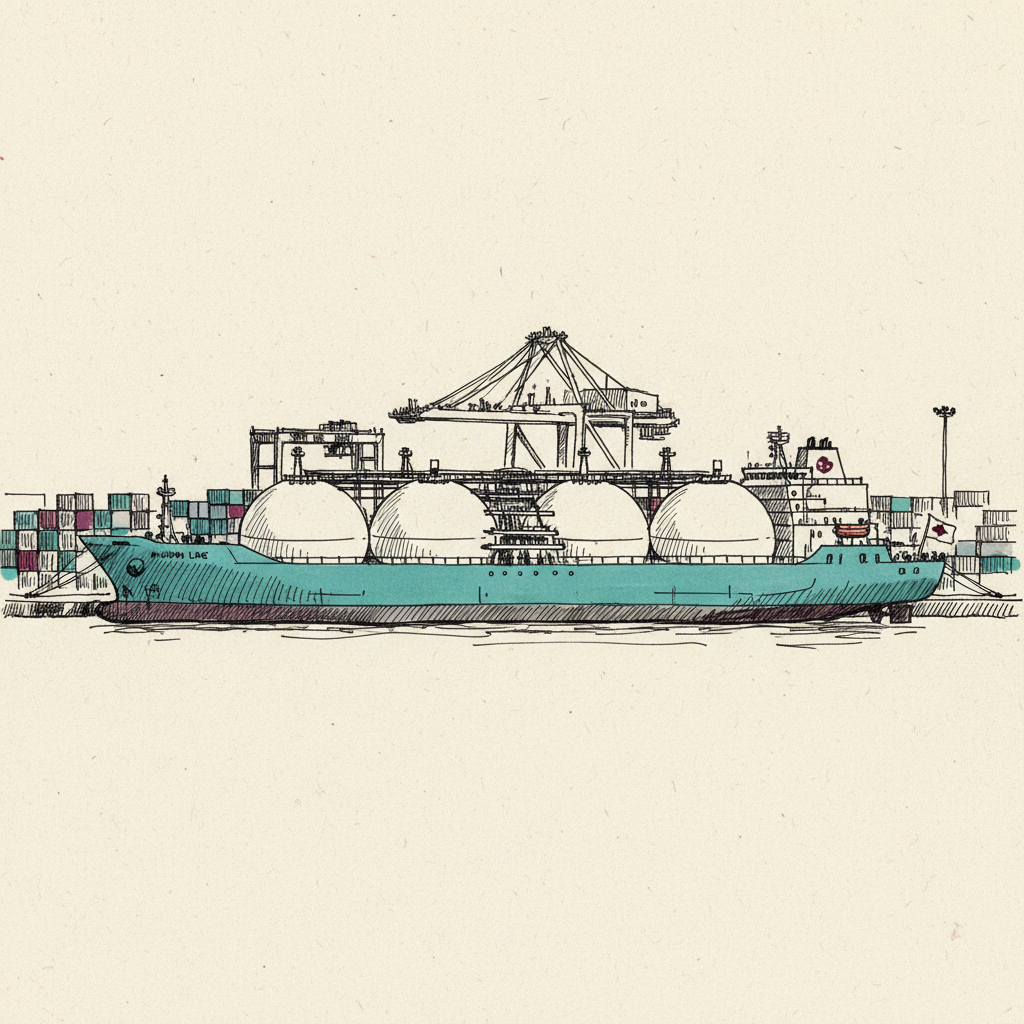
Mubaraz
ADNOC LNG carrier; first confirmed loaded LNG vessel to transit Strait of Hormuz since the war began.
Last refreshed: 29 April 2026 · Appears in 1 active topic
Was the Mubaraz the first loaded LNG tanker through Hormuz since the war started?
Timeline for Mubaraz
Mentioned in: TTF breaks band on Trump life-support line
European Energy MarketsMentioned in: TTF holds €43-47 through Hormuz week
European Energy MarketsMentioned in: Project Freedom moves TTF only 1.48%
European Energy MarketsCompleted first confirmed loaded LNG transit through Hormuz since war began, on 27 April
European Energy Markets: Mubaraz: first loaded LNG out of HormuzBackground
Mubaraz is an LNG carrier in ADNOC's fleet, loaded at ADNOC's Das Island terminal in the UAE in early March 2026. The vessel went dark — ceasing AIS transponder transmissions — on approximately 31 March, then reappeared west of India on 27 April 2026, completing the first confirmed loaded LNG transit through the strait of Hormuz since the conflict that began two months prior. The cargo is destined for a terminal in China, with an estimated arrival date of 15 May 2026.
Mubaraz is a Q-Flex class LNG carrier — a mid-sized vessel class in the 210,000-216,000 cubic metre capacity range, developed by Qatargas and adopted more broadly across Gulf LNG exporters. The vessel's reappearance is significant for European energy market pricing: JKM, the Japan/Korea Marker for LNG SPOT prices, stood at $16.55/MMBtu against TTF equivalent near $14.80 at the time of the transit signal, confirming that Atlantic Basin flexible cargoes are routing east rather than towards Europe.
The Mubaraz transit is a data point in the broader question of whether Hormuz LNG flows can be sustained through active hostilities in The Gulf region. Its month-long dark period and the absence of prior loaded transits since the conflict began suggests that the resumption, while significant, remains episodic rather than a return to normal operational patterns.