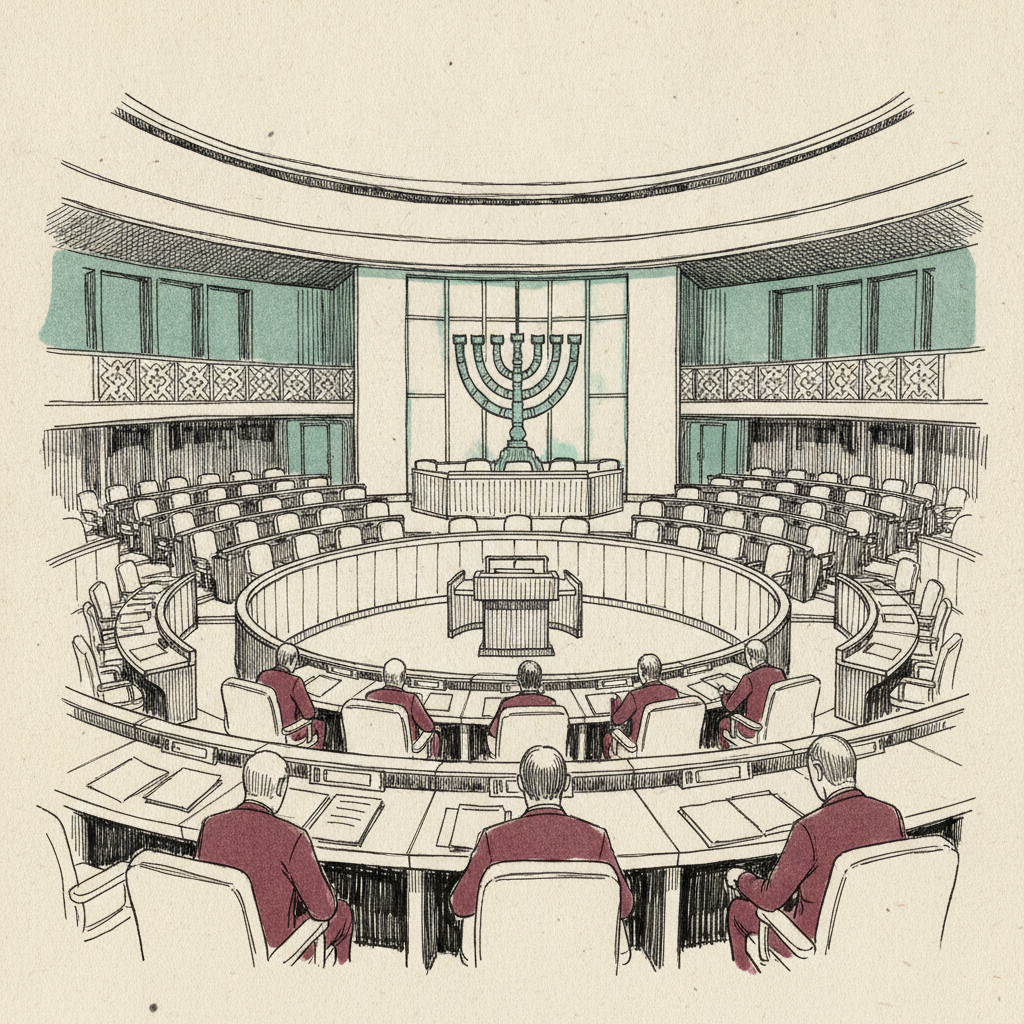
Knesset
The parliament of the State of Israel, a 120-seat unicameral legislature that enacts law and oversees the government.
Last refreshed: 16 June 2026 · Appears in 1 active topic
Timeline for Knesset
Mentioned in: Netanyahu sidelined by the deal on Iran
Iran Conflict 2026Israel rejects a deal it never signed
Iran Conflict 2026Mentioned in: Debris hits 400m from al-Aqsa Mosque
Iran Conflict 2026Mentioned in: Five salvos at Israel in eighteen hours
Iran Conflict 2026Debris near Knesset and Holy Sepulchre
Iran Conflict 2026Background
The Knesset is Israel's Parliament, a 120-seat unicameral chamber elected by proportional representation for four-year terms. It sits in Jerusalem and has operated continuously since its first session in 1949, the year after the state of Israel was founded. The Knesset enacts all legislation, approves the state budget, elects the President, and can remove the Prime Minister through a vote of no confidence. Coalition governments are the norm given Israel's proportional system: no single party has ever won an outright majority, making small faction leaders pivotal and coalitions inherently fragile. The 25th Knesset, elected in November 2022, returned Benjamin Netanyahu to power at the head of the most right-wing government in Israel's history, with Coalition partners including Bezalel Smotrich's Religious Zionism party and Itamar Ben-Gvir's Otzma Yehudit.
In the 2026 Iran conflict the Knesset building became a marker of the war's physical reach: intercepted Iranian missile debris fell near the Knesset and the Church of the Holy Sepulchre in Jerusalem's Old City in March 2026, the debris field reaching the most politically and religiously concentrated kilometre of real estate on earth. The Knesset's political composition shaped Israel's response to the conflict: FAR-right Coalition ministers used the chamber's platform to reject any negotiated outcome, with Ben-Gvir declaring the June 2026 Islamabad memorandum "does not bind us in any way" and Smotrich demanding ten buildings in Beirut destroyed for every Hezbollah drone fired. Even the opposition, led by former defence minister Benny Gantz, called the memorandum a strategic failure.
The Knesset's wider significance lies in its role as the pressure valve for Israeli democratic tensions. A judicial overhaul package passed in 2023 triggered the largest protest movement in Israeli history and degraded the Supreme Court's oversight powers. The 2026 wartime government has operated with minimal parliamentary scrutiny, with Netanyahu and Defence Minister Katz authorising significant military actions without prior cabinet approval, compressing the Knesset's constitutional role further.
How many seats does the Knesset have?
What did Israeli politicians say about the Iran ceasefire deal?
Was the Knesset hit by Iranian missiles?
Who is in charge of the Israeli parliament in 2026?
What is Israel's judicial overhaul and how does it affect the Knesset?


