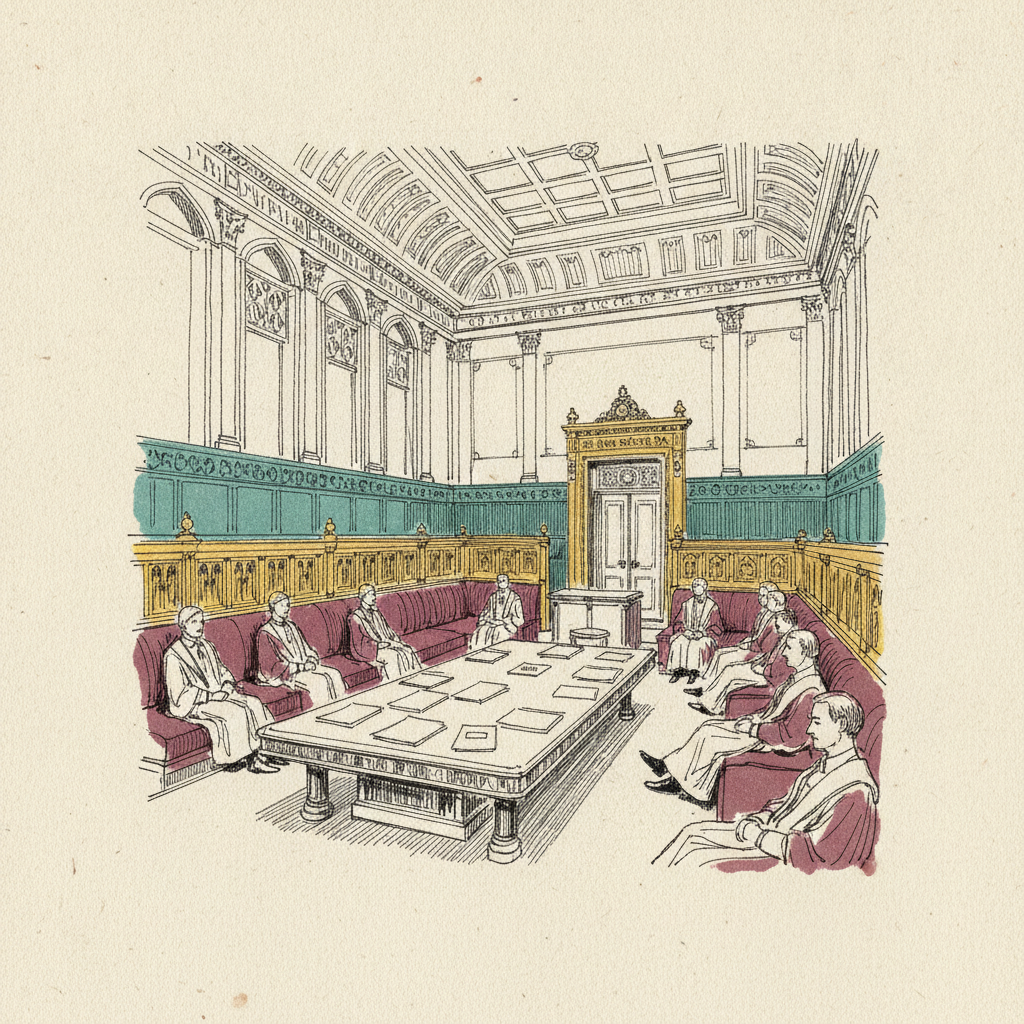
House of Lords
UK Parliament's unelected Upper Chamber; scrutinises, revises, and can delay but not permanently block legislation.
Peers approved the principle of the Representation of the People Bill at Second Reading on 14 September 2026; as of 5 October, 73 amendments, four of them caps on party donations, awaited a committee stage with no date set.
Last refreshed: 7 October 2026 · Appears in 3 active topics
Can the House of Lords block the Cyber Security and Resilience Bill?
Timeline for House of Lords
Scheduled six committee sittings on the Bill
UK Local Elections 2026: Peers table 160 changes to voting BillMentioned in: MHCLG seeks £2.8m for votes at 16
UK Local Elections 2026Mentioned in: Florida AG secures Raúl Castro warrant
Cuba DispatchMentioned in: UK AISI vets frontier models pre-release
European Tech SovereigntyMentioned in: Peers table AI amendments to cyber bill
Cybersecurity: Threats and DefencesBackground
The House of Lords is the unelected Upper Chamber of the UK Parliament. Most of its members are appointed life peers, alongside Church of England bishops who sit as the Lords Spiritual. Many crossbench peers have no party affiliation and come from Science, law, business and security backgrounds.
Under the Parliament Acts of 1911 and 1949, the Lords can delay most Bills but cannot block them for good. It works mainly by detailed scrutiny and amendment, often of technical Bills after they leave the Commons, as with the Cyber Security and Resilience Bill in July 2026.
In autumn 2026, peers hold the main Bill on party funding. Proposed caps on donations, which the Commons did not adopt, are being argued in the Lords while the Electoral Commission separately reviews spending limits.
Peers weigh caps on party donations
The Representation of the People Bill reached the Lords after MPs approved it on 2 September, 411 to 102, with its retrospective ban on cryptocurrency donations intact. Peers gave it a Second Reading on 14 September.
By 5 October, 73 amendments were waiting for committee stage, for which no date had been fixed. Four of those amendments set donation limits. The tightest, Lord Cromwell's, allows £100,000 per donor over five years; the loosest, Lord Carlile's, allows £5m annually. None of the four is retrospective, so all would miss the £72m given to Reform UK in September.
Lords examined wider cyber duties
The Cyber Security and Resilience Bill had its Lords Second Reading on 14 July 2026. It would bring managed service providers and data centres into critical-infrastructure rules, require near-miss incidents to be reported, and allow fines of up to £17m or 4% of global turnover.
The Bill was in committee by 23 July, the date on its running amendment paper. Lord Alton had proposed an amendment on transnational repression; the published record did not show whether it was tabled, debated or adopted.
What happens to the Cyber Security and Resilience Bill in the House of Lords?
How many members does the House of Lords have?
What powers does the House of Lords have over legislation?
Can the House of Lords block a bill it disagrees with?


Written with AI from Lowdown's published reporting. Not individually reviewed by an editor. Updated 7 October 2026. Editorial standards.