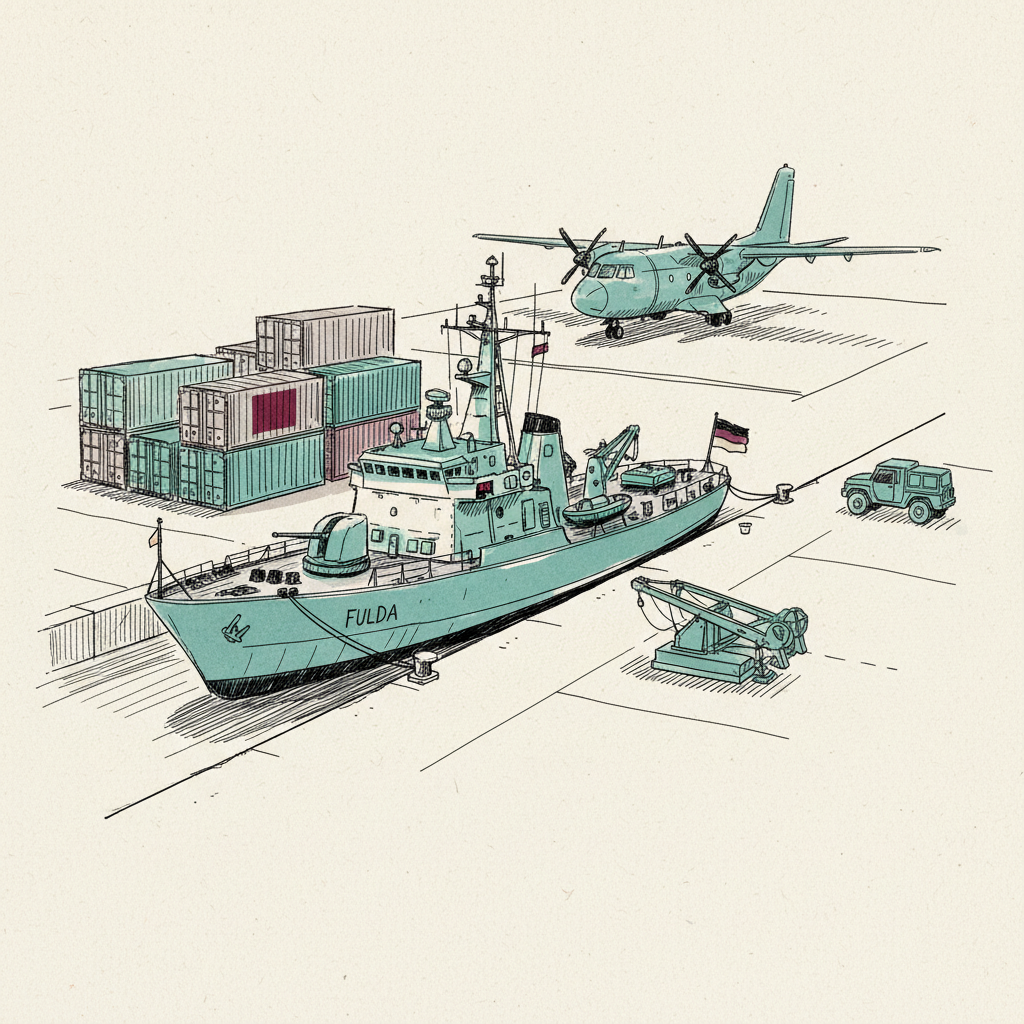
Fulda
German Frankenthal-class minehunter; committed to European Hormuz Coalition on 18 May 2026.
Last refreshed: 19 May 2026 · Appears in 2 active topics
Does Germany committing a minehunter count as joining the war against Iran?
Timeline for Fulda
Sailed in company with RFA Lyme Bay as MCM escort
Autonomous Systems: Land & Sea: Allied robot minehunters reach the GulfCENTCOM logs 70 Hormuz vessel redirections
Iran Conflict 2026Committed to Hormuz coalition by Germany
Iran Conflict 2026: Four states add Hormuz coalition kitBackground
FGS Fulda is a Frankenthal-class minehunter of the Deutsche Marine (German Navy). Germany committed her to the European Hormuz Coalition standby force on 18 May 2026 alongside replenishment ship Mosel, marking Berlin's first operational naval contribution to the Coalition after the Bundesstag ruled out direct participation in combat operations against Iran.
The Frankenthal class was developed in the late 1980s as a replacement for Germany's Lindau-class minesweepers. The twelve vessels in the class use a GRP hull to reduce magnetic and acoustic signatures, carry two Pinguin B3 mine-disposal drones, and are equipped with the DSQS-11M mine-hunting sonar. Operational depth range extends to 200 metres, making the class one of the deepest-capable MCM assets in European inventories.
Fulda's deployment alongside Belgium's BNS Primula gives the Hormuz Coalition two shallow-water mine-clearance platforms to address the in-water gap that CENTCOM's cumulative 70-vessel redirection tally highlights. No rules of engagement have been published for either vessel.
What is the Fulda minehunter Germany committed to Hormuz?
Is Germany participating in military action against Iran?
How deep can the Frankenthal-class minehunter operate?



