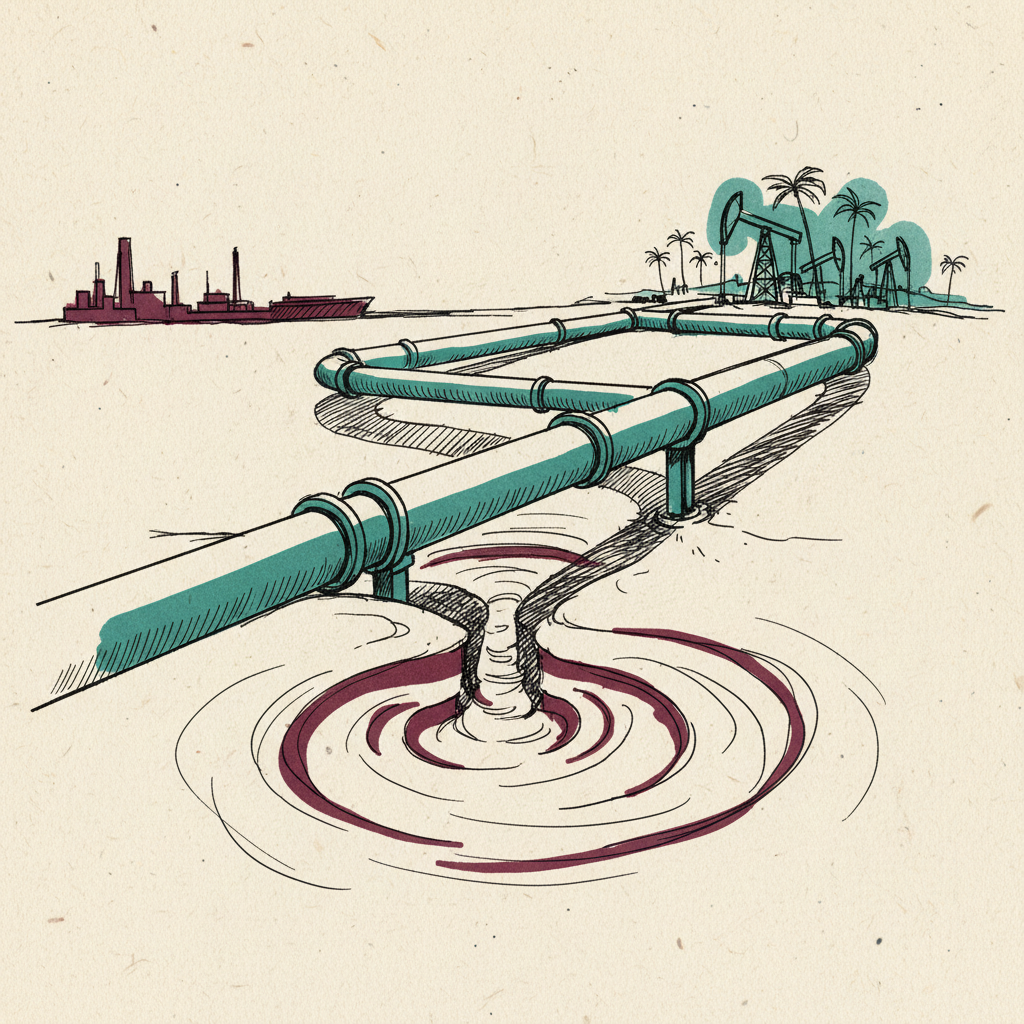
East-West pipeline
Saudi Arabia's 1,200 km crude pipeline from Eastern Province to Yanbu, bypassing Hormuz.
Last refreshed: 13 April 2026 · Appears in 1 active topic
How much oil does the Saudi bypass route actually carry?
Timeline for East-West pipeline
Mentioned in: Gulf producers build around the strait
Iran Conflict 2026Mentioned in: Bab el-Mandeb returns as second chokepoint
Iran Conflict 2026restored to full capacity routing exports to Red Sea at Yanbu
Iran Conflict 2026: Saudi pipeline bypass restores 7 million bpd routeWhat is the East-West Pipeline and why does it matter in 2026?
Can Saudi Arabia bypass the Strait of Hormuz?
How much oil did the Hormuz blockade actually stop?
Background
The East-West pipeline, known commercially as Petroline, is Saudi Arabia's 1,200 km crude oil export artery running from the Eastern Province's Abqaiq hub to the Red Sea terminal at Yanbu. It has a nameplate capacity of 8 million Barrels Per Day and was restored to its full operational throughput of 7 million bpd on 12 April 2026 in response to the US naval blockade of Iranian ports. The restoration allowed Saudi Arabia to reroute virtually all of its crude exports away from the Strait of Hormuz, the world's most critical oil chokepoint, whose blockade had sent Brent crude surging above $103 a barrel.
Petroline was built in the 1980s partly in response to the Iran-Iraq War, which first demonstrated the vulnerability of Gulf export routes to military disruption. Saudi Aramco operates the pipeline under a dedicated subsidiary. The Yanbu terminal feeds directly into tanker routes through the Red Sea and the Suez Canal, giving Saudi exports a westward PATH entirely independent of the Persian Gulf. At 7 million bpd the pipeline moves roughly the same volume as the combined daily exports of Iraq and the UAE.
The speed with which Saudi Arabia activated the bypass in April 2026 was significant: it confirmed that Riyadh had maintained and tested the pipeline's full capacity in anticipation of exactly this scenario, and that Saudi Arabia could effectively insulate its own export revenues from the blockade. The action reduced the immediate supply shock, but Left other Gulf producers — Iraq, Kuwait, the UAE — fully exposed to the Hormuz closure. It also demonstrated that Riyadh's cooperation with the blockade had hard limits defined by its own economic interest.

