Basra
Southern Iraqi oil hub; Iraq's primary crude export terminal and Basra Light/Medium production centre.
Last refreshed: 13 September 2026 · Appears in 1 active topic
With Basra's seaborne exports down 97%, how is Iraq keeping any oil flowing?
Timeline for Basra
Mentioned in: Iraq shuts three Iranian crossings and the flights
Iran Conflict 2026Mentioned in: Fujairah distillates double at the floor
European Oil MarketsIraq ramps Ceyhan pipeline toward 770kbd
European Oil MarketsMentioned in: Hengaw counts 7,650 dead across 27 provinces
Iran Conflict 2026Mentioned in: Kyiv moves the oil war to the Black Sea
Russia-Ukraine War 2026Background
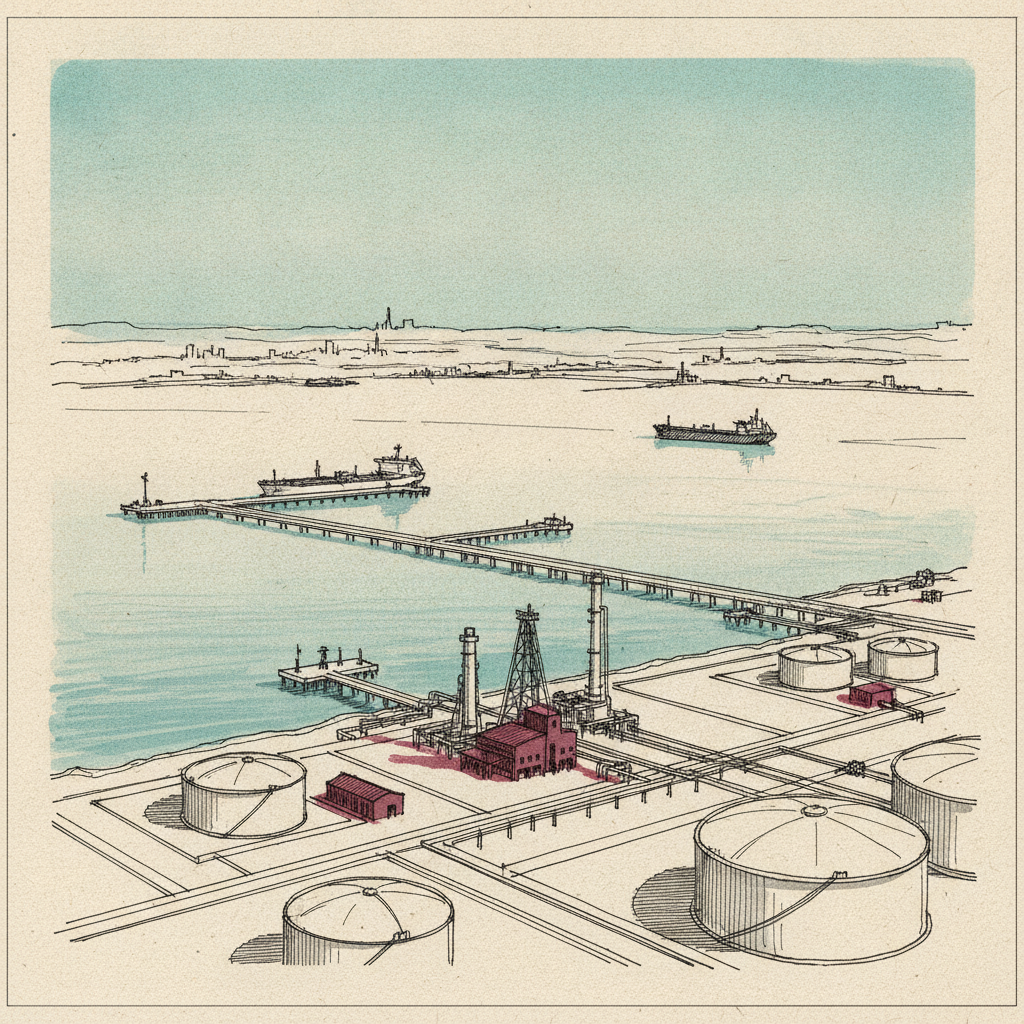
Basra is Iraq's second-largest city and the heart of its oil economy, located on the Shatt al-Arab waterway near the northern end of The Persian Gulf. The surrounding region holds the majority of Iraq's proven oil reserves, producing two flagship export grades: Basra Light (around 29° API, ~2% sulphur) and Basra Medium (around 24° API, higher sulphur). Iraq's southern oil infrastructure, concentrated around the Basra Oil Terminal and the offshore Al Basra and Khor Al Amaya loading platforms, handles the vast majority of the country's roughly 4 million Barrels Per Day of production capacity. Basra is the starting point of the pipelines, loading platforms and logistics chains through which Iraq earns around 90% of its government revenues.
The city and its oil infrastructure sit at the intersection of multiple geopolitical pressures. Basra is predominantly Shia and has been the site of periodic civil unrest driven by unemployment, poor services and perceived neglect by Baghdad. The Iran-Iraq War left the region heavily damaged, and subsequent decades of sanctions, conflict and under-investment constrained the field development that Iraq's IOC partners have sought. The geography of the Shatt al-Arab and the shallow northern Gulf makes Basra's offshore loading platforms inherently exposed to any conflict escalation in the broader Gulf region.
The Hormuz blockade from March 2026 severed Basra's principal export route. Iraq declared Force majeure on all oilfields operated by foreign companies in mid-March as storage filled and Hormuz transits became impossible. By May 2026, southern Iraqi output had fallen 70% to 1.3 million Barrels Per Day with seaborne exports down 97%, a near-total collapse of the export function that defines Basra's economic role. Baghdad's response was to ramp the Kirkuk-Ceyhan pipeline from northern fields as the only viable non-Hormuz alternative, shifting Iraq's export centre of gravity from Basra's Gulf terminals to Kirkuk's land route through Turkey. Exports have since partly recovered: Iraq's Ministry of Oil said national crude exports, most of which originate in the south, averaged around 3 million Barrels Per Day in the first week of September 2026, though the ministry did not break out a Basra-specific figure.
Basra province held one of the three Iraq-Iran border crossings, al-Shalamcheh, that Baghdad closed alongside al-Shaib and Mandali after investigators traced the launch sites of the drones that struck Saudi Arabia's Petroline pipeline to land nearby. Iraq's Security Media Cell published a phased reopening on 13 September 2026: passenger traffic at Shalamcheh resumed that day, with commercial traffic following on 14 September. The closure and its four-day repair curve sit alongside Basra's wider loss of Gulf export capacity through the Hormuz blockade, adding a second, land-based disruption to the province's cross-border trade with Iran.
What crude oil grades does Basra produce and export?
Why did Iraqi oil exports collapse in 2026?
Where is Basra and what is its role in Iraq's oil industry?
What happened near Basra's oil terminal in March 2026?
What Basra border crossing did Iraq close in September 2026?
Has Iraq's oil output recovered since the Hormuz blockade collapse?


Written with AI from Lowdown's published reporting. Not individually reviewed by an editor. Updated 13 September 2026. Editorial standards.