Skip to content
You can now search across every topic, entity and event.What's new
US Midterms 2026
14JUN

DeSantis signs Florida 24R-4D map into law

3 min read
11:52UTC

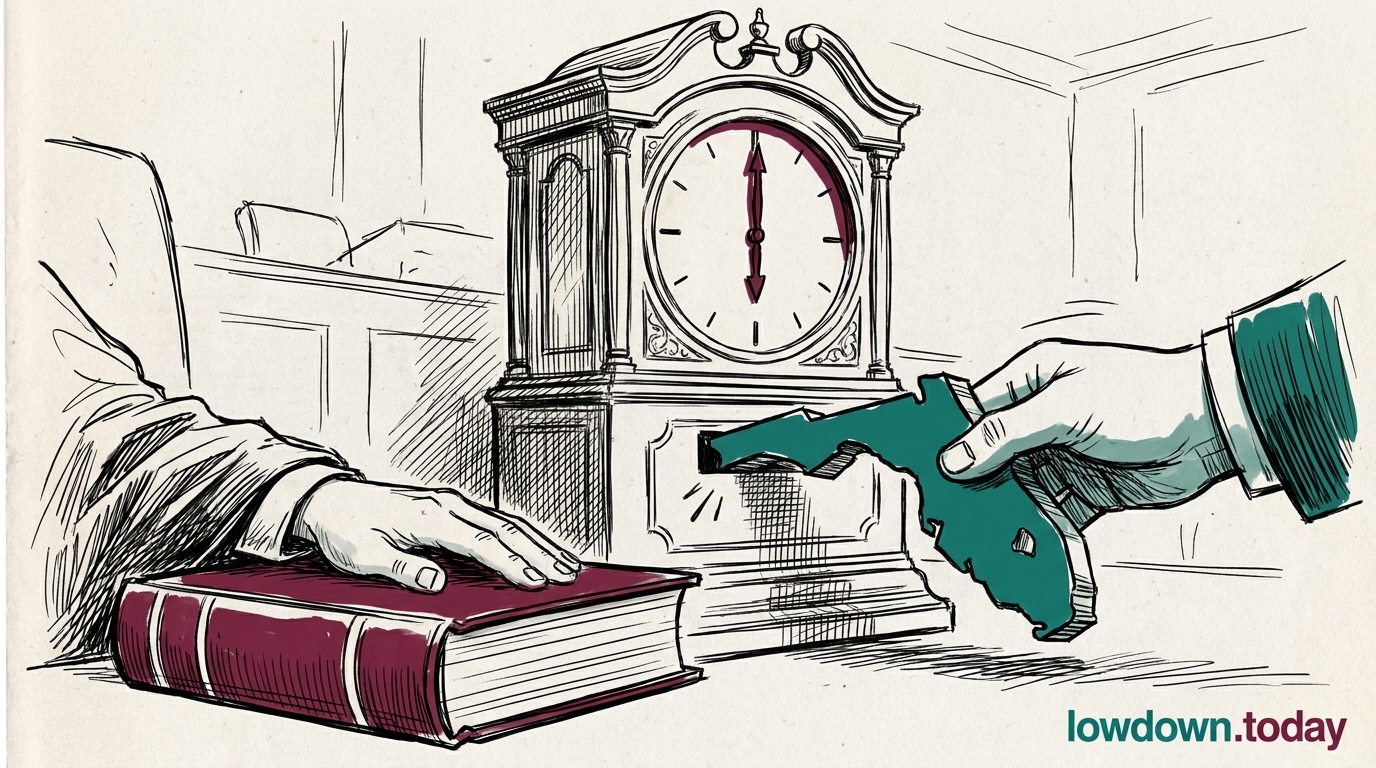
Governor Ron DeSantis signed Florida's 24R-4D congressional map on Monday 4 May, four days after the Senate's 21-17 vote and five after the House's 83-28.

PoliticsDeveloping
Key takeaway

Florida banked four Democratic House seats with a signature timed to the day Callais came down.

Governor Ron DeSantis signed Florida's 24R-4D congressional map on Monday 4 May 2026 in Tallahassee. 1 The Florida House had passed it 83-28 on Wednesday 29 April, the same day Louisiana v. Callais came down in Washington. The Senate followed 21-17 on Thursday 30 April. Senate President Ben Albritton had told reporters in April that the chamber would not draft its own map and would wait for the governor's office .

Four Democratic incumbents are drawn for elimination: Kathy Castor in Tampa, Darren Soto in Orlando, Lois Frankel in West Palm Beach, and Debbie Wasserman Schultz in Fort Lauderdale. Sabato's Crystal Ball, the University of Virginia ratings shop, moved nine Florida districts on signing day. FL-09 went from Likely Democrat to Likely Republican; FL-22 from Safe Democrat to Leans Republican; FL-25 from Safe Democrat to Toss-up. Four formerly Safe Republican seats slipped to Likely Republican, opening a small Democratic counter-target list. 2

The rescheduled session passed the map the same day Callais arrived traced the original timing. The synchronicity removed the VRA-cover argument the governor's office had previously offered for the delay; the legal exposure now runs through Florida's own Fair Districts Amendment, not federal voting law.

Deep Analysis

In plain English

Congressional districts in the US are redrawn every ten years after the census to reflect population shifts. But states can also redraw them mid-decade, between censuses. That is what Florida just did. Governor Ron DeSantis designed a map that gives Republicans 24 of Florida's 28 congressional seats, up from their current hold. Four Democratic congresspeople, in Tampa, Orlando, West Palm Beach, and Fort Lauderdale, will have to run in redrawn districts where they are now expected to lose, based on election-forecasting ratings. The map passed the Republican-controlled state legislature on party-line votes and was signed on 4 May. Opponents filed a legal challenge the same afternoon, arguing it violates a 2010 Florida constitutional amendment that voters passed to prevent this kind of politically driven line-drawing.

Deep Analysis
Root Causes

Three structural conditions produced the map's design. First, the removal of the VRA majority-minority mandate by Callais eliminated the main legal argument that would have protected the two Black-majority districts in the 2022 DeSantis map, which were already in litigation.

Second, Florida's legislature operates under a constitutional requirement to pass a map within the special session calendar; once DeSantis delayed the session to 28 April, the legislature had no independent map and functionally ratified whatever the governor produced.

Third, the 2021 redistricting cycle established a precedent that the governor, not an independent commission, controls the map. Florida voters rejected an independent commission proposal in 2020; the 2010 Fair Districts Amendment did not create commission oversight, only a judicial anti-gerrymandering standard.

What could happen next?
  • Consequence

    All four targeted Democratic incumbents (Castor, Soto, Frankel, Wasserman Schultz) must now run in redrawn districts rated unfavourable; Sabato's Crystal Ball put FL-25 at Toss-up and FL-09 at Likely Republican on signing day.

    Immediate · 0.85
  • Risk

    The Fair Districts Amendment challenge filed 4 May could reach the Florida Supreme Court before the November primary; if the court draws a remedial map, some districts may revert to competitive status.

    Short term · 0.6
  • Precedent

    If the map survives litigation, it establishes that a governor can design congressional maps directly, bypassing the legislature's drafting role, in states where the executive has formal map-submission authority.

    Long term · 0.7
First Reported In

Update #5 · Callais lands; maps move

Florida Phoenix· 7 May 2026
Read original
Different Perspectives
EU Commission trade directorate
EU trade officials note Iowa Senate moving on Iran-war fertiliser prices confirms the cross-topic energy transmission they flagged after Gulf shocks in May. A Democratic Senate from January 2027 would restore Ways and Means leverage on tariff schedules, reducing the probability of a locked Republican trade posture through 2028.
Chatham House democracy analysts
Chatham House analysts assess the Florida qualifying deadline as the point at which redistricting litigation migrated from a live 2026 variable to a post-cycle accountability mechanism; the shadow docket's 7-day Alabama reversal on 2 June and the 13 June Florida lock together confirm that judicial review now operates retrospectively rather than preventively in redistricting disputes.
V-Dem Institute
V-Dem Institute
V-Dem's electoral integrity index identifies the Callais-to-Alabama-stay-to-Florida-qualifying sequence as completing a 13-year Roberts Court rollback: Shelby County (2013) removed preclearance, Brnovich (2021) narrowed vote-denial claims, Callais removed the majority-minority mandate, and the shadow-docket reversal window now forecloses injunctive remedies within any single electoral cycle, meaning judicial review operates retrospectively rather than preventively in redistricting disputes.
Brennan Center for Justice
The Brennan Center characterises Florida's 6-1 ruling as jurisdictional avoidance achieving the same result as a merits ruling, split precisely on appointment lines: all six DeSantis appointees declined to examine his own map. The Equal Ground challenge continues at the First District Court of Appeal with no 2026 remedy available.
National Republican Senatorial Committee
The NRSC brought NRSC v. FEC because the Senate Leadership Fund's parallel-operation model cannot replicate direct candidate coordination, and the December 2025 argument signalled the conservative majority would strike caps ranging from $61,800 to $3.7M per race. A favourable ruling would let the NRSC channel unlimited funds directly through Iowa and four other live Senate campaigns.
EU Commission trade policy directorate
EU trade analysts note the D+6.9 generic ballot is the first reading this cycle making a Democratic House flip structurally plausible; a Ways and Means Committee under Democratic chairmanship after January 2027 would restore congressional leverage on tariff schedules, reducing the probability of locked Republican tariff posture through 2028.