Skip to content
You can now search across every topic, entity and event.What's new
US Midterms 2026
14JUN

Fair Districts lawsuit hits Florida map

2 min read
11:52UTC

Plaintiffs filed the first state-court challenge to Florida's 24R-4D map on Monday 4 May, hours after Ron DeSantis signed it, citing the 2010 Fair Districts Amendment.

PoliticsDeveloping
Key takeaway

Florida's 2010 Fair Districts Amendment is the only legal route left after Callais closed the federal one.

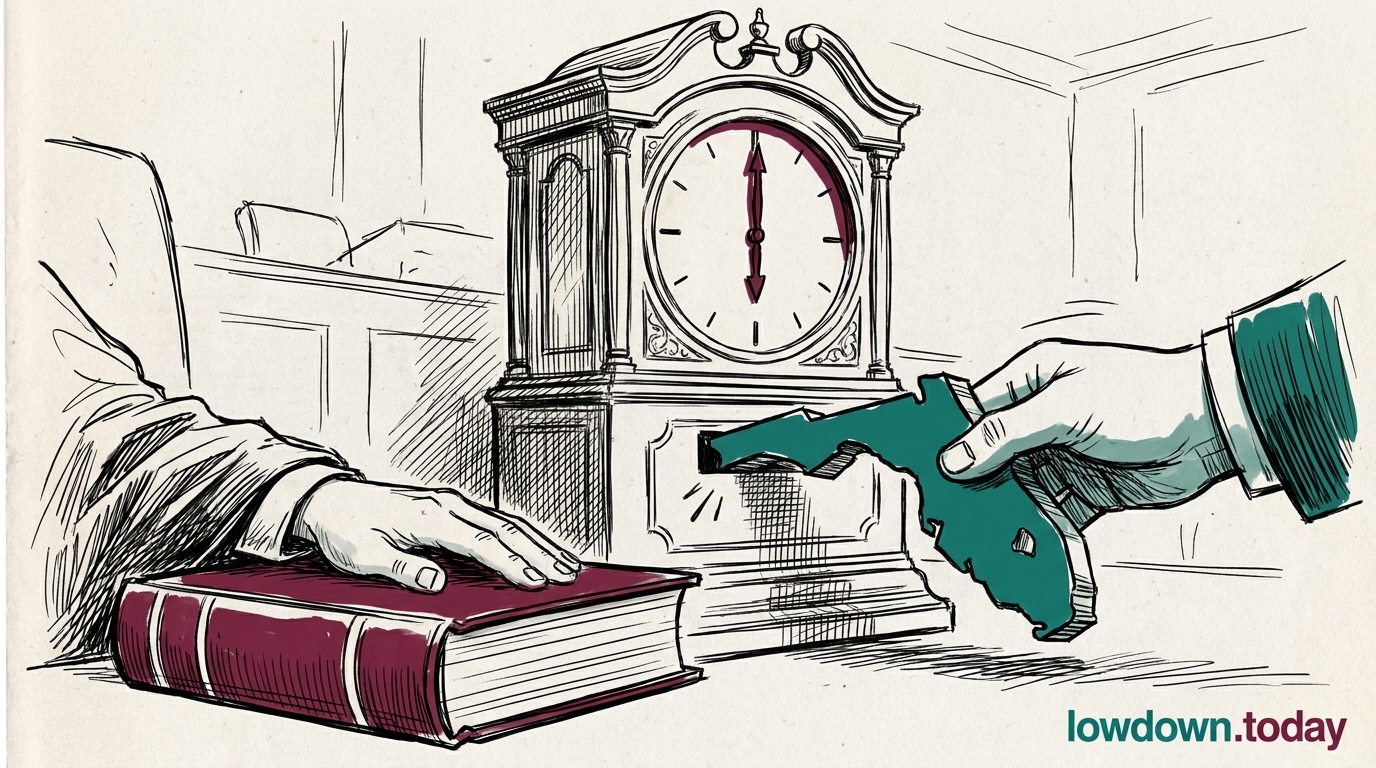
Plaintiffs filed the first legal challenge to the 24R-4D map within hours of Governor Ron DeSantis's signature on the afternoon of Monday 4 May. 1 The complaint cites Florida's Fair Districts Amendment, the 2010 state constitutional ban on partisan gerrymanders adopted by referendum, which prohibits drawing districts to favour or disfavour a political party.

The procedural point matters because Louisiana v. Callais removed the federal Voting Rights Act Section 2 route to challenge mid-decade maps; the Fair Districts Amendment is a state-level ban that the federal ruling does not touch. State courts in Tallahassee, not federal courts in Atlanta, will hear it.

The amendment is narrower than VRA Section 2 in scope: it does not mandate majority-minority districts, it bars partisan intent. Plaintiffs must therefore prove the DeSantis map was drawn for partisan advantage, a higher evidentiary bar than the demographic test that has now been retired federally. The 2015 Florida Supreme Court ruling that struck the prior congressional map under the same amendment is the only useful precedent. Senate President Ben Albritton's April refusal to draft the map and DeSantis's original session-timing manoeuvre both feed into the litigation record on intent.

Deep Analysis

In plain English

Florida voters passed the Fair Districts Amendment in 2010 by a large margin. It says that when Florida draws congressional districts, maps cannot be designed to give one political party an advantage. When courts find a violation, they can strike the map and order a redraw. This amendment exists separately from federal law, so when the Supreme Court removed a key federal protection for minority voters last week, the Florida amendment remained fully in force. The new lawsuit argues that the 24R-4D map was designed precisely to help Republicans and hurt Democrats, which the amendment prohibits. The challenge does not claim racial discrimination under the Voting Rights Act. Instead, it claims partisan intent. To win, plaintiffs need to show that the map was drawn to favour Republicans, which may involve examining emails, meeting records, and who was in the room when the lines were drawn.

Deep Analysis
Root Causes

Florida's Fair Districts Amendment was drafted specifically to address the 2002 gerrymander and the subsequent 2012 maps. Its framers anticipated legislative manipulation and wrote a broad intent standard. What they did not anticipate was a governor taking direct control of map design, effectively bypassing the legislative process the Amendment was written to police.

The legal gap exists because Florida's constitution gives the governor authority to submit a proposed map to the legislature, which the legislature may adopt or amend. DeSantis used this power to its maximum extent; the legislature ratified the submission without substantive revision. The Amendment's drafters assumed the legislature would be the active designer.

What could happen next?
  • Risk

    Discovery in the Fair Districts case may produce internal communications from the governor's redistricting staff that expand the evidentiary record beyond what the 2015 Romo litigation surfaced.

    Short term · 0.65
  • Opportunity

    If the Florida Supreme Court grants an expedited hearing, a remedial map order before the November 2026 election could restore one or more of the four targeted Democratic districts.

    Short term · 0.5
  • Precedent

    A ruling on whether the Fair Districts Amendment reaches governor-drafted maps would define the constitutional boundary of executive map-submission authority across every state where the governor has formal map powers.

    Long term · 0.75
First Reported In

Update #5 · Callais lands; maps move

Florida Phoenix· 7 May 2026
Read original
Different Perspectives
EU Commission trade directorate
EU trade officials note Iowa Senate moving on Iran-war fertiliser prices confirms the cross-topic energy transmission they flagged after Gulf shocks in May. A Democratic Senate from January 2027 would restore Ways and Means leverage on tariff schedules, reducing the probability of a locked Republican trade posture through 2028.
Chatham House democracy analysts
Chatham House analysts assess the Florida qualifying deadline as the point at which redistricting litigation migrated from a live 2026 variable to a post-cycle accountability mechanism; the shadow docket's 7-day Alabama reversal on 2 June and the 13 June Florida lock together confirm that judicial review now operates retrospectively rather than preventively in redistricting disputes.
V-Dem Institute
V-Dem Institute
V-Dem's electoral integrity index identifies the Callais-to-Alabama-stay-to-Florida-qualifying sequence as completing a 13-year Roberts Court rollback: Shelby County (2013) removed preclearance, Brnovich (2021) narrowed vote-denial claims, Callais removed the majority-minority mandate, and the shadow-docket reversal window now forecloses injunctive remedies within any single electoral cycle, meaning judicial review operates retrospectively rather than preventively in redistricting disputes.
Brennan Center for Justice
The Brennan Center characterises Florida's 6-1 ruling as jurisdictional avoidance achieving the same result as a merits ruling, split precisely on appointment lines: all six DeSantis appointees declined to examine his own map. The Equal Ground challenge continues at the First District Court of Appeal with no 2026 remedy available.
National Republican Senatorial Committee
The NRSC brought NRSC v. FEC because the Senate Leadership Fund's parallel-operation model cannot replicate direct candidate coordination, and the December 2025 argument signalled the conservative majority would strike caps ranging from $61,800 to $3.7M per race. A favourable ruling would let the NRSC channel unlimited funds directly through Iowa and four other live Senate campaigns.
EU Commission trade policy directorate
EU trade analysts note the D+6.9 generic ballot is the first reading this cycle making a Democratic House flip structurally plausible; a Ways and Means Committee under Democratic chairmanship after January 2027 would restore congressional leverage on tariff schedules, reducing the probability of locked Republican tariff posture through 2028.