Skip to content
Welcome, thoughtbot's Giant Robots listeners!Start here
US Midterms 2026
27OCT

Koch PAC drops $6.4M in one day

3 min read
13:20UTC

Americans for Prosperity Action filed about $6.4 million of Senate adverts across five states on Tuesday 2 June, tilting the airwaves Republican even as Democrats held the party-committee cash lead.

PoliticsAssessed
Key takeaway

AFP Action's early Iowa and Montana spend signals exposure in seats forecasters still rate Republican.

Americans for Prosperity Action (AFP Action), the Koch network's Super PAC, filed roughly $6.4 million of Senate independent expenditures in a single day on Tuesday 2 June, across five states⁠1. Federal law bars these independent expenditures from coordinating with any campaign. The breakdown: $1.77M for Mike Rogers in Michigan, $1.75M on Ohio backing Jon Husted and opposing Sherrod Brown, $798,000 for Ashley Hinson in Iowa, $500,000 for Kurt Alme in Montana, and $375,000 against Chris Pappas in New Hampshire. Federal Election Commission data shows Republican-aligned Senate IEs outpacing Democratic-aligned ones by roughly 2.3 to 1 across the 29 May to 6 June window⁠2.

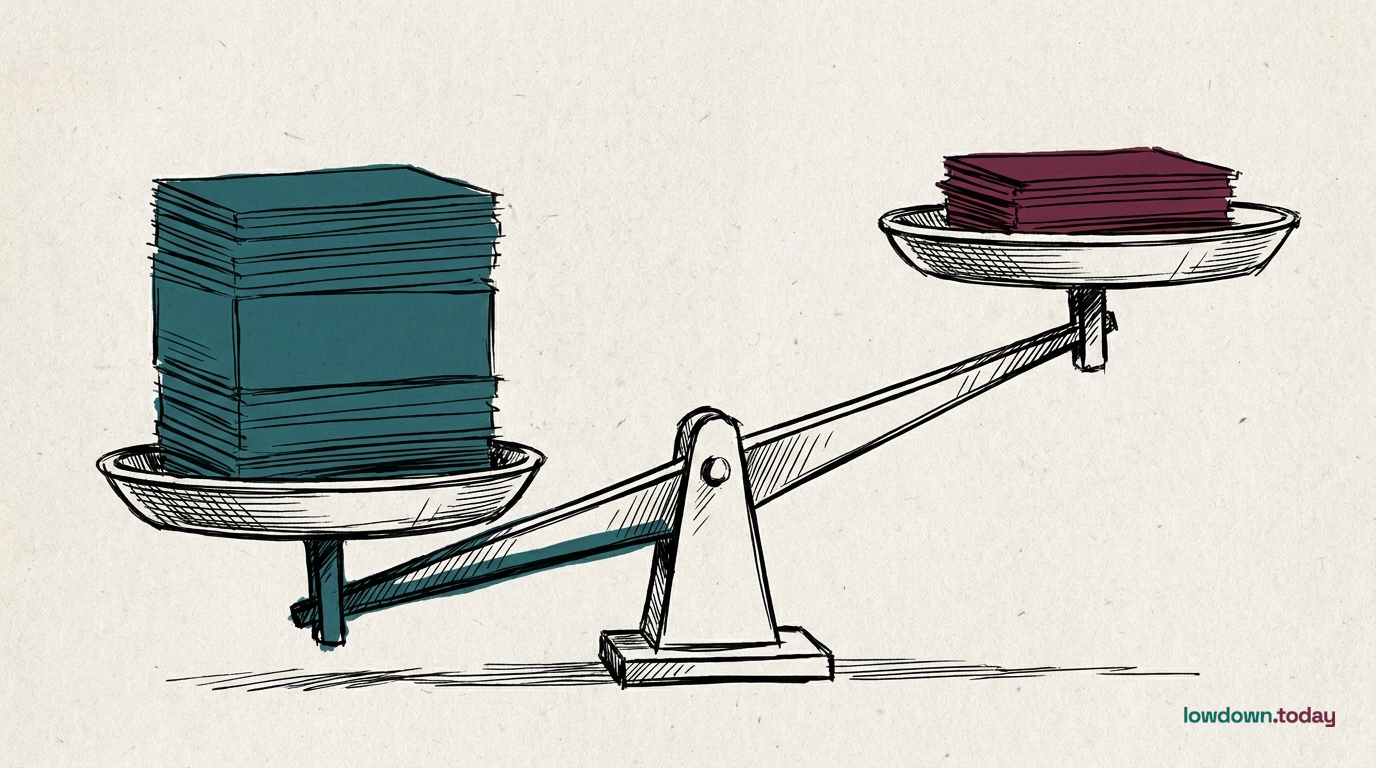
That inverts the committee-cash picture. Democrats hold the party-committee edge, with the DCCC carrying a $12.6M cash lead over its Republican counterpart the NRCC, a reversal of the NRCC's $8.3M Q1 advantage that flipped over April. Neither lead substitutes for the other. A committee dollar funds field offices, registration drives and coordinated expenditures tied to a named candidate; a super-PAC dollar buys a television week and nothing else. The 2026 money fight is running on two separate tracks, one ground-war and one broadcast, and each side leads a different one.

The state choices read as a leading indicator. AFP Action's $798,000 for Iowa and $500,000 for Montana are heavier than public ratings imply for seats forecasters still lean Republican, and the spend landed before any forecaster moved to match it. Outside money built on donor data that runs more current than any published model arrives where a network privately sees exposure. Where the Koch network defends first marks where its own modelling sees risk, which is why the Iowa and Montana placements matter beyond their dollar size.


Deep Analysis

In plain English

In US elections, 'independent expenditures' (IEs) are money spent by outside groups to support or oppose candidates, but which cannot legally be coordinated with the candidate's own campaign. the Supreme Court's Citizens United ruling (2010) removed limits on how much these groups can spend. Americans for Prosperity Action is the political arm of the network built by billionaire Charles Koch. On 2 June 2026 it filed paperwork showing it had spent $6.4 million in a single day across five US Senate races. This kind of large, sudden deployment is a signal: it tells TV stations to reserve airtime, and it signals to other donors that the Koch network has decided these are priority races. Republican groups collectively spent about 2.3 times more on Senate outside money than Democratic groups in the same week. Democratic committees have more money in their own accounts, but outside money and committee money cannot legally be used for the same things.

Deep Analysis
Root Causes

AFP Action can deploy $6.4 million across five states in a single day because the post-Citizens United (2010) regulatory framework places no aggregate cap on Super PAC independent expenditures, and the FEC's electronic filing system means disclosures are public within 48 hours of filing, creating a signalling mechanism where the spend itself is the announcement.

The concentration of the deployment in two Senate seats (Michigan and Ohio representing 55% of the total) reflects the mechanics of the electoral college's Senate equivalent: if Republicans hold Michigan and Ohio, the Senate majority is almost certainly preserved regardless of outcomes in Iowa, Montana, and New Hampshire. AFP Action's internal seat-priority model is therefore visible in the dollar weighting, which skews toward must-hold seats over marginal-gain opportunities.

What could happen next?
  • Consequence

    AFP Action's deployment effectively sets airtime reservation prices in Michigan and Ohio DMAs, pricing late-entering Democratic outside groups out of the best broadcast inventory.

  • Meaning

    AFP Action's willingness to spend in races it did not control in the primary (Rogers, Husted) suggests the Koch network has adopted a Senate-majority-first logic over candidate-selection purity for 2026.

First Reported In

Update #8 · Shadow docket shields maps

Federal Election Commission· 6 Jun 2026
Read original →
Different Perspectives
Missouri voters
Missouri voters
Missouri voters rejected Proposition A by 61.83% to 38.17% at 95% reporting, repealing the 2025 map that split Kansas City. Trump carried the state, yet its 2022 lines now stay for future elections too.
Senate Leadership Fund (SLF)
SLF reported about $43.9m of independent expenditures from 27 October to 1 November, almost all against Democrats, including $12.37m against Sherrod Brown. Seven of its ten targets won; Dan Osborn lost in Nebraska and two are uncalled.
Richard Hudson, chair of the National Republican Congressional Committee
Hudson, who runs House Republicans' campaign arm, conceded North Carolina's 9th District to Richard Ojeda before any AP call. Democrats lead 10 of the state's 14 House districts on the unofficial feed.
Department of Justice (DOJ)
DOJ lost before Judge David O. Carter on 28 October and a 9th Circuit panel on 30 October on its demand to set aside 20,000 California ballots, and says it will appeal the Alaska dismissal. No court has set a ballot aside.
Senator Dan S. Sullivan
Sullivan, who trails Mary Peltola 48.2% to 47.9% on first choices, told CNN he would accept the result. DOJ's suit to stop Alaska certifying anyone but him was dismissed on 1 November.
Scott Colom's campaign
Colom's campaign estimates that about 15,000 affidavit ballots remain to be counted in a race he leads by roughly 65 to 100 votes. Those ballots count only if voters confirm their ID or eligibility by 5pm on 10 November.

Written with AI from Lowdown's published reporting. Not individually reviewed by an editor. Editorial standards.