Skip to content
You can now search across every topic, entity and event.What's new
US Midterms 2026
7SEP

Virginia court kills Democrats' last 2026 track

3 min read
13:32UTC

The Supreme Court of Virginia struck down the mid-decade redistricting amendment 4-3 on Friday 8 May, eleven days after oral argument; the ruling closes every Democratic counter-track for 2026.

PoliticsDeveloping
Key takeaway

A century-old timing rule, applied 4-3, unwound a 50-49 referendum and $79 million of advertising.

The Supreme Court of Virginia struck down the mid-decade redistricting amendment 4-3 on Friday 8 May, eleven days after the bench heard oral argument . The majority held the legislature had violated the constitution's intervening-election rule: approximately 1.3 million ballots in the 2025 general election, around 40% of the total, had been cast before legislators completed the first of two required votes on the amendment text 1. The US Supreme Court declined to intervene. The procedural basis leaves no federal appeal path.

The 2021 bipartisan commission maps stand for the 2026 cycle. Cook Political Report's conditional move of five Virginia House seats toward Democrats, made on the day of the SCOVA arguments, is now void. The ruling completes the procedural sequence Judge Hurley began on 22 April when he voided the referendum result on equivalent timing grounds . A 50.7-49.3% popular vote and roughly $79 million of 501(c)(4) campaign spending were unwound despite the margin.

The intervening-election rule predates the partisan-redistricting fight by more than a century. SCOVA's 4-3 application of it to the 2025 general election is a doctrinally orthodox reading, severable from the political effect, which is why the federal court declined to take the case up. The dissent, written by Justice Mims, argued that the legislature's first vote satisfied the rule because the second vote was the operative ratification; on that reading, the timing of the second vote, not the first, governs.

The ruling pairs with the Maryland counter-track, dead since April after Senate President Bill Ferguson held the House-passed map off his chamber's floor . With Virginia closed, the Democratic 2026 retaliation map exists only as intent in California and Albany, and neither delivers seats by November.

Deep Analysis

In plain English

Virginia has an unusual system for changing its constitution. First, one set of state legislators must vote yes. Then voters elect a new legislature. That new legislature must vote yes again. Voters then hold a public referendum on the text both legislatures approved. In 2025, Virginia held a referendum on changing how its congressional districts were drawn. Around 1.3 million people voted in that referendum before the state legislature had even finished completing the first required step. Virginia's Supreme Court ruled 4-3 that casting 1.3 million ballots before the first legislative vote violated the intervening-election rule and nullified the amendment. This matters for 2026 because the change would have made five Virginia seats more likely to go Democrat. Without it, the existing 2021 maps stay in place.

Deep Analysis
Root Causes

The Virginia ruling has two structural roots that the event body does not develop.

Virginia's amendment process requires two separately elected legislatures to pass an amendment before it goes to referendum, a design found in fewer than ten states. The intervening-election rule exists precisely to ensure that the second legislature, elected after the first passage, has ratified the text the voters will see.

The 2025 attempt to compress this timeline by completing both legislative steps across a single election cycle created the timing conflict SCOVA resolved against the amendment.

The second root is the $79 million in 501(c)(4) spending that the redistricting campaign deployed. That level of investment in a referendum drive forced a compressed calendar, which in turn pushed the first legislative vote into a window where early-voting ballots were already being cast. The spending that was supposed to make the amendment succeed may have contributed to the procedural failure by compressing the timeline beyond what the constitution permitted.

What could happen next?
  • Precedent

    SCOVA's application of the first-vote trigger rather than the ratification trigger creates a stricter intervening-election standard than most states have applied, and could be cited in other states attempting mid-decade constitutional amendment redistricting.

    Medium term · 0.68
  • Consequence

    The $79 million in 501(c)(4) campaign spending on the Virginia redistricting referendum produced zero seats for November 2026, accelerating Democratic donor reallocation toward Texas and other competitive individual race targets.

    Short term · 0.75
  • Consequence

    Cook Political Report's conditional five-seat shift toward Democrats is void. Virginia's 2026 House map reverts to the 2021 bipartisan commission lines, leaving the state's competitive seats unchanged from pre-cycle baselines.

    Immediate · 0.95
  • Risk

    The no-federal-appeal path means the Democratic redistricting toolkit in Virginia is exhausted until at least 2028, when the two-legislature sequence could theoretically complete with correct timing.

    Long term · 0.88
First Reported In

Update #6 · A primary nullified mid-vote

Virginia Mercury· 19 May 2026
Read original
Different Perspectives
New Hampshire student voters
Students who hold no accepted photo ID under HB 323 cannot vote in the 8 September primary after Judge Laplante declined to block the law on timing grounds. Whether the same rule applies on 3 November is still open.
Alaska Democratic Party
The Alaska Democratic Party moved $884,835 in coordinated spending to Mary Peltola between 17 and 30 July, more than the DCCC spent nationally in the same fortnight.
National Republican Senatorial Committee
The NRSC, which sued to remove coordinated-spending caps in NRSC v. FEC, put $2,230,472 behind candidates in the first complete month after winning that case, more than double the total for the prior six months combined.
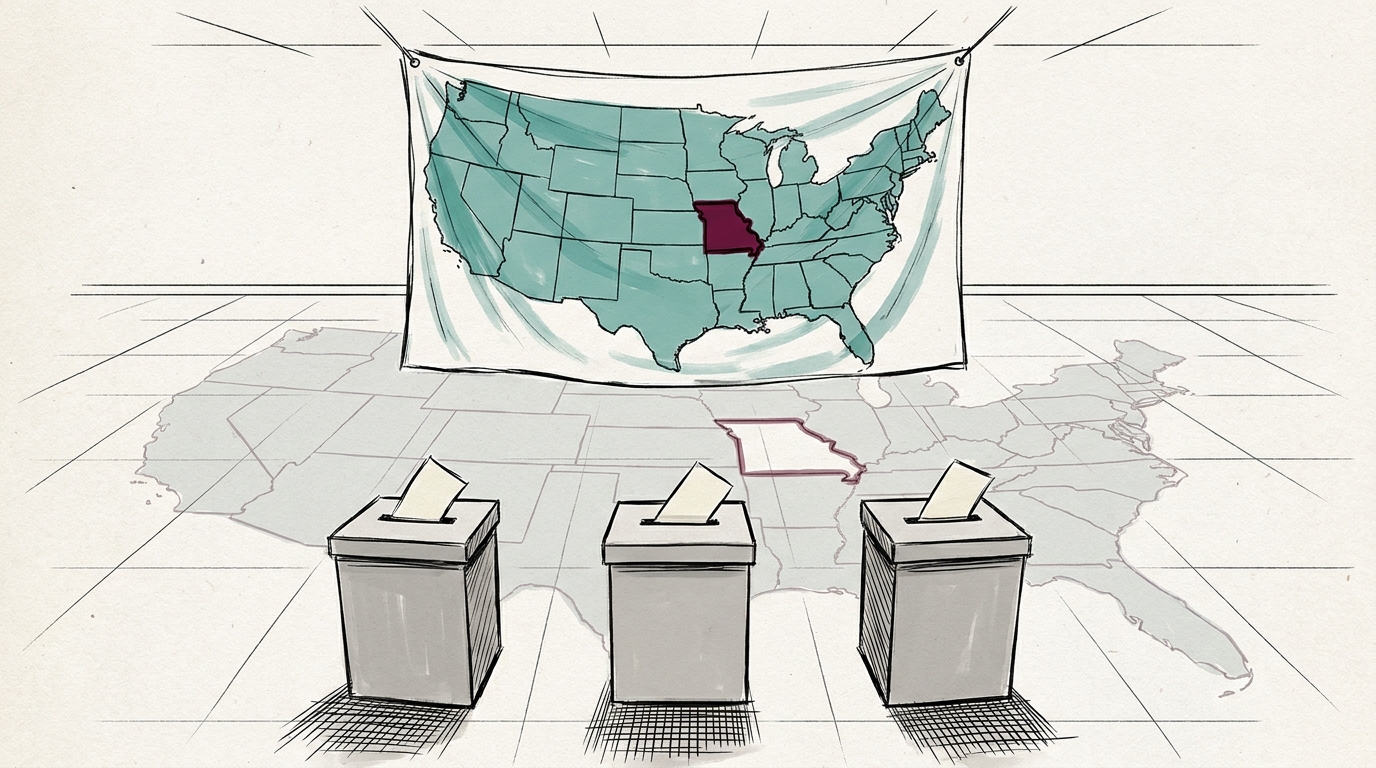
Supreme Court of Missouri
The unanimous court held that Article III, section 49 carries no redistricting exception, so a referendum petition against a congressional map is as valid as against any other law. It ordered the 2022 map to govern unless voters approve HB 1 on 3 November.
Denny Hoskins, Missouri Secretary of State
Hoskins told the Supreme Court that changing the congressional map after 1.2 million primary votes and ahead of the 19 September overseas-ballot deadline violates Purcell and the Elections Clause. He wants HB 1 reinstated before ballots print for November.
Senate Republican leadership
Floor time is finite at 51-47 with a bipartisan funding negotiation running, and a contested procedural fight over grant conditions is not the best use of it this month. Nothing has been abandoned; the resolution keeps its place on the calendar.
