Skip to content
You can now search across every topic, entity and event.What's new
US Midterms 2026
7SEP

Pollsters split eight points on the House

3 min read
13:32UTC

Pollsters now disagree by eight points on the same race. Silver Bulletin reads D+6.2; institutional surveys cluster at D+3 to D+5, leaving Democrats, on Harry Enten's reckoning, right on the border for the House.

PoliticsDeveloping
Key takeaway

Strict polls put Democrats at the House threshold; loose ones put them in wave water.

Nate Silver's Silver Bulletin put its generic congressional ballot average at D+6.2 on 20 June, down from the D+6.9 it reached on 28 May 1. The generic ballot, the poll asking which party a voter would back for the US House, no longer agrees with itself across pollsters. Institutional pollsters tell a quieter story: NBC, Marquette and Ipsos cluster at D+3 to D+5, with Reuters/Ipsos at D+3, while Emerson sits out at D+11 2. The readings disagree by eight points on the same question in the same fortnight.

That spread is what campaigns have to work with. Harry Enten of CNN put the stakes plainly on 17 June: Democrats need roughly D+3 to D+4 to overcome the Republican redistricting edge and win the House, which leaves them, on the institutional numbers, "right on the border" 3. Aggregators place them in comfortable wave water; the high-quality polls place them at the waterline. The gap is a fight about who turns out, decided by how each pollster screens for likely voters and weights party identification. Midterm electorates are smaller and more partisan than presidential ones, and the eight points reflect competing bets on whether 2026 turnout looks like a base-mobilisation year or a broad-anger year.

Intra-party defection supplies the evidence for the pessimistic read. Donald Trump's economy approval hit a record-low 33% in a Marist Poll fielded 8 to 11 June and published over 18 to 20 June, his worst since Marist began asking in 2019 4. The figure inside his own coalition matters most: 22% of Republicans disapprove of his handling of the economy 5, the home-team erosion that has preceded past waves. A Republican strategist would counter that headline approval near 36% still holds in an electorate that votes its tribe regardless of grocery bills.

Deep Analysis

In plain English

The generic congressional ballot is a poll question that asks voters whether they plan to vote for a Democrat or Republican for Congress, without naming a specific candidate. Pollsters use it to estimate how the national environment will translate into actual seat gains or losses. Right now, depending on which poll you look at, Democrats are leading by anywhere from three to eleven percentage points on this measure. That range is unusually wide. The disagreement is not about a fact; it is about what method you use to estimate who will actually turn out to vote in November. Harry Enten, a CNN data analyst, said on 17 June that Democrats need to lead by about three to four points to overcome the Republicans' map advantage and take control of the House. Reuters/Ipsos at D+3 puts Democrats exactly at that threshold. Emerson at D+11 puts them far above it. Whether November lands closer to D+3 or D+7 is the most consequential unresolved question of the cycle.

Deep Analysis
Root Causes

The eight-point spread between Emerson (D+11) and Reuters/Ipsos (D+3) traces to methodological assumptions, not electoral reality. Emerson uses a registered-voter screen; Reuters/Ipsos applies a tighter likely-voter model corrected for partisan non-response. Both are defensible.

Trump's 33% economy approval (Marist) provides the structural underpinning for the D+6 to D+7 range. When economy approval falls below 35% in a midterm year, the president's party has historically lost an average of 35 to 45 House seats.

The 22% Republican intra-party disapproval on the economy is the more unusual figure: it suggests Trump's economic handling is generating discontent among voters who will almost certainly still vote, but may vote differently than their party registration predicts.

What could happen next?
  • Risk

    If the true environment is closer to D+3 (institutional polls), Democrats face a grind-out majority fight that depends on turning out their base in specific districts. A D+6 environment is wave territory; a D+3 environment is not.

  • Meaning

    The 22% Republican economic disapproval rate in Marist is a leading indicator of potential cross-party defection in competitive districts; it is above the 15-18% intra-party disapproval that preceded the 2018 Democratic wave.

First Reported In

Update #10 · Wave or grind: the measure splits

Silver Bulletin· 21 Jun 2026
Read original
Different Perspectives
New Hampshire student voters
Students who hold no accepted photo ID under HB 323 cannot vote in the 8 September primary after Judge Laplante declined to block the law on timing grounds. Whether the same rule applies on 3 November is still open.
Alaska Democratic Party
The Alaska Democratic Party moved $884,835 in coordinated spending to Mary Peltola between 17 and 30 July, more than the DCCC spent nationally in the same fortnight.
National Republican Senatorial Committee
The NRSC, which sued to remove coordinated-spending caps in NRSC v. FEC, put $2,230,472 behind candidates in the first complete month after winning that case, more than double the total for the prior six months combined.
Supreme Court of Missouri
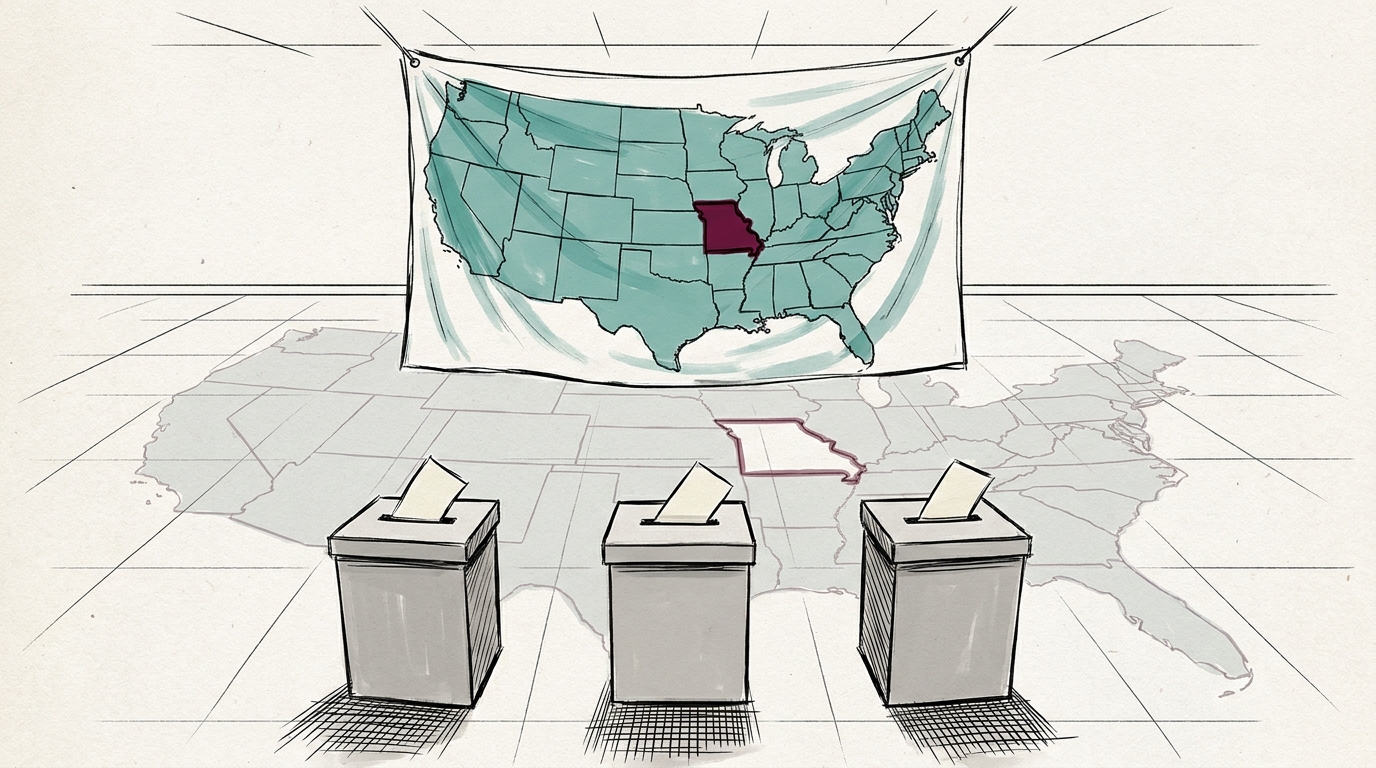
The unanimous court held that Article III, section 49 carries no redistricting exception, so a referendum petition against a congressional map is as valid as against any other law. It ordered the 2022 map to govern unless voters approve HB 1 on 3 November.
Denny Hoskins, Missouri Secretary of State
Hoskins told the Supreme Court that changing the congressional map after 1.2 million primary votes and ahead of the 19 September overseas-ballot deadline violates Purcell and the Elections Clause. He wants HB 1 reinstated before ballots print for November.
Senate Republican leadership
Floor time is finite at 51-47 with a bipartisan funding negotiation running, and a contested procedural fight over grant conditions is not the best use of it this month. Nothing has been abandoned; the resolution keeps its place on the calendar.
