Skip to content
You can now search across every topic, entity and event.What's new
US Midterms 2026
7SEP

Generic ballot hits D+5.8, first this cycle

3 min read
13:32UTC

Silver Bulletin's generic-ballot average reached D+5.8 on Tuesday 28 April, the first reading at that level this cycle and a 9.1-point cumulative swing from R+3.3 in January 2025.

PoliticsDeveloping
Key takeaway

A 9.1-point shift across 16 months is the structural signal; what matters is whether it holds through Labor Day.

Silver Bulletin's generic-ballot average reached D+5.8 on Tuesday 28 April, the first reading at that level this cycle 1. The figure is an aggregate of national polls asking voters whether they plan to support a Democrat or Republican for Congress; D+5.8 means Democrats lead by 5.8 percentage points. Cumulatively, the average has swung 9.1 points from R+3.3 in January 2025, a movement that has been consistent rather than spiked.

Three completed special elections sit alongside the polling shift. The GA-14 runoff on Wednesday 8 April produced a 25-point swing toward Democrats in a Republican stronghold ; the Wisconsin Supreme Court race the same day delivered a 20-point liberal margin ; the NJ-11 result on 16 April held the safe Democratic baseline. Two of those three ran 15 to 25 points ahead of the generic ballot. That ratio is what distinguishes a noise pattern from a structural one: overperformance concentrated in competitive or Republican-leaning seats, baseline performance in safe seats.

The cumulative 9.1-point shift from January 2025 is the structural variable. A swing of that size across 16 months of polling tracks closely with the 2017-2018 cycle that preceded the Democratic 41-seat House gain. The historical analogy is imperfect because the current House map is different and the Senate map is much harder for Democrats. Counter-view from polling sceptics: generic-ballot swings of this magnitude often compress in the final two months of a campaign as the out-party's structural advantage gets priced in by national polling and as paid advertising lands. The figure that matters is not D+5.8 in April; it is whatever the average reads at Labor Day.

Deep Analysis

In plain English

A generic ballot poll asks voters: if an election were held today, would you vote for a Democrat or Republican for Congress? Nate Silver's polling aggregator, Silver Bulletin, now shows Democrats leading by 5.8 percentage points on 28 April, the highest reading this election cycle. This is a swing of 9.1 points from January 2025, when Republicans led by 3.3 points. Historically, a swing this large has produced significant House seat changes, though the precise number depends on how efficiently votes translate to seats in the districts being contested.

Deep Analysis
Root Causes

The 9.1-point swing from R+3.3 to D+5.8 is driven by two converging factors that Silver Bulletin's aggregate separates: declining Republican approval in suburban districts that were competitive in 2022-2024, and a collapse in low-income voter Republican support traceable to tariff-driven cost-of-living increases.

These factors are structurally different. Suburban decline is a longer-running trend that began in 2016 and has continued through each subsequent election. Low-income defection is a new factor tied to specific economic policy, specifically the 2025-2026 tariff regime, and is potentially reversible if tariff policy changes before November.

What could happen next?
  • Consequence

    Brookings Institution regression maps D+5.8 to 12-20 Republican seat losses in November, which would give Democrats a House majority if the top end of that range materialises on a map where Republicans currently hold 217 seats.

  • Risk

    Generic ballot compression in the final two months before an election is a documented pattern in midterm cycles. If D+5.8 compresses to D+3 or below by Labor Day, the structural advantage narrows below the seat-change threshold.

First Reported In

Update #4 · Calendar versus court

Silver Bulletin· 28 Apr 2026
Read original
Different Perspectives
New Hampshire student voters
Students who hold no accepted photo ID under HB 323 cannot vote in the 8 September primary after Judge Laplante declined to block the law on timing grounds. Whether the same rule applies on 3 November is still open.
Alaska Democratic Party
The Alaska Democratic Party moved $884,835 in coordinated spending to Mary Peltola between 17 and 30 July, more than the DCCC spent nationally in the same fortnight.
National Republican Senatorial Committee
The NRSC, which sued to remove coordinated-spending caps in NRSC v. FEC, put $2,230,472 behind candidates in the first complete month after winning that case, more than double the total for the prior six months combined.
Supreme Court of Missouri
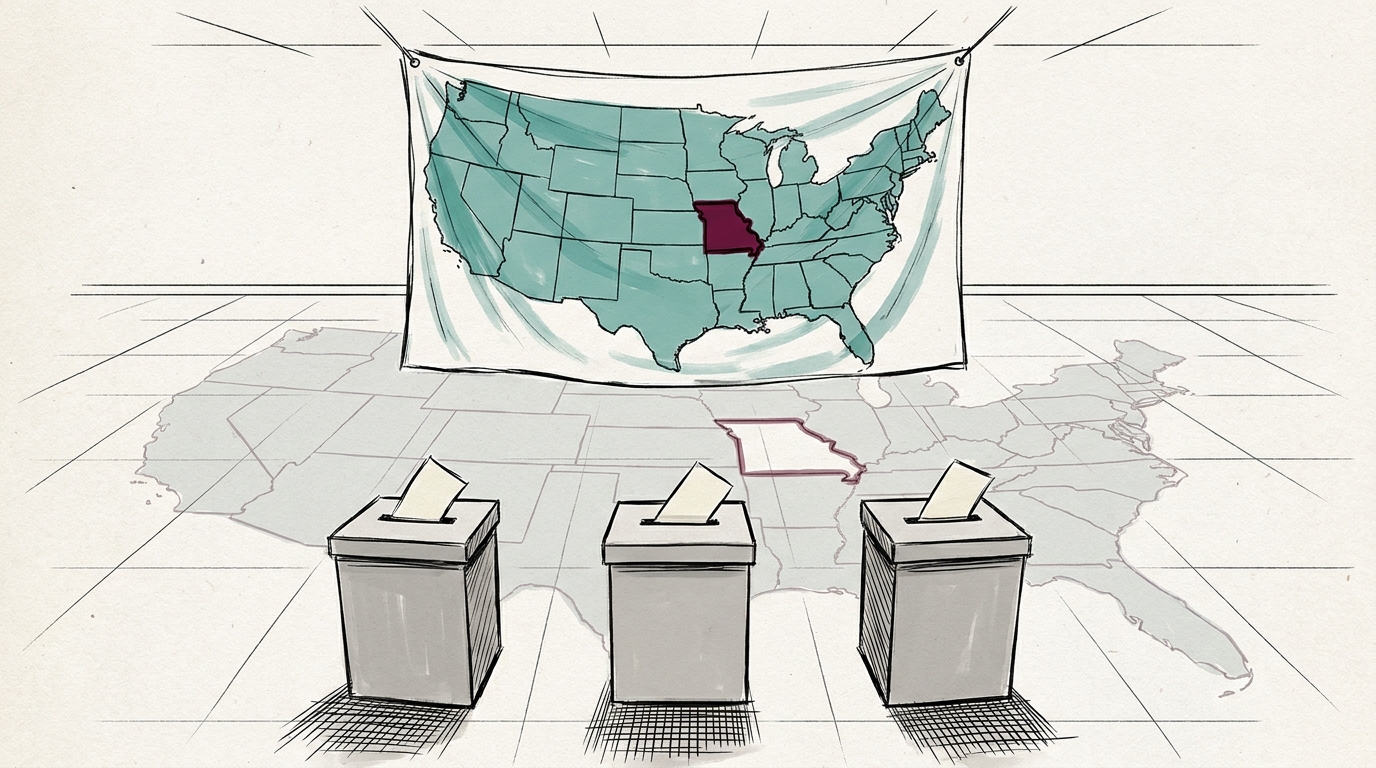
The unanimous court held that Article III, section 49 carries no redistricting exception, so a referendum petition against a congressional map is as valid as against any other law. It ordered the 2022 map to govern unless voters approve HB 1 on 3 November.
Denny Hoskins, Missouri Secretary of State
Hoskins told the Supreme Court that changing the congressional map after 1.2 million primary votes and ahead of the 19 September overseas-ballot deadline violates Purcell and the Elections Clause. He wants HB 1 reinstated before ballots print for November.
Senate Republican leadership
Floor time is finite at 51-47 with a bipartisan funding negotiation running, and a contested procedural fight over grant conditions is not the best use of it this month. Nothing has been abandoned; the resolution keeps its place on the calendar.
