Skip to content
Briefings are running a touch slower this week while we rebuild the foundations.See roadmap
Russia-Ukraine War 2026
27MAR

Russia sends upgraded drones to Iran

2 min read
20:48UTC

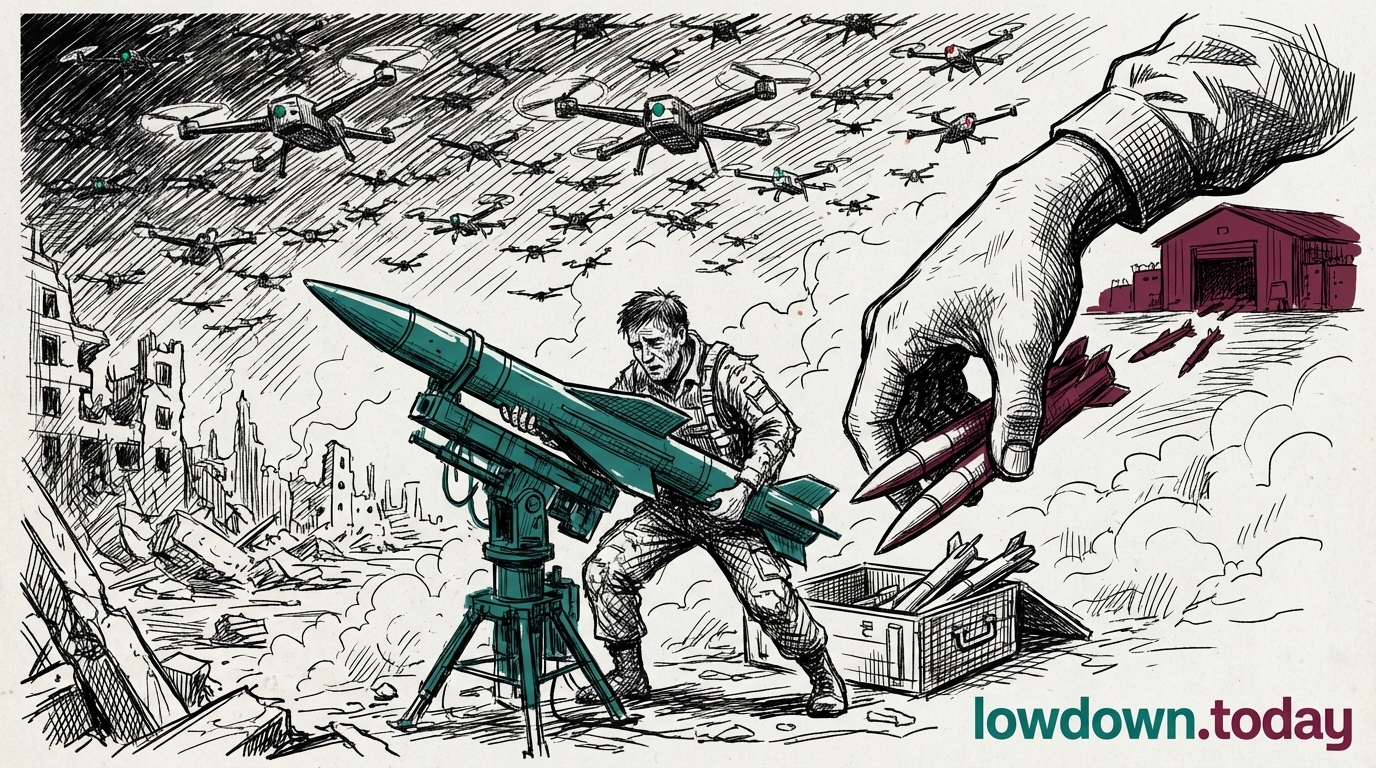
Iran taught Russia to build Shaheds. Russia industrialised the design and shipped upgraded versions back at 1,000 per day.

ConflictDeveloping
Key takeaway

Industrial-scale drone production reshapes the war's attritional arithmetic against depleting defences.

Russia shipped upgraded Geran-2 drone variants to Iran via sea, with delivery completed by end of March . President Zelensky confirmed the transfer. Russia also provided satellite targeting data, according to the Washington Post. Russia builds roughly 1,000 Geran-2s per day. 1

The reversal is strategically remarkable. Iran supplied Russia with the original Shahed-136 drones for use in Ukraine. Russia industrialised the design, upgraded it with jet propulsion and improved guidance, and is now shipping the product back. Iran's single-day intercept numbers on 3 April (47 drones in one UAE engagement alone) may reflect this expanded supply. With THAAD and Arrow stocks depleting, the attritional arithmetic favours the side that can produce munitions at industrial scale.


Deep Analysis

In plain English

Iran originally designed a cheap drone called the Shahed-136 and gave the design to Russia for use in Ukraine. Russia built a factory and upgraded the design, producing 1,000 of them a day. It then shipped upgraded versions back to Iran. This matters because Iran's missiles and drones are being intercepted at high rates, burning through expensive US and Israeli defensive rockets. With Russia supplying cheap drones faster than defences can be rebuilt, the war of attrition favours Iran.

Deep Analysis
Root Causes

Russia's incentive is threefold: degrade US military capacity and attention, test upgraded drone variants in live combat, and deepen Iran's strategic dependency for oil and political cover.

The Geran-2 improvement over the Shahed-136 includes jet propulsion and improved guidance, making it harder to intercept and more accurate. At 1,000 per day, Russia can sustain Iranian strike capacity indefinitely against depleting THAAD and Arrow stocks.

What could happen next?
  • Consequence

    Russian industrial supply allows Iran to sustain drone strike rates indefinitely, accelerating Arrow-3 and THAAD depletion beyond RUSI's March projections.

  • Precedent

    The Shahed-Geran supply loop creates a precedent for reverse-technology transfer between Russia and Iran that will outlast this conflict and reshape both arsenals.

First Reported In

Update #58 · First US aircraft fall over Iran

USNI Proceedings / War on the Rocks· 4 Apr 2026
Read original
Different Perspectives
North Korea / DPRK
North Korea / DPRK
ISW confirmed the first mounting of DPRK Type-75 MLRS on Russian autonomous UGVs near Kharkiv on 7 June, the latest step in a supply axis that escalated from shells in 2023 to troops in 2024. Pyongyang gains live battlefield data on its ordnance and on Russia's uncrewed-systems programme.
IAEA / Rafael Grossi
Grossi confirmed Chornobyl structural damage with nuclear material metres away and could not attribute the ZNPP 15-hour blackout during the agreed repair window. Six ceasefires brokered and broken at ZNPP, compounded by Rosatom's May attack on IAEA neutrality, have eroded his ability to enforce the windows he negotiates.
Emmanuel Macron / France
Macron co-signed the E3 framework whose line-of-contact baseline marks Europe's first formal acceptance that 1991 borders are not the opening position. France's role carries weight because Macron had previously proposed a European force for Ukraine, and the framework's multinational force point is the vehicle for that.
Keir Starmer / E3
Keir Starmer / E3
Starmer, Macron and Merz met Zelenskyy on 7 June and backed a five-point framework taking the line of contact as the talks baseline, conceding roughly one fifth of Ukraine in exchange for a multinational force and frozen assets. With US mediation ended, the NATO Ankara summit on 7-8 July is the next test.
Vladimir Putin / Kremlin
Putin used SPIEF to reject Zelenskyy's summit letter, citing 'elements of rudeness', and repeated the pre-agreed treaty precondition that has frozen every diplomatic round since May. The SPIEF platform's message of investor confidence was punctured by naval fires visible from St Petersburg, which Moscow declined to dispute in scale.
Ukraine / Unmanned Systems Forces
Commander Brovdi confirmed USF units tracked and set fire to Boikyi at Kronstadt, while Code 9.2 struck the Chonhar Bridge the following day. Ukraine is sequencing strikes for rear-area interdiction and political timing rather than ground gains, trading the Baltic Fleet's home base for the logistics squeeze Russia cannot absorb without rationing its own occupied territory.



