Skip to content
Briefings are running a touch slower this week while we rebuild the foundations.See roadmap
Russia-Ukraine War 2026
27MAR

UNSC emergency session ends with nothing

3 min read
20:48UTC

Guterres condemned all sides; Russia invoked betrayal, Iran invoked war crimes, the US invoked non-proliferation. No binding resolution emerged.

ConflictDeveloping
Key takeaway

The Security Council's emergency session produced competing condemnations but no binding action, confirming that the Council cannot constrain conflicts in which permanent members are primary actors or their close allies.

The UN Security Council convened its emergency session on Saturday, following France's call earlier in the conflict . Secretary-General António Guterres condemned the US-Israeli strikes as violations of international law and the UN Charter, then condemned Iran's retaliatory strikes — a symmetrical formulation that claims institutional authority while satisfying no party.

The session produced four positions and no outcomes. The US delegation asserted the strikes were lawful and that "Iran cannot have a nuclear weapon" — framing non-proliferation as sufficient legal basis for pre-emptive military action. Russia's representative called the operation a "real betrayal of diplomacy," extending Moscow's earlier characterisation of the strikes as "pre-planned aggression carried out under cover of talks" . Iran's UN ambassador called it a "war crime." No resolution was put to a vote because its failure was predetermined: the United States holds veto power over any measure constraining its own military action.

The Council had already failed to produce binding action in the conflict's opening hours . Saturday confirmed that the failure is structural. The veto was written into the UN Charter in 1945 to ensure the great powers would join the organisation; its consequence is that the body charged with maintaining international peace cannot function when a permanent member is the belligerent. The pattern is not new — the Council was sidelined before the 2003 Iraq invasion and paralysed throughout the Syrian civil war by Russian vetoes — but each repetition strips the institution of relevance in conflicts between or involving major powers.

The practical effect is that no international body can constrain or authorise the ongoing campaign in real time. The International Court of Justice may issue advisory opinions. The General Assembly can pass non-binding resolutions. Individual states can adjust bilateral relations. None of these mechanisms will alter the military operation's trajectory. International humanitarian law will be adjudicated, if at all, after the fighting ends — and by institutions whose jurisdiction the belligerents may not accept.


Deep Analysis

In plain English

The UN Security Council is the world's primary body for authorising or condemning military action, but it has a structural flaw: any of its five permanent members — the US, UK, France, Russia, and China — can veto any resolution. Since the US supports and participated in the strikes, no resolution demanding a ceasefire or declaring the action illegal can pass. The session became a theatre of competing accusations: Russia and Iran called the strikes a war crime or a betrayal of diplomacy, the US called them lawful, and the Secretary-General condemned all sides symmetrically. That symmetrical formulation satisfies nobody and changes nothing on the ground. No binding outcome is possible under the current Charter architecture when a P5 member is directly involved.

Deep Analysis
Synthesis

The Security Council session is significant not for what it achieved but for what it institutionally confirmed: the multilateral order as currently constituted cannot restrain major-power military action against non-P5 states. The competing rhetorical positions will form the foundational competing narratives for subsequent legal proceedings, war crimes inquiries, and historical assessments of the campaign. Iran's 'war crime' framing lays procedural groundwork for eventual ICJ proceedings — as South Africa demonstrated over Gaza. Russia's 'betrayal of diplomacy' framing is designed to exploit Western institutional contradictions and bolster Moscow's positioning as a defender of sovereignty norms. The US insistence on legality under a self-defence or counter-proliferation doctrine will be tested domestically in the war powers debate. None of these legal tracks will affect the immediate military campaign, but they will define the political and legal landscape for years — particularly regarding what precedents the international community treats as established for future non-proliferation enforcement actions.

Root Causes

The Council's structural paralysis on this issue has three driving forces. First, the veto architecture concentrates enforcement power among the P5, meaning any conflict involving a P5 member or their close ally cannot be adjudicated by the Council — a design feature that has always privileged major-power prerogative over universal rule of law. Second, the US position that Iran's nuclear programme constitutes an existential proliferation threat creates a good-faith belief among the US delegation that the strikes serve a legitimate security purpose that the Council has failed to address through other means, making US delegation representatives largely impervious to the force of condemnation. Third, decades of failed diplomatic efforts — the JCPOA collapse, repeated IAEA standoffs — have eroded the credibility of the UN system as a tool for managing the Iranian nuclear file, making Council condemnation politically weightless in Washington.

Escalation

The Council's paralysis removes the primary multilateral pressure valve that historically nudges parties toward de-escalation negotiations. With no credible international arbiter capable of compelling a ceasefire, the conflict trajectory now depends entirely on bilateral calculations — primarily Washington and Tehran. Russia's characterisation of the strikes as a 'real betrayal of diplomacy' is calibrated: it signals Moscow may deepen rhetorical support for Tehran and positions Russia as the defender of international order, though material Russian support for Iran remains unlikely given Moscow's own strategic constraints. The Secretary-General's symmetrical condemnation — attacking both sides — provides neither party with a diplomatic exit ramp framed as a victory. Assessment: the Council's failure modestly increases escalation risk by foreclosing the multilateral de-escalation track entirely and leaving the conflict to resolve through military exhaustion or direct bilateral negotiation.

What could happen next?
  • Precedent

    Unilateral military action against a non-nuclear-weapon state justified by proliferation risk has been executed without Security Council authorisation, establishing a precedent other states may invoke for preventive strikes against perceived nuclear programmes.

    Long term · Assessed
  • Consequence

    Iran's 'war crime' framing at the Security Council lays the procedural groundwork for future ICJ proceedings that could constrain Israeli and US officials' international travel and diplomatic activity.

    Medium term · Assessed
  • Risk

    Russia's 'betrayal of diplomacy' characterisation may harden Moscow's rhetorical and diplomatic support for Tehran, complicating any future negotiated settlement brokered through Western-aligned institutions.

    Short term · Suggested
  • Meaning

    The Security Council's structural inability to act confirms the effective end of the post-1945 collective security architecture as a meaningful constraint on great-power-backed military action.

    Long term · Assessed
First Reported In

Update #6 · Pentagon produced no evidence for Iran war

PBS· 1 Mar 2026
Read original
Causes and effects
This Event
UNSC emergency session ends with nothing
The Security Council's inability to produce any binding response confirms that the institution's enforcement mechanism is structurally disabled when a permanent member is the belligerent — a design feature of the 1945 Charter, not a temporary breakdown.
Different Perspectives
North Korea / DPRK
North Korea / DPRK
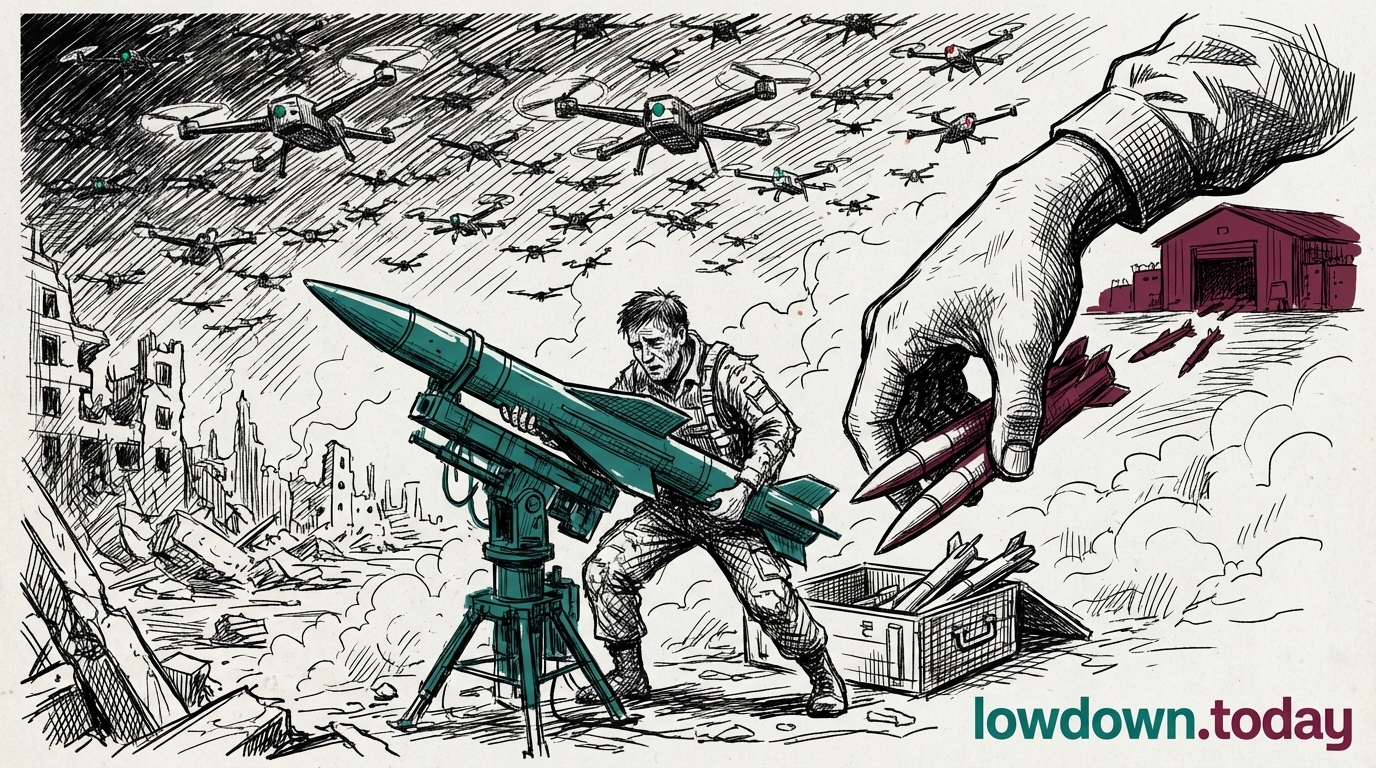
ISW confirmed the first mounting of DPRK Type-75 MLRS on Russian autonomous UGVs near Kharkiv on 7 June, the latest step in a supply axis that escalated from shells in 2023 to troops in 2024. Pyongyang gains live battlefield data on its ordnance and on Russia's uncrewed-systems programme.
IAEA / Rafael Grossi
Grossi confirmed Chornobyl structural damage with nuclear material metres away and could not attribute the ZNPP 15-hour blackout during the agreed repair window. Six ceasefires brokered and broken at ZNPP, compounded by Rosatom's May attack on IAEA neutrality, have eroded his ability to enforce the windows he negotiates.
Emmanuel Macron / France
Macron co-signed the E3 framework whose line-of-contact baseline marks Europe's first formal acceptance that 1991 borders are not the opening position. France's role carries weight because Macron had previously proposed a European force for Ukraine, and the framework's multinational force point is the vehicle for that.
Keir Starmer / E3
Keir Starmer / E3
Starmer, Macron and Merz met Zelenskyy on 7 June and backed a five-point framework taking the line of contact as the talks baseline, conceding roughly one fifth of Ukraine in exchange for a multinational force and frozen assets. With US mediation ended, the NATO Ankara summit on 7-8 July is the next test.
Vladimir Putin / Kremlin
Putin used SPIEF to reject Zelenskyy's summit letter, citing 'elements of rudeness', and repeated the pre-agreed treaty precondition that has frozen every diplomatic round since May. The SPIEF platform's message of investor confidence was punctured by naval fires visible from St Petersburg, which Moscow declined to dispute in scale.
Ukraine / Unmanned Systems Forces
Commander Brovdi confirmed USF units tracked and set fire to Boikyi at Kronstadt, while Code 9.2 struck the Chonhar Bridge the following day. Ukraine is sequencing strikes for rear-area interdiction and political timing rather than ground gains, trading the Baltic Fleet's home base for the logistics squeeze Russia cannot absorb without rationing its own occupied territory.



