Skip to content
You can now search across every topic, entity and event.What's new
Russia-Ukraine War 2026
19JUL

Trump: war ends when Iran 'cries uncle'

3 min read
13:35UTC

The president's third reformulation of victory conditions in a week defines no measurable threshold, names no counterpart to deliver it, and is contradicted by the IRGC's record single-day launch volume two days prior.

ConflictDeveloping
Key takeaway

Defining war-end as 'cry uncle' removes every incentive for Iran to signal de-escalation — any such signal would be interpreted as near-defeat rather than a negotiating opening — structurally guaranteeing continued fighting rather than enabling war termination.

President Trump stated Saturday that the conflict ends only when Tehran's leaders "cry uncle" or their military is "no longer functional." He claimed the US and Israel have "wiped out" Iran's navy, air force, and missile capability in one week, calling Iran's military "almost non-existent."

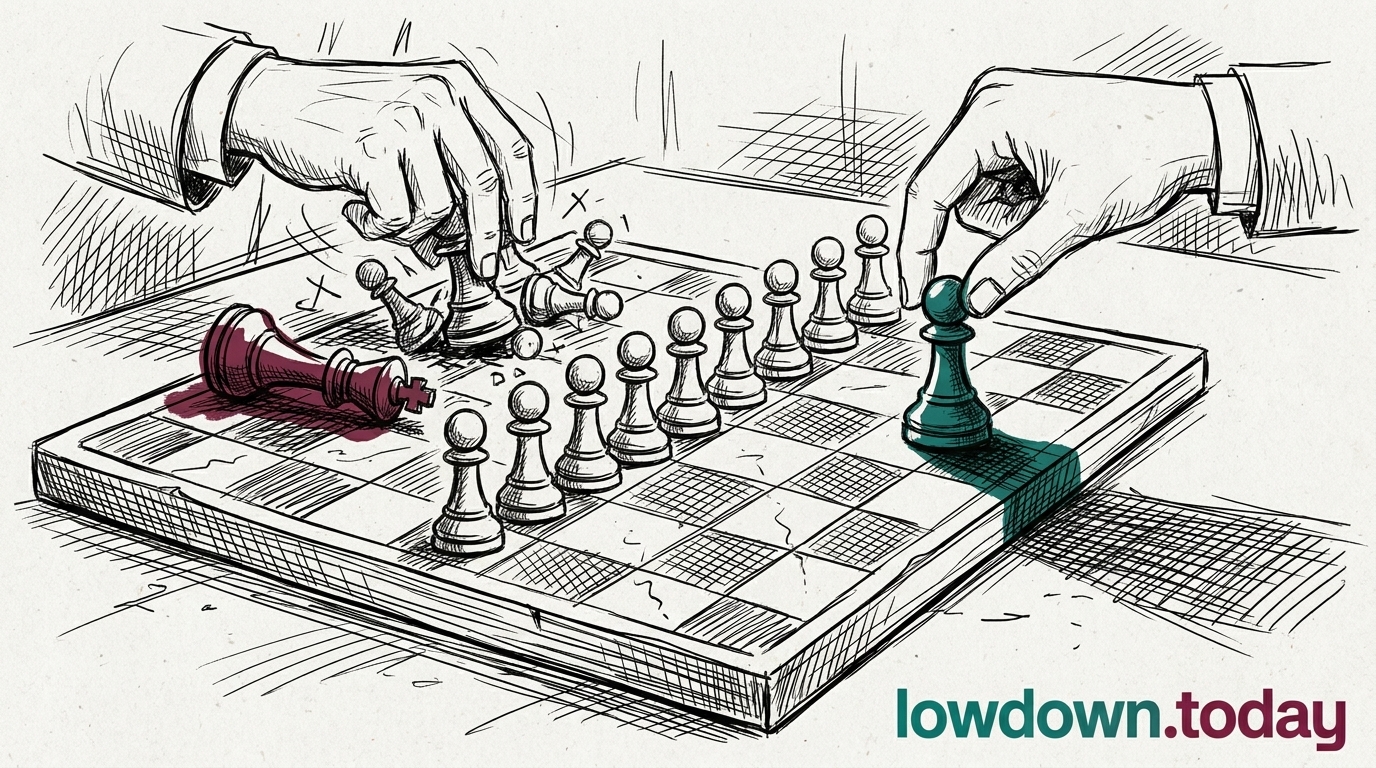
The demand trajectory over nine days describes a target that recedes faster than events can reach it. Trump began the war with the stated objective of destroying Iran's nuclear infrastructure. By Thursday, he had escalated to "no deal with Iran except UNCONDITIONAL SURRENDER" . On Friday, "Make Iran Great Again" — aspirational, attached to nothing operational. Saturday's "cry uncle" is American slang for psychological submission. It is not a legal instrument. It has no treaty framework, no measurable threshold, and no mechanism for delivery. Wars end when someone signs something or stops fighting; "cry uncle" is neither.

The claim that Iran's military capability has been eliminated does not survive contact with the IRGC's own operations. On Friday, 109 drones and 9 ballistic missiles struck UAE targets — a single-day record for the conflict that directly contradicted CENTCOM's earlier claims of a 90% reduction in Ballistic missile launches and an 83% reduction in drone operations . On Saturday, Kheibarshekan missiles reached Israel's Haifa refinery, and the IRGC struck two commercial tankers by name. The gap between the political claim of a destroyed military and the operational reality of sustained offensive launches has widened as the conflict has progressed.

The succession crisis makes delivery of any capitulation structurally impossible. Ayatollah Khamenei is dead. His funeral has been postponed indefinitely . The Interim Leadership Council is publicly split — President Pezeshkian ordered forces to stop attacking neighbouring countries ; Parliament Speaker Ghalibaf stated Saturday that the strikes followed the late Supreme Leader's own directives. The IRGC ignored Pezeshkian's halt order within hours . In the Korean War, armistice talks required 575 meetings over two years between clearly identified military and political counterparts with authority over their forces. Here, the US demands capitulation from an institution whose chain of command is fractured, whose political oversight is contested, and whose provincial commanders were designed to operate without central direction.

Deep Analysis

In plain English

When a leader says the war ends only when the enemy 'cries uncle' — playground language for total psychological submission — they have made it impossible for the other side to stop on any terms short of complete humiliation. No government, especially one in the middle of a leadership succession crisis, can publicly admit total defeat without collapsing internally. The practical effect is that Iran has no negotiated exit available under the current framing, which means its rational choice is to keep fighting and keep demonstrating capability. The condition is not a war-ending criterion — it is structurally a war-prolonging one.

Deep Analysis
Synthesis

'Cry uncle' fails as a war-termination criterion on three simultaneous structural grounds the body identifies individually but does not combine: it is subjectively defined with no agreed metric for compliance; there is no Iranian authority capable of delivering it amid the succession crisis; and it eliminates any face-saving pathway that would allow Iranian leadership to end the conflict while surviving politically — making the demand self-defeating as a war-ending instrument even if Iranian leadership wanted to comply.

Root Causes

The shifting demand trajectory — from nuclear disarmament to unconditional surrender to 'cry uncle' — reflects the absence of a defined US political end-state at the outset of the conflict. Wars initiated without a pre-defined acceptable settlement tend to produce demand inflation as each military success raises the asking price; this dynamic is well-documented in post-Second World War conflict-termination literature and was explicitly observed in the Korean War armistice negotiations.

Escalation

The 'cry uncle' framing creates a structural prolongation dynamic: Iran cannot meet the condition without regime-fatal humiliation, so the conflict has no negotiated off-ramp while this framing holds publicly. Unless a private backchannel through Oman or Qatar is operating on different terms, the public demand trajectory points toward extended conflict with no defined endpoint.

What could happen next?
  • Risk

    The credibility gap between Trump's 'almost non-existent' military claim and Iran's demonstrated strike tempo — 109 drones and 9 ballistic missiles at the UAE on Friday alone — will cause allied intelligence consumers to apply systematic discount factors to future US capability assessments, degrading coalition cohesion in ways that outlast this conflict.

    Medium term · Assessed
  • Consequence

    By removing a negotiated off-ramp, the 'cry uncle' framing structurally prolongs the conflict — the only available endings are Iranian regime collapse or a private backchannel operating on different terms than the public demand.

    Short term · Assessed
  • Meaning

    The divergence between Trump's 'cry uncle' and Hegseth's explicit 'not regime change' reflects an unresolved internal US debate about war aims — not a unified policy — with operational implications for targeting authorisation and post-conflict planning.

    Immediate · Assessed
  • Precedent

    If 'cry uncle' becomes the stated US war-end condition, it signals to other potential adversaries that the US does not intend to offer negotiated settlements — raising the cost of future deterrence by eliminating the credible off-ramp that deterrence theory requires.

    Long term · Suggested
First Reported In

Update #28 · Iran and Israel swap refinery strikes

Fox News· 8 Mar 2026
Read original
Causes and effects
This Event
Trump: war ends when Iran 'cries uncle'
Trump's shifting war-end conditions — from nuclear disarmament to unconditional surrender to 'cry uncle' — describe a subjective threshold with no legal mechanism for delivery. The accompanying claim that Iran's military has been 'wiped out' is contradicted by the IRGC's continued offensive operations, and Iran's succession crisis means no unified authority exists to deliver the capitulation demanded.
Different Perspectives
The United Kingdom
The United Kingdom
Starmer pledged £300 million in Kyiv on 16 July toward Ukraine's Gripen E squadron, adding to the PURL expansion Trump and Rutte had announced two days earlier. London is paying into a scheme built around a shortfall NATO's own published $4bn-plus pledge does not close against Zelenskyy's roughly $15bn stated need.
Brussels
Brussels
The EU's 21st sanctions package missed its Coreper vote on 15 July over Greek LNG re-export rights and an Austrian bank compensation demand, the same week Hungary stalled accession clusters on procedure rather than veto. Both processes run on unanimity, so a single national interest, not Russia policy, sets the pace either can move at.
Hungary's Tisza government
Budapest refused to open EU accession Clusters 2 and 3 for Ukraine at COELA on 17 July, offering Moldova a standalone opening instead, and the question returns on 22 July. Having ended Orbán's blanket loan veto in May, it now blocks the narrower rule-of-law chapters where its own electorate is least comfortable.
Washington
Washington
Trump and Rutte expanded PURL on 14 July, letting allies fund the American interceptors and jets Washington will license but no longer gift outright. The same week, Lockheed Martin told allies it cannot guarantee PAC-3 MSE delivery timelines even after tripling output, so Washington now shapes Ukraine's air defence through a supply queue rather than a donation decision.
Moscow
Moscow
Novak ordered a study into cutting the diesel exchange quota to 10% within a week of his export ban, while June delivered Russia's first budget surplus of 2026 and National Wealth Fund liquidity above its own May forecast. Its own investors disagree: the Moscow Exchange has fallen for its longest losing streak since 1997.
Ukraine's government and its street protesters
Zelenskyy sacked Fedorov on 15 July, installed an acting SBU officer in his place, and did not move against three days of protest that followed across eight cities. He is betting that visible tolerance for dissent, timed to EU accession hearings on rule of law, outweighs whatever command dispute forced the reshuffle.
