Skip to content
You can now search across every topic, entity and event.What's new
Russia-Ukraine War 2026
19JUL

Johnson pulls the House war-powers vote

4 min read
13:35UTC

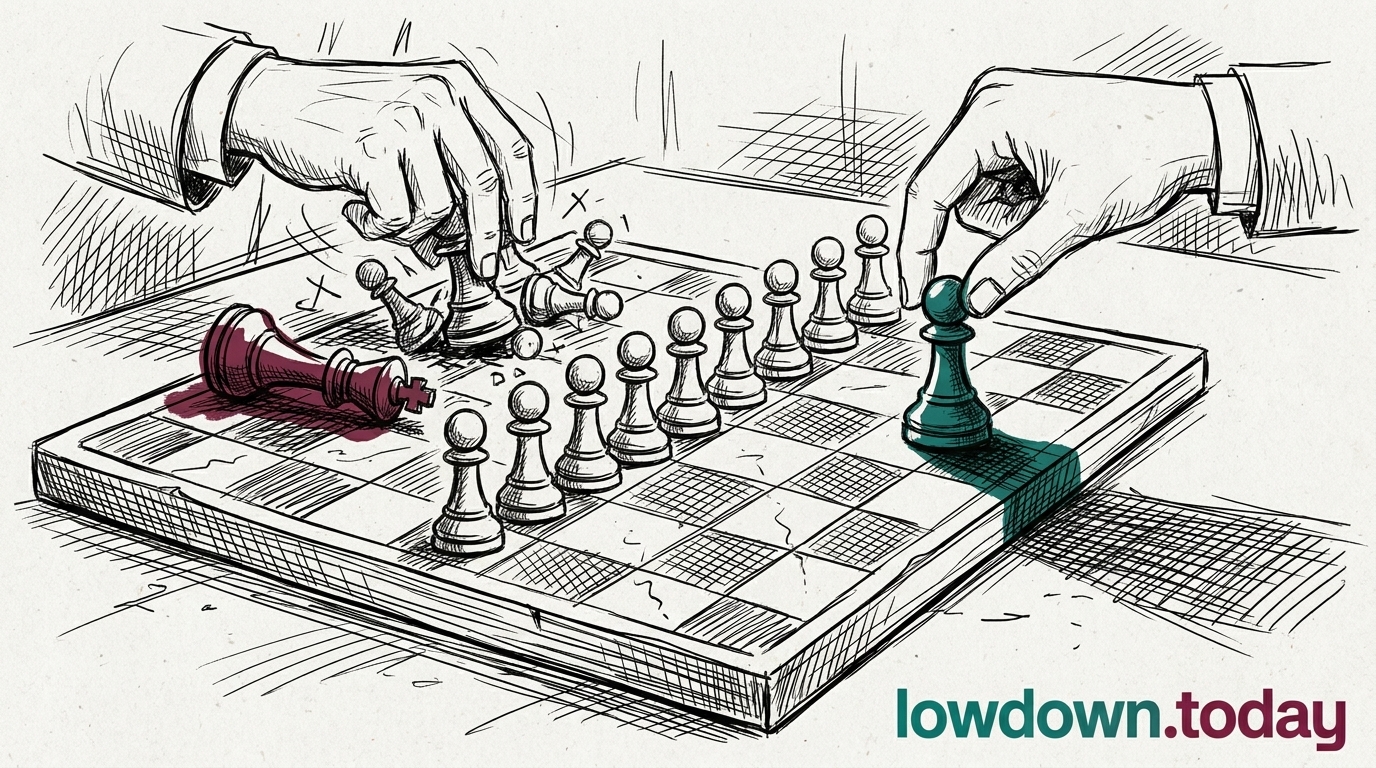
House Speaker Mike Johnson cancelled the scheduled Iran war-powers vote on 21 May rather than risk a recorded loss, sending sponsor Gregory Meeks into the Memorial Day recess and the WPR clock onto a 1 June cliff that lands the day the House returns.

ConflictDeveloping
Key takeaway

Johnson swapped a recorded loss for procedural retreat; the WPR clock runs on while the House sits at recess.

House Speaker Mike Johnson cancelled the scheduled vote on the Iran war-powers resolution on Thursday 21 May, hours before the chamber broke for the Memorial Day recess. Public Broadcasting Service (PBS) NewsHour and Cable News Network (CNN) reported that Republican absences had left the chamber on the verge of losing the resolution; Bloomberg named GOP absences as the specific mechanical reason 1. The sponsor, Democratic Representative Gregory Meeks of New York, now waits until after the recess; Democratic Representative Jared Golden of Maine, who held against his own party on the 14 May tie , had publicly committed to switching.

A pulled vote on a privileged resolution avoids a recorded loss without producing a win. The chamber record carries neither, which is the only form in which leadership can absorb a defeat. The cancellation mirrors, from the opposite direction, the Senate's 50-47 discharge motion two days earlier , which broke a year-long committee blockage on the same resolution. The discharge was a procedural assault that forced the vote; the House cancellation is a procedural retreat that prevents one.

The War Powers Resolution (WPR, the 1973 statute requiring Congress to authorise force within 30 days or trigger a presidential wind-down) clock expires on Monday 1 June , the same day the House returns from recess. Defence Secretary Pete Hegseth told the Senate on 12 May that Article 2 of the Constitution covers the Iran strikes and no Authorisation for Use of Military Force is required; the chamber that would test that doctrine is now away from Washington while the statutory deadline runs.

House parliamentary practice treats a pulled vote as procedural housekeeping; the substantive consequence is harder. Johnson chose to enter the recess having lost control of the count, betting that ten days of GOP whip pressure can change the arithmetic before the resolution returns. Golden's switch removes the Democratic holdout who blocked the 14 May tie. The next House attempt starts from a different baseline, and lands in the same week the WPR cliff hits.

Deep Analysis

In plain English

After a US military action, Congress has the right under a 1973 law called the War Powers Resolution to demand the President end the conflict within 60 days unless Congress authorises it. That 60-day clock already ran out for the Iran war. There is now a 30-day wind-down period that expires on 1 June. Democrat Gregory Meeks had scheduled a vote in the House of Representatives that would have told the President to stop the military campaign. Speaker Mike Johnson, who controls the House schedule, cancelled it hours before a holiday recess. The reason was simple arithmetic: enough Republican members were absent or planning to vote yes that Johnson thought the resolution would pass; which would hand the President's own party a public embarrassment. The problem is the House does not return from its holiday until 1 June, which is the exact day the legal deadline runs out. So Congress has effectively skipped the window it had to act, while the President keeps conducting the war.

Deep Analysis
Root Causes

Pete Hegseth's 12 May Senate testimony is the structural driver. By asserting publicly that Article 2 of the Constitution covers the Iran strikes and no Authorisation for Use of Military Force is required, Hegseth created a Republican trap: any Republican who votes for the war-powers resolution is implicitly rejecting the Defence Secretary's constitutional interpretation.

That makes a yes vote politically costly for Republicans who want to appear loyal to the administration while the no vote leaves them opposing a resolution that is gaining ground with their constituents. The Republican whip problem is not about Iran; it is about whether members are willing to contradict Hegseth's doctrine on the record.

The Memorial Day recess timing compounds the mechanical problem. The House broke for recess with the WPR 30-day wind-down cliff landing on 1 June, the day members return. Johnson chose recess over a recorded loss, betting that ten days of closed-door whip pressure can change the arithmetic. But the same Article 2 argument that made the vote unwinnable before recess will be present when the House returns: Hegseth's testimony is in the record regardless of the calendar.

What could happen next?
  • Risk

    The WPR 30-day wind-down expires 1 June, the day the House returns. If Johnson schedules the vote immediately on return and it passes, the administration faces a legal obligation to begin withdrawal. If Johnson delays again, the statutory deadline passes without House action, which Hegseth's team will argue validates the Article 2 position retroactively.

    Immediate · Assessed
  • Consequence

    Golden's publicly committed vote switch means the next House attempt starts from a more favourable baseline than the 212-212 tie on 14 May. Johnson must find at least one additional Republican persuasion target during recess to prevent a loss when the chamber returns.

    Short term · Assessed
  • Precedent

    If the WPR deadline passes without congressional action while Hegseth's Article 2 doctrine stands unrebutted, it will be cited in future administrations as evidence that the President retains unilateral military authority for conflicts of at least 90 days before facing effective legislative constraint.

    Long term · Suggested
First Reported In

Update #105 · Khamenei keeps the uranium; House pulls the vote

PBS NewsHour· 22 May 2026
Read original
Different Perspectives
The United Kingdom
The United Kingdom
Starmer pledged £300 million in Kyiv on 16 July toward Ukraine's Gripen E squadron, adding to the PURL expansion Trump and Rutte had announced two days earlier. London is paying into a scheme built around a shortfall NATO's own published $4bn-plus pledge does not close against Zelenskyy's roughly $15bn stated need.
Brussels
Brussels
The EU's 21st sanctions package missed its Coreper vote on 15 July over Greek LNG re-export rights and an Austrian bank compensation demand, the same week Hungary stalled accession clusters on procedure rather than veto. Both processes run on unanimity, so a single national interest, not Russia policy, sets the pace either can move at.
Hungary's Tisza government
Budapest refused to open EU accession Clusters 2 and 3 for Ukraine at COELA on 17 July, offering Moldova a standalone opening instead, and the question returns on 22 July. Having ended Orbán's blanket loan veto in May, it now blocks the narrower rule-of-law chapters where its own electorate is least comfortable.
Washington
Washington
Trump and Rutte expanded PURL on 14 July, letting allies fund the American interceptors and jets Washington will license but no longer gift outright. The same week, Lockheed Martin told allies it cannot guarantee PAC-3 MSE delivery timelines even after tripling output, so Washington now shapes Ukraine's air defence through a supply queue rather than a donation decision.
Moscow
Moscow
Novak ordered a study into cutting the diesel exchange quota to 10% within a week of his export ban, while June delivered Russia's first budget surplus of 2026 and National Wealth Fund liquidity above its own May forecast. Its own investors disagree: the Moscow Exchange has fallen for its longest losing streak since 1997.
Ukraine's government and its street protesters
Zelenskyy sacked Fedorov on 15 July, installed an acting SBU officer in his place, and did not move against three days of protest that followed across eight cities. He is betting that visible tolerance for dissent, timed to EU accession hearings on rule of law, outweighs whatever command dispute forced the reshuffle.
