Skip to content
Foundations rebuilt, and the first new thing is here: search across every topic, entity, and event.Try search
Russia-Ukraine War 2026
5MAR

Phantom tanker briefly cracks $100

4 min read
04:57UTC

Brent crude dipped to $99.83 after a false report that an India-flagged tanker had transited the Strait of Hormuz. It hadn't — and the market corrected within hours.

ConflictDeveloping
Key takeaway

Oil markets have priced a closed Hormuz but not yet the structural consequences of closure lasting months rather than days.

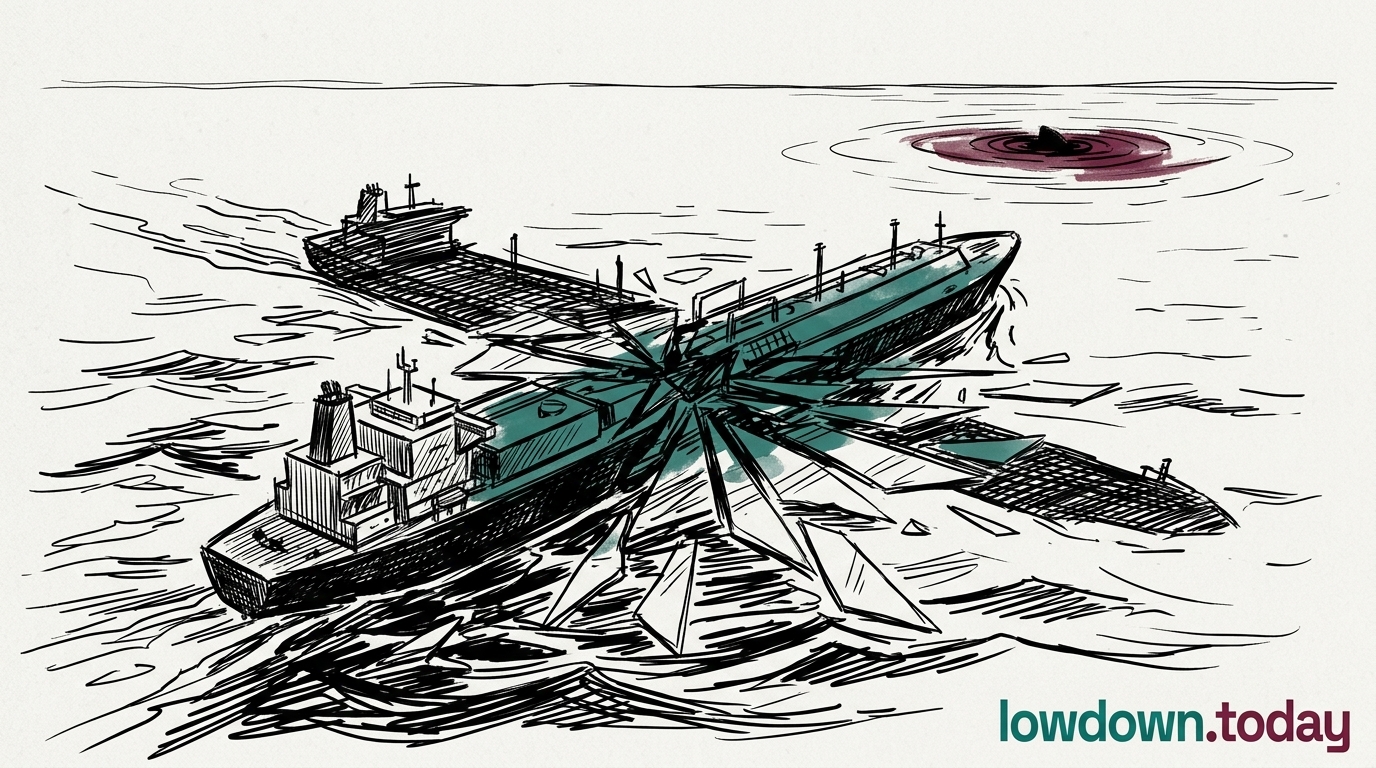
Brent Crude fell to $99.83 per barrel on Friday morning — briefly below the $100 threshold it first breached on a closing basis four days earlier — after reports circulated that an India-flagged tanker had sailed through the strait of Hormuz. The tanker was in fact moving east of Hormuz, carrying gasoline bound for Africa. An Indian government official corrected the record. The market reversed within hours.

This is the third time in a fortnight that unverified or false information about Hormuz transit has moved oil prices. Energy Secretary Chris Wright's since-deleted 10 March claim that the US Navy had already escorted a tanker through the strait briefly sent prices down approximately 12 per cent intraday before the retraction. President Trump's 8 March statement that the war would end "very soon" triggered a $30 intraday reversal from Brent's $119.50 peak . In each case, the correction was swift and complete: prices returned to or exceeded their prior level once the claim dissolved. The oil market has become a real-time lie detector for Hormuz claims, and every test so far has registered false.

Brent remains on track for a weekly gain of roughly 8 per cent. WTI fell to $94.44 but is heading for a 4 per cent weekly rise. The IRGC's declaration that "not a litre of oil" would pass through Hormuz , combined with the IEA's assessment that Gulf flows have fallen to "a trickle" , has established the market's baseline assumption: the strait is functionally closed. Tanker traffic through Hormuz is down 90 per cent from pre-war levels . The IEA's record 400-million-barrel strategic reserve release failed to shift that assumption. The pattern is fixed — every hint of reopening, whether false, premature, or aspirational, produces a dip that reverses within hours. Only verified, sustained commercial transit will move prices down durably, and neither the military capacity nor the diplomatic framework to provide it exists today.

Deep Analysis

In plain English

The Strait of Hormuz is a narrow channel between Iran and Oman through which about one-fifth of the world's traded oil passes every day — oil bound for China, Japan, South Korea, India, and Europe. Right now it is effectively closed by the war. On Friday, a rumour spread that an Indian tanker had sailed through, implying the strait was open again. Oil prices immediately dropped below $100. But the tanker wasn't in the strait — it was heading somewhere else entirely. Prices bounced straight back. This episode tells us something important about how markets are working right now: they are running on fragments of information, and any hint of Hormuz reopening — even a false one — causes an instant price reaction. The fact that prices recovered within hours confirms that traders have already accepted the strait is closed. Only genuine, verified ship movements through Hormuz will bring prices down in a lasting way. Until then, every false signal just illustrates how tightly wound the market has become.

Deep Analysis
Synthesis

The India-flagged tanker episode is analytically significant beyond its price effect. India has been the one major economy publicly maintaining trade relationships with both Iran and Western powers throughout the conflict. A genuine Indian tanker transit through Hormuz would signal a quiet diplomatic accommodation between New Delhi, Tehran, and Washington — and oil markets interpreted the false report in exactly those terms, pricing in a geopolitical settlement probability, not just a supply reopening. The false alarm reveals that oil futures are not purely pricing barrels: they are pricing the probability of a political resolution. This means the market will react to any credible diplomatic signal — not just verified ship movements — creating both a policy lever and a disinformation risk.

Root Causes

The market's extreme sensitivity to false Hormuz signals reflects a structural information deficit: there is no reliable real-time civilian shipping intelligence for contested waters. Lloyd's war risk exclusions and the routine AIS transponder blackouts common in conflict zones mean traders are operating on fragments. Algorithmic trading systems trained to scan shipping news create reflexive buy and sell responses to any relevant keyword, amplifying rumour-driven volatility far beyond what human discretionary traders would generate. The false-signal pattern will recur as long as Hormuz remains closed and information is scarce.

What could happen next?
2 risk1 meaning1 consequence1 opportunity
  • Risk

    At $100/barrel Brent, demand destruction begins in price-sensitive developing economies — import bills in South Asia and sub-Saharan Africa will rise sharply within weeks of sustained closure.

    Short term · Assessed
  • Meaning

    Every false-signal price dip that immediately reverses confirms markets have fully internalised a closed strait — only verified ship transits, not rumours or diplomatic statements, can durably move prices down.

    Immediate · Assessed
  • Consequence

    Steep oil futures backwardation discourages new production investment, meaning the supply gap compounds over the medium term even after Hormuz physically reopens and ships resume transit.

    Medium term · Suggested
  • Risk

    War risk insurance premiums are a shadow blockade — commercially unviable voyages reduce throughput even without physical military interdiction, making the effective closure wider than the declared military closure.

    Short term · Assessed
  • Opportunity

    A coordinated IEA strategic reserve release could temporarily cap Brent below $100, buying time for diplomatic resolution without triggering demand destruction in developing-economy importers.

    Short term · Suggested
First Reported In

Update #34 · Tehran march bombed; first deaths in Oman

BNN Bloomberg· 13 Mar 2026
Read original
Different Perspectives
North Korea / DPRK
North Korea / DPRK
ISW confirmed the first mounting of DPRK Type-75 MLRS on Russian autonomous UGVs near Kharkiv on 7 June, the latest step in a supply axis that escalated from shells in 2023 to troops in 2024. Pyongyang gains live battlefield data on its ordnance and on Russia's uncrewed-systems programme.
IAEA / Rafael Grossi
Grossi confirmed Chornobyl structural damage with nuclear material metres away and could not attribute the ZNPP 15-hour blackout during the agreed repair window. Six ceasefires brokered and broken at ZNPP, compounded by Rosatom's May attack on IAEA neutrality, have eroded his ability to enforce the windows he negotiates.
Emmanuel Macron / France
Macron co-signed the E3 framework whose line-of-contact baseline marks Europe's first formal acceptance that 1991 borders are not the opening position. France's role carries weight because Macron had previously proposed a European force for Ukraine, and the framework's multinational force point is the vehicle for that.
Keir Starmer / E3
Keir Starmer / E3
Starmer, Macron and Merz met Zelenskyy on 7 June and backed a five-point framework taking the line of contact as the talks baseline, conceding roughly one fifth of Ukraine in exchange for a multinational force and frozen assets. With US mediation ended, the NATO Ankara summit on 7-8 July is the next test.
Vladimir Putin / Kremlin
Putin used SPIEF to reject Zelenskyy's summit letter, citing 'elements of rudeness', and repeated the pre-agreed treaty precondition that has frozen every diplomatic round since May. The SPIEF platform's message of investor confidence was punctured by naval fires visible from St Petersburg, which Moscow declined to dispute in scale.
Ukraine / Unmanned Systems Forces
Commander Brovdi confirmed USF units tracked and set fire to Boikyi at Kronstadt, while Code 9.2 struck the Chonhar Bridge the following day. Ukraine is sequencing strikes for rear-area interdiction and political timing rather than ground gains, trading the Baltic Fleet's home base for the logistics squeeze Russia cannot absorb without rationing its own occupied territory.