Skip to content
Welcome, thoughtbot's Giant Robots listeners!Start here
Russia-Ukraine War 2026
13MAY

Ukraine lands 347 drones on Moscow's Victory Day

3 min read
20:00UTC

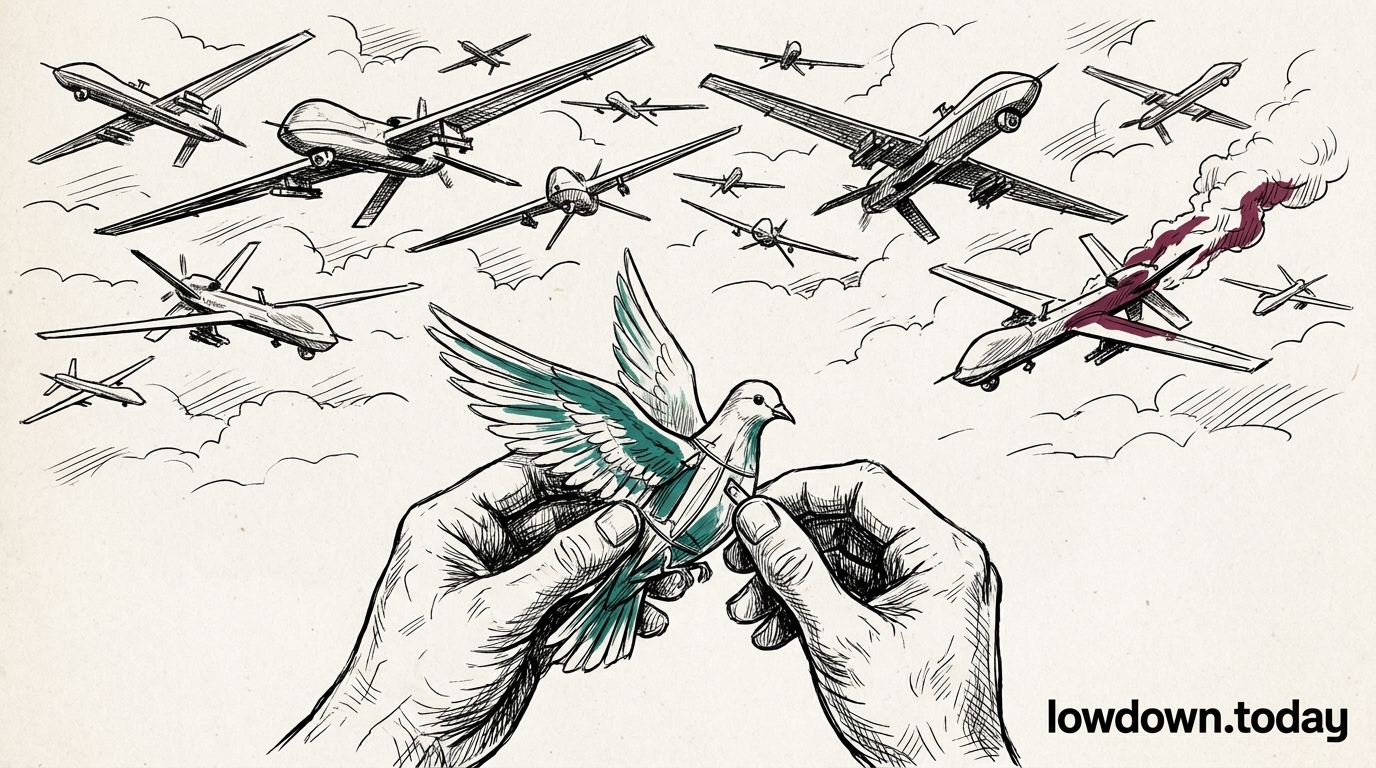
Ukraine launched the second-largest aerial attack of the war on the night of 8-9 May, the eve of Russia's Victory Day. The Russian Defence Ministry reported 347 Ukrainian drones downed across 20 regions, with Moscow Mayor Sergei Sobyanin confirming 26 intercepted over the capital.

ConflictDeveloping
Key takeaway

Ukraine demonstrated saturation-strike volume against Moscow at the moment Russian drone quality is failing in the air.

Ukraine launched the second-largest aerial attack of the war on the night of 8-9 May, the eve of Russia's Victory Day. The Russian Defence Ministry reported 347 Ukrainian drones downed across 20 regions⁠1. Moscow Mayor Sergei Sobyanin confirmed 26 drones intercepted over Moscow specifically. Russia shut down all mobile internet and SMS messaging across Moscow on 9 May and ringed the parade route with 101 air defence systems. The largest Ukrainian aerial attack to date, 389 drones, came in March 2026.

Russia's Moscow mobile-internet shutdown on 9 May concedes that civil signals leak GPS spoofing and drone telemetry data the moment a saturation strike crosses the border. A communications blackout across a capital city on a public holiday is not a routine air defence posture; it is a public acknowledgement that Ukrainian targeting now relies on Russian network metadata as part of the kill chain.

Ukraine's offensive capability has scaled in parallel to Russia's quality collapse. Tekever's AR3 ISR drone has now logged more than 50,000 operational hours in Ukraine on prior MoD-funded contracts, one component of a strike architecture that has been industrialised around long-endurance reconnaissance and short-range interceptor pairing. The figure that matters is throughput: 347 inbound airframes against 101 fielded interceptor systems, plus whatever Pantsir and S-400 batteries were already deployed inside Moscow's ring.

The count itself comes from the Russian Defence Ministry, which has incentive to overstate intercept totals; Ukraine's General Staff has not publicly confirmed launch numbers. Even discounted, a 347-figure on the Kremlin's own admission resets the working assumption about how much Ukrainian strike volume Russian air defence absorbs on a benchmarked night.

Deep Analysis

In plain English

Ukraine launched 347 drones at Moscow on the night of 8-9 May, the evening before Russia's Victory Day parade. Russia said it shot them all down. Moscow's mayor confirmed 26 were intercepted specifically over the city. Russia shut down mobile internet across Moscow and ringed the parade route with 101 air defence systems. A year ago Ukraine could not sustain an attack at this scale. Now it can, and Russia must absorb the political and military cost of defending its capital on its most important national holiday.

Deep Analysis
Root Causes

Ukraine's capacity to sustain a 347-drone salvo on a single night rests on three developments from the preceding twelve months.

First, dispersed production. Ukraine's drone industry now operates from dozens of sites rather than identifiable factories, after Russian targeting destroyed centralised facilities in 2023. The dispersal trades per-unit efficiency for survivability and makes a single strike unable to meaningfully reduce production.

Second, one-way attack drone unit economics. Ukraine's FPV-class and maritime strike drones cost $400-$2,500 per unit. At that price, a 347-salvo costs approximately $140,000-$870,000 in drone acquisition, a fraction of the interceptor cost Russia must expend. Russia's Pantsir-S1 interceptors cost roughly $80,000 per round; if Russia fired 200 interceptors, the cost asymmetry already favours Ukraine.

Third, navigation technology. Star-tracker and optical-flow navigation on longer-range Ukrainian drones, cited by CSIS, allows significant GPS-denied accuracy at ranges required to reach Moscow. This is the technical gate Ukraine crossed in late 2025 that made capital-city strikes operationally practical rather than symbolic.

First Reported In

Update #8 · The week defence-AI got priced

Kyiv Independent· 10 May 2026
Read original →
Causes and effects
This Event
Ukraine lands 347 drones on Moscow's Victory Day
Russia shut down all mobile internet and SMS messaging across Moscow on 9 May and ringed the parade route with 101 air defence systems. Ukraine's ability to put 347 drones over Russian airspace in one night sets a saturation-strike volume that NATO air defence schemes will be benchmarked against. The attack pairs with the Russian quality collapse reported four days earlier: volume doctrine hit a ceiling at exactly the moment Ukrainian strike capability scaled.
Different Perspectives
Government of Latvia
Latvia abstained on 22 September when the EU renewed its individual sanctions for 36 months at the price of delisting Alisher Usmanov and Mikhail Fridman, and promised national sanctions of its own. Riga's abstention marks how far a frontline member state will go to keep listed names listed.
India's Ministry of External Affairs
After the House passed the Graham bill on 16 September, India's foreign ministry said it would keep buying energy on market terms and protect its trade. Russia supplied 30.3% of India's crude imports in fiscal 2026, so the tariff decision due around 18 October falls directly on New Delhi.
Kaja Kallas, EU foreign policy chief
Kallas answered the US licence on 10 October by saying Europe would not ease pressure, and EU ministers adopted a 22nd package of nearly 1,600 listings two days later. Brussels is tightening as Washington loosens, though TASS reported the package adds no significant new trade restrictions.
Donald Trump and the US Treasury
The Treasury licensed Russian diesel imports until 7 April 2027 on the day of Trump's call with Putin, and Trump then told reporters Ukraine should find a new leader. Washington is trading sanctions relief for fuel supply while pressing Kyiv to halt the refinery strikes behind the shortage.
Kremlin and Deputy Prime Minister Alexander Novak
After the 9 October call the Kremlin said Russia was ready to supply oil and petroleum products to American and global markets, and Novak brought forward the end of diesel export curbs. Moscow is selling the shortage back as goodwill, with volumes that Decree No. 686 now hides from outside checks.
Volodymyr Zelenskyy, President of Ukraine
Zelenskyy called GL 135 an investment in prolonging the war and offered to stop striking Russian refineries if Russia stops destroying Ukraine's energy system. Answering Trump's call for a new leader, he set a total 60-day ceasefire as the condition for elections, which puts the next move on Moscow.

Written with AI from Lowdown's published reporting. Not individually reviewed by an editor. Editorial standards.
