Skip to content
Welcome, thoughtbot's Giant Robots listeners!Start here
Russia-Ukraine War 2026
13MAY

Air Force hands robot fighter to upstarts

3 min read
20:00UTC

The US Air Force funded its first autonomous-fighter production on 17 June, picking Anduril (FQ-44A) and General Atomics (FQ-42A) over Boeing, Lockheed Martin and Northrop Grumman, all three of which bid and lost.

ConflictDeveloping
Key takeaway

Funded CCA production moves autonomous air combat out of the heritage primes' hands for the first time.

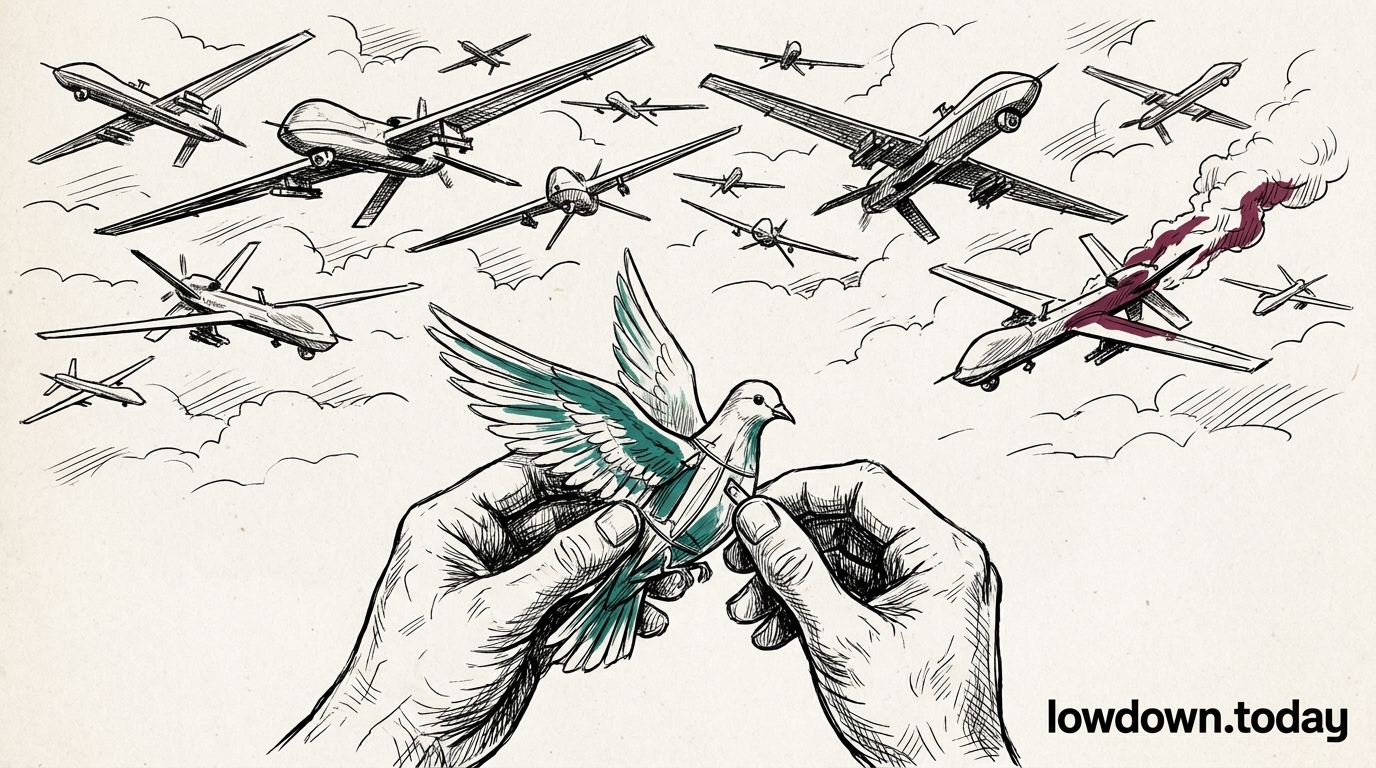
The US Air Force awarded its first funded production contracts for the Collaborative Combat Aircraft programme on 17 June 2026, picking Anduril (airframe designation FQ-44A) and General Atomics (FQ-42A)⁠1. A Collaborative Combat Aircraft, or CCA, is an autonomous drone wingman built to fly alongside crewed fighters. A fresh source selection re-scored all five original competitors, and Boeing, Lockheed Martin and Northrop Grumman, three of the four largest US defence contractors, all bid and none was selected.

This is the first time production money, rather than another prototype study, has sat behind the airframe. The FY2027 request carries about $1.4 billion for development and $1 billion for procurement, against a target of more than 150 aircraft at under $30 million each⁠2. That unit ceiling is roughly a third of an F-35A at about $82.5 million, so the Air Force can field a whole wingman fleet for the per-airframe cost of a far smaller crewed buy.

The heritage-prime oligopoly expected to inherit this franchise. The Defence Autonomous Warfare Group budget line had already jumped to $54.6 billion in a single cycle, and the institutions that won are not the ones that built the last three generations of fighters. The fair reading is continuity rather than upset: General Atomics has flown the Reaper for thirty years, and Anduril had swept counter-drone, CCA prototyping and Golden Dome before this award. The primes were not edged out in a fly-off. They were removed from production.

What remains unresolved is money rather than capability. Anduril still projects a $1.2 billion annual loss with profit deferred to 2030, and the FY2027 figures are a request awaiting congressional appropriation. The contract validates the manufacturing-rate strategy without yet validating the economics behind it.

Deep Analysis

In plain English

The US Air Force runs fighter jets piloted by humans. Those jets cost around $82 million each. The Air Force now wants to add autonomous drone wingmen that fly alongside them, doing some of the dangerous work at a fraction of the price. Instead of giving the contract to the big defence companies that normally build warplanes (Boeing, Lockheed Martin, Northrop Grumman), the Air Force picked two newer firms. Anduril is a Silicon Valley defence startup; General Atomics makes the Reaper surveillance drone. Both bid under $30 million per aircraft. The big three lost. This matters because it signals a change in who gets to build America's future warplanes.

Deep Analysis
Root Causes

Three structural forces pushed non-traditional firms past Boeing and Lockheed Martin in this source selection.

First, the Pentagon's shift from cost-plus to firm-fixed-price contracts for autonomous systems meant incumbents could no longer rely on government-funded margin compression. Anduril and General Atomics structured bids assuming Arsenal-1 and Palmdale factory efficiencies that the legacy overhead structures of Boeing and Lockheed cannot match without stranding existing workforce commitments.

Second, the DAWG budget line's jump from $225.9 million to $54.6 billion created a funding envelope large enough that a single award could validate an entirely new prime relationship. Legacy primes whose revenue base depends on cost-plus development have limited incentive to aggressively price fixed-cost production; insurgent firms whose entire enterprise value rests on winning production volume do.

Third, Congress's allocation of $680 million to CCA in prior appropriations established a formal programme of record that bypassed the usual Other Transaction Authority pathway insurgent firms typically use to avoid FAR-compliant competition , a pathway that would have favoured incumbents' programme management infrastructure.

What could happen next?
  • Consequence

    Boeing, Lockheed Martin and Northrop Grumman face programme-of-record exclusion from the fastest-growing segment of US air power acquisition, with no legal redress available unless a GAO protest succeeds on procedural grounds.

    Immediate · Assessed
  • Risk

    Arsenal-1's rated capacity of 150 aircraft per year will be tested against a contracted requirement; any shortfall triggers a breach-of-contract scenario that could revive a legacy prime at the next competitive round.

    Medium term · Assessed
  • Precedent

    The CCA source selection establishes that Silicon Valley defence entrants can now win platform production contracts, not just software overlays, against heritage primes on a price-competitive basis.

    Long term · Assessed
First Reported In

Update #13 · Air Force shuts primes out of drone wingman

Breaking Defense· 25 Jun 2026
Read original →
Different Perspectives
Government of Latvia
Latvia abstained on 22 September when the EU renewed its individual sanctions for 36 months at the price of delisting Alisher Usmanov and Mikhail Fridman, and promised national sanctions of its own. Riga's abstention marks how far a frontline member state will go to keep listed names listed.
India's Ministry of External Affairs
After the House passed the Graham bill on 16 September, India's foreign ministry said it would keep buying energy on market terms and protect its trade. Russia supplied 30.3% of India's crude imports in fiscal 2026, so the tariff decision due around 18 October falls directly on New Delhi.
Kaja Kallas, EU foreign policy chief
Kallas answered the US licence on 10 October by saying Europe would not ease pressure, and EU ministers adopted a 22nd package of nearly 1,600 listings two days later. Brussels is tightening as Washington loosens, though TASS reported the package adds no significant new trade restrictions.
Donald Trump and the US Treasury
The Treasury licensed Russian diesel imports until 7 April 2027 on the day of Trump's call with Putin, and Trump then told reporters Ukraine should find a new leader. Washington is trading sanctions relief for fuel supply while pressing Kyiv to halt the refinery strikes behind the shortage.
Kremlin and Deputy Prime Minister Alexander Novak
After the 9 October call the Kremlin said Russia was ready to supply oil and petroleum products to American and global markets, and Novak brought forward the end of diesel export curbs. Moscow is selling the shortage back as goodwill, with volumes that Decree No. 686 now hides from outside checks.
Volodymyr Zelenskyy, President of Ukraine
Zelenskyy called GL 135 an investment in prolonging the war and offered to stop striking Russian refineries if Russia stops destroying Ukraine's energy system. Answering Trump's call for a new leader, he set a total 60-day ceasefire as the condition for elections, which puts the next move on Moscow.
